For almost two decades, the most common question business owners asked their SEO teams was simple:
“How much traffic did we get this month?”
Traffic graphs determined SEO success. Increasing traffic signified SEO success. A decline in the traffic was always a major concern and signified that something has gone wrong.
But today, the search landscape has changed dramatically.
Today, people discover information through:
- Large Language Models (LLMs) such as ChatGPT, Perplexity, and Gemini
- AI-generated search results like Google AI Overviews
- Social search platforms like TikTok, Instagram, Reddit, and YouTube
- Traditional search engines
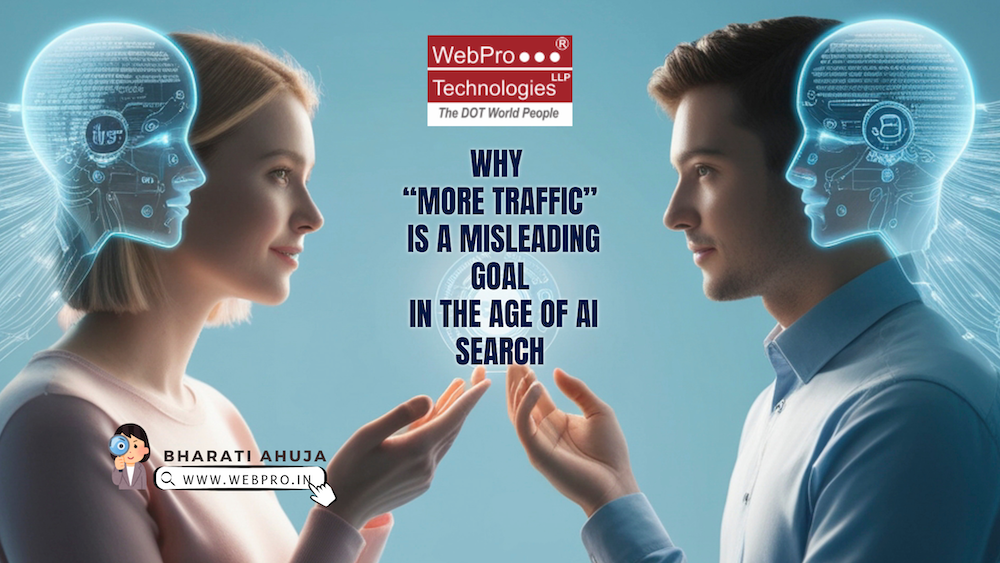
In this environment, “more traffic” is no longer the best indicator of SEO success.
In fact, focusing only on traffic may mislead the SEO journey entirely in the wrong direction.
This article explains:
- Why traffic is a misleading SEO goal in 2026
- The single most important metric businesses should track instead
- What modern SEO reporting should look like
- A clear reporting template for businesses investing in SEO
The Changing Nature of Search
Search behavior has fragmented.
In the past, discovery typically followed a simple path:
User → Google → Website
Now the journey often looks like this:
User → ChatGPT answer
User → Instagram search
User → Reddit thread
User → Google AI Overview
User → Brand search → Website
Many users never click a website at all.
AI search engines frequently answer the question directly in the interface, reducing the need for a click. Traditional metrics like CTR, rankings, and traffic were designed for a world where a click always happened. That assumption no longer holds.
As AI answers become more common, visibility and influence matter more than raw traffic numbers.
The “Traffic Obsession” Problem in SEO
In the era of traditional search engines, SEO success was strongly tied to website traffic, because the entire discovery model of search was designed around driving users from search results to websites. This explains why traffic became the dominant SEO metric for almost two decades.
In 2026 and the era of LLMs and Social Media search we not only see a decline in traffic, in fact we see that there are zero clicks for the major search queries or prompts related to them. And this should not be considered as a negative or adverse development for an ongoing SEO project, Let us understand why?
The Rise of “Zero-Click Discovery”
Another reason traffic is declining as a metric is the growth of zero-click search.
Users increasingly:
- Read answers directly in AI tools
- Watch short videos for explanations
- Ask LLMs for recommendations
- See summaries in search results
This means a brand may influence a purchase without receiving a click.
For example:
- User asks ChatGPT for “best institute for NEET coaching in India”
- ChatGPT mentions a brand
- User later searches for that brand name
- User visits the website and converts
In analytics tools, the conversion appears as direct or branded search traffic.
But the true discovery channel was the AI answer.
Traffic Is Declining — But Value Is Increasing
Interestingly, many studies show that AI-driven visitors may actually be more valuable.
Some analysts suggest AI search visitors can be significantly more valuable per visit due to higher intent.
Other research shows similar conversion rates between AI traffic and traditional organic traffic depending on industry.
The important takeaway:
The number of visitors matters less than the quality of those visitors.
The Most Important SEO Metric in 2026
If traffic is not the right metric, what is?
The most important SEO metric today is:
Organic Conversions
Organic conversions represent:
- Leads generated
- Sales completed
- Demo requests
- Downloads
- Signups
- Inquiries
In simple terms:
Did organic visibility create real business outcomes?
This metric ties SEO directly to business growth.
Experts increasingly emphasize that conversions and revenue impact should replace raw traffic as the primary success metric for SEO campaigns.
Secondary Metrics That Matter More Than Traffic
Traffic still has value, but it should be treated as a supporting metric, not the main KPI.
The most useful metrics today fall into three categories.
- Business Impact Metrics
These show the real ROI of SEO.
Track:
- Organic conversions
- Organic revenue
- Sales-qualified leads from organic search
- Pipeline value from organic
If SEO does not contribute to revenue, traffic numbers are irrelevant.
- Visibility Metrics
In AI search, being cited matters as much as being clicked.
Important metrics include:
- Brand mentions in AI answers
- Share of search
- Topic visibility
- Topical authority
As AI answers replace traditional result pages, brands must measure how often they appear in those answers, not just their ranking positions.
- Engagement Metrics
Engagement helps determine whether traffic is qualified or irrelevant.
Key signals include:
- Time on page
- Scroll depth
- Pages per session
- Assisted conversions
High engagement often indicates that the content matches user intent and helps move the user closer to conversion.
A New Mindset for SEO
The future of SEO is not about maximizing traffic.
It is about maximizing influence.
Brands must aim to:
- Appear in AI answers
- Build topical authority
- Generate brand demand
- Convert high-intent visitors
This is a major shift from “ranking for keywords” to “being the trusted source for answers.”
A Practical SEO Reporting Template for Businesses
Many businesses spend significant monthly budgets on SEO but receive reports filled with:
- Keyword rankings
- Traffic graphs
- Impressions
- Technical metrics
These metrics rarely answer the most important question:
“Is our SEO investment generating business growth?”
Below is a simple reporting template business owners can use to evaluate SEO performance clearly.
Monthly SEO Performance Report Template
- Executive Summary
Month:
SEO Investment:
Key highlights:
- Organic revenue change
- Lead generation trend
- Major visibility improvements
- AI visibility changes
- Business Impact Metrics (Primary KPIs)
| Metric | Last Month | Current Month | Change |
| Organic Leads | |||
| Organic Sales | |||
| Organic Conversion Rate | |||
| Revenue from Organic | |||
| Pipeline Value |
This section answers:
Is SEO producing customers?
- Traffic Quality Metrics
| Metric | Last Month | Current Month | Change |
| Organic Sessions | |||
| Engaged Sessions | |||
| Avg Engagement Time | |||
| Pages per Visit |
These metrics reveal visitor quality, not just volume.
- Visibility Metrics
| Metric | Last Month | Current Month | Change |
| Share of Search | |||
| Topical Authority Score | |||
| Brand Search Volume | |||
| AI Citations |
This section shows market visibility and brand influence.
- Content Performance
Top performing pages:
| Page | Visits | Leads | Conversion Rate |
This helps identify which content actually generates business results.
- AI Search Visibility
Track appearances in:
- ChatGPT responses
- Google AI Overviews
- Perplexity answers
- Gemini summaries
Example reporting table:
| Query | Platform | Brand Mentioned | Competitors Mentioned |
This measures AI discoverability.
- Competitive Benchmark
| Competitor | Share of Search | Brand Mentions | Top Keywords |
SEO is always relative.
Businesses should know whether their visibility is growing faster than competitors.
- SEO Actions Completed
Examples:
- Technical fixes
- Content published
- Pages optimized
- Backlinks earned
- Digital PR campaigns
This section shows the work done to create growth.
- Strategic Recommendations
Examples:
- New content topics
- Conversion optimization
- Internal linking improvements
- AI search optimization
- Brand authority building
The Future of SEO Measurement
The SEO industry is transitioning from traffic-focused measurement to influence-focused measurement.
Successful SEO teams will measure:
- Conversions
- Revenue impact
- AI visibility
- Brand demand
Traffic will still matter.
But it will no longer be the headline metric.
In the SEO industry, it is very easy to become obsessed with numbers.
For years, the most common obsession was traffic. Today, the conversation has shifted and many businesses are becoming equally obsessed with revenue metrics or conversions reported every month.
In my personal opinion, both extremes can be misleading.
SEO is not a channel that behaves in a straight line month after month. It is a long-term compounding growth system. Judging its success purely based on short-term numbers—whether traffic or revenue—often leads to incorrect conclusions and unnecessary strategic changes.
What matters more is overall progress over time.
Stay tuned for our next post which focuses on :
The Ideal SEO Reporting Frequency for Meaningful Insights For Better Decision Making