The Google+ VP Bradley Horowitz Says: “Google+ is not like the social networks of the past”

In one of his recent interviews, the Google+ VP Bradley Horowitz mentioned that if FaceBook had 1 billion users then Google+ too had 1 billion users or more if the users of all Google products were put together. According to him unlike FaceBook, Google Plus is not only a social media platform but an attempt by Google to weave all the Google products together to offer more value to users and brands.

Google plus is the foundation layer and not a parallel product which exists individually. It is the identity and relationships system for Google which is woven in all the Google products. As per their statistics 400 million users have signed up for Google Plus but 100 million of them are active as per their strictest definition of an “ Active Google+ User” and the numbers are growing on a regular basis.

The Google+ VP Bradley Horowitz also mentioned that Google+ is not like the social networks of the past. It had a completely different edge and was following a different path. It was clearly indicated by him that they considered FaceBook was a social network of the past. He further added that they want Google+ to work the way the real world works and the advertisements and Sponsored links on social networks is annoying the users and they want to add the commercial aspect to Google+ but in a very holistic way. All the examples given by him clearly indicated that Google+ signals enhanced and added value to search Ads. by offering recommendations from users in your circle.

Hence, the search and social are supplementing each other rather than having independent individual existence for Google. He also added that in 5 – 10 years from now Google is aiming Google+ to be a platform for uncluttered meaningful communication where context is also in the picture along with the connections.

As a SEO I get the message clear and loud that Google+ signals will get more and more integrated in search results and if brands adopt and adapt to Google+ as soon as possible then they are going to grow alongside with the growth of Google+ as they have an opportunity to create footprints on social and get topically correlated ASAP. As mentioned above all the Google products are being woven into Google+ and Google+ as a social media platform converges to diverge and diverges to converge.


Enhanced by Zemanta

The Evolving Face Of SEO - 14 SEO Facts For 2013

Author : Bharati Ahuja

Google turned 14 in 2012 and like any teenager it is still trying to acquire skills to face the world with more confidence and put its best foot forward. Obviously SEO – Search Engine Optimization has a direct correlation with search engines but as the search engines become more capable and as the search algorithms evolve and become more sophisticated many in the SEO world are even contemplating to rechristen SEO with some other name.

But does calling SEO by some other term change the true meaning of SEO? As a matter of fact has the SEO process and procedures changed or as they say is actually SEO dead?

The answer is NO, NO and an emphatic NO.

As black hat SEOs first focused on keyword stuffing and then went on link building sprees now after the Panda and Penguin updates this confused lot is talking about content development and undoing all the link building they have done in the past.

Survival of the fittest
Survival of the fittest (Photo credit: onkel_wart (thomas lieser))

But some of the SEO Evolution facts are:

1. SEO is not dead but has gained more life for people who understand the genuine meaning of optimization for search engines.

2. SEO has come under more scrutiny as the search engines are more capable now to detect spam and have upgraded their algorithms to penalize spammy techniques.

3. As websites moved from static websites to dynamic websites increasing the potential for regular additional content the search engines too first worked on indexing such content but this year the focus has been on penalizing thin and poor quality content to give more quality results to the users.

4. Websites penalized are the ones with poor quality non topical, spammy links and thin content.

5. Websites which catered to technical aspects of SEO and do not have low quality links and thin content were not affected by the updates.(That’s what my experience says) Its like if you have a good track record it adds up to your goodwill.

6. With social and search integrations and upgraded algorithms one needs to do more that just on-page optimization and technical SEO. One needs to focus on UGC (User generated Content) and offer a regular flow of content in the form of blog posts , videos, infographics , images, podcasts, etc. to be able to generate the UGC and share it on various social media platforms to generate the much needed social signals.

7. Panda or no Panda content has been king since the first web page was published on the web. It is Google who has become capable in picking quality content in 2012

8. The on-page and technical SEO still remain the same but as the search engines have evolved and are better equipped with advanced algorithms the completion for high rankings has increased and Darwin’s theory of “The Survival Of The Fittest” is largely applicable today on the web.

9. Where there is content there is a creator hence Google came up with the Authorship Tag and the Knowledge Graph – The next big step to qualify content and the creator.

10. If content creation is a necessity then content curation is the answer if coming up with regular content is a problem.

11. SEO is just one aspect of the whole online presence. As Scott Gardner of Bank of America had mentioned in a related discussion on SEO 2013 : Search is multifaceted. Don’t forsake any part of the pie. Make sure you don’t lose the market share you’ve gained in other areas. You need a balance.

12. When we optimize the site the focus is on factors which will retain a long term search presence and thereby generate targeted traffic .

13. Rankings are important but when we speak of SEO we work on the quality factors of the website and then earn the rankings to get targeted traffic but incase of PPC we pay for the rankings and buy the targeted traffic.

14. It is the prime duty of every SEO to educate the client about the true meaning of SEO and make them set realistic SEO expectations.

Enhanced by Zemanta

SEO Objectives, Budgets, Metrics, Challenges and SEO Fee Structure In 2012 As Per The SEMPO Survey 2012

Author : Bharati Ahuja

The State of Search Marketing Report is based on an online survey of nearly 900 client-side (advertisers) and agency respondents. The survey was live between March 12th and May 15th 2012. A total of 883respondents from 36 countries took part in the survey, with US-based respondents accounting for 64% of the total. The sample included 272 advertisers and 611 supply-side respondents (mainly agencies) carrying out search marketing and social media activity on behalf of clients.

Following is a brief synopsis of the survey regarding the SEO trends for 2012 :

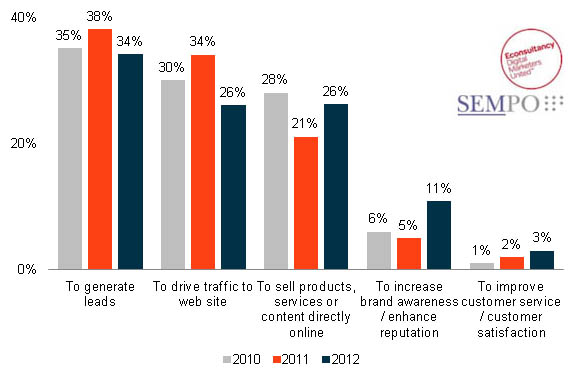
Objectives For SEO 2012 


To generate leads and drive traffic to the website is the major SEO objective for companies investing in SEO. But the objective of driving traffic to website has gone down by 8% in 2012 since last year.
The other main SEO objective is to sell products, services or content online which is the prime objective for companies investing in paid search according to the survey.

As the focus on driving traffic decreases the focus on increasing brand awareness and enhancing reputation has gone up by 6% since 2011. I think this indicates that companies investing in SEO are focusing more on quality SEO metrics and activities.

Metrics To Measure For SEO In 2012:

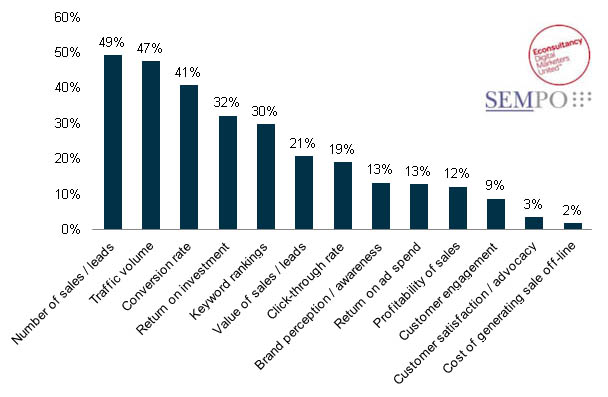
From the above metrics being focused on, by the companies the SEO trend will take a true turn for quality when the quality of the sales/leads will be more important that the quantity. As good SEO should drive targeted traffic not just volumes of traffic.

Secondly, it is not only about keyword rankings but about ranking for global keywords and global terms and terminology for the products and services offered by the companies. So its more about getting the site rank for correlated terms which can be achieved only by having substantial quality content and an engaging social media presence. This global keyword search presence should be a more important metric than traffic volume as the traffic volume and brand perception will follow if this has been achieved.

Though from the above objectives we can see that the companies are more open to quality SEO activities, a lot still needs to be done to educate the clients to focus on quality metrics so that the objectives can be achieved.

Budget For SEO In 2012


Though the companies having a budget of $1 to $25000 has gone down by 7% in 2012 as compared to last year , the companies allocating a budget of $25000 to $75000 has gone up by 9% in 2012. There is a 4% increase in the no. of companies allocating a budget of more than $3 million too. This again is a positive trend that companies are willing to allocate higher budgets for SEO.
This will pave the way for quality SEO activities as good content and good social media presence both are highly priced.

SEO – Inhouse v/s Hiring An SEO Specialist or Agency 

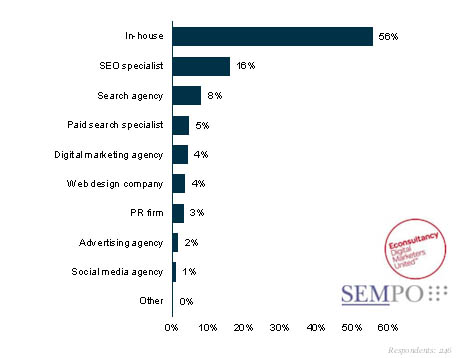
Glad to see that there are more companies willing to hire SEO specialists rather than SEO agencies. This again proves that SEO is a specialized service which needs to be implemented by individuals or small close knit and like minded teams for better results.
Challenges For Managing SEO In 2012: 

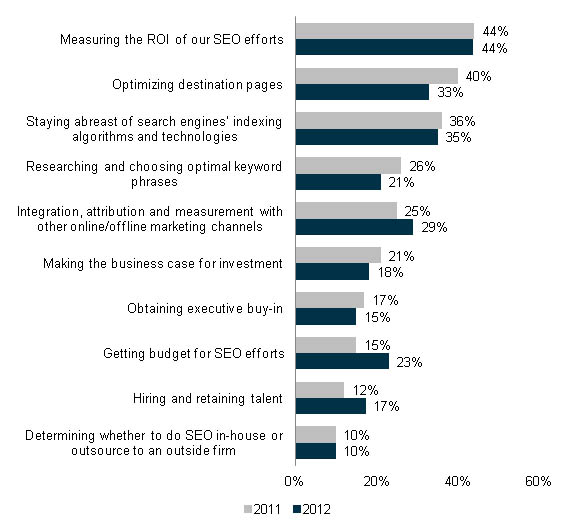
Measuring the ROI from SEO seems to be still at the helm for the challenges faced for managing SEO. This problem will be automatically solved when the metrics to measure SEO is decided upon by the company. This will be a continuing trend though, because the total ROI from SEO can never be measured as the ROI from SEO is an ongoing thing. This is because the brand and reputation created by SEO makes the company accrue returns in future. Many times the targeted traffic which visits the site as a result of SEO services may not take any immediate decision for buying or contacting the company but may delay the decision for various reasons.
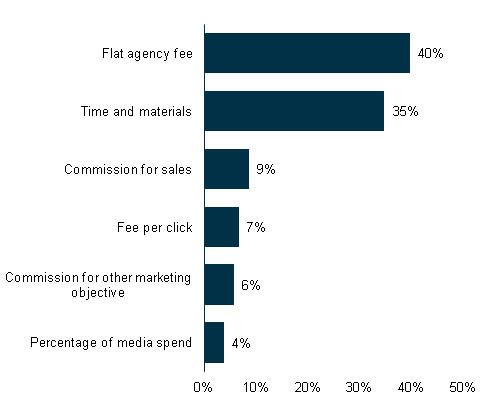

Typical Fee Structure For SEO 

40% of the companies pay a flat fee to their SEO specialists or agencies. This is again a very positive trend and I am glad to see this because we have been having this SEO flat fee structure for our annual SEO projects since 2005.

Overall SEO seems to be on the main agenda of the companies. This again proves that SEO is evolving and not dying.

The full SEMPO report is available to SEMPO members which can be downloaded from SEM Research page.

Google Adds “Associate” Feature To Google Webmaster Tools For YouTube Integration

Google products integration seems to be getting stronger day by day. Google has added the “Associate” feature to Google Webmaster Tools for organizations having multiple presences on the web. This feature allows webmasters to add "associates" -- trusted users who can act on behalf of your site in other Google products. Unlike site owners and users, associates can't view site data or take any site actions in Webmaster Tools, but they are authorized to perform specific tasks in other products.
Google Webmaster Tools logo
Google Webmaster Tools logo (Photo credit: Kinologik)
Image representing YouTube as depicted in Crun...
Image via CrunchBase
For example, Webmaster Tools lives atwww.google.com/webmasters, but it also has a Twitter account and a YouTube channel. It's important that visitors to these other properties have confidence that they are actually associated with the Webmaster Tools site. To add or change associates In Webmaster Tools: 1. On the Webmaster Tools home page, click the site you want. 2. Under Configuration, click Associates. 3. Click Add a new associate. 4. In the text box, type the email address of the person you want to add. 5. Select the type of association you want. Settings In YouTube Account: It’s also possible for users to request association from a site’s webmaster. 1. Log in to your YouTube partner account. 2. Click on the user menu and choose Settings > Associated Website. 3. Fill in the page you would like to associate your channel with. 4. Click Add. If you’re a verified owner of the site, you’re done. But if someone else in your organization manages the website, the association will be marked Pending. The owner receives a notification with an option to approve or deny the request. 5. After approval is granted, navigate back to this page and click Refresh to complete the Google explained on its official blog that - for example, Webmaster Tools lives at  www.google.com/webmasters, but it also has a Twitter account and a YouTube channel. It's important that visitors to these other properties have confidence that they are actually associated with the Webmaster Tools site. Currently , there is only the YouTube option available for this feature. It will not be surprising if gradually other Google products also get added to it. I presume (Just guessing) Google+ to be the immediate next product to be integrated soon.
Enhanced by Zemanta

The Website Owner And The SEO Company – The Mutually Beneficial Association

All this hoopla about Google sending notifications to web masters about unnatural links and warnings about removing them from their link profile is just like a teenager being caught with wrong friends and is warned by his parents to stop hanging out with them else he would be grounded and all allowances and perks shall be withdrawn.

Last Year the crux of my YouMoz post - “tation-of-the-seo-industry-12060" target="_blank">The Question About The Reputation Of The SEO Industry” was :

The reputation of the SEO industry is getting tarnished because of two main reasons:

.False promises by people who want to make a fast buck by calling them SEOs
·Very high expectations of website owners

If you see both are inter-connected if SEOs give realistic perspective about the whole SEO process then the expectations of the website owners would also be realistic. On the other hand if the website owners do not have false notions about the SEO results and they do not put pressure for quick results then the scene would be much different.

The article http://www.seobook.com/curious-case-small-business-and-seo also clearly points out how the business owner, the SEO Company, Google and the SEO community is directly and indirectly responsible for tarnishing the much needed SEO service by all businesses.

I totally agree that people falling under these 4 categories are sometimes jointly and sometimes individually guilty and responsible for such a situation of ultimate penalty to arise.

Many times due to lack of knowledge and at times due to impatience and greed the business owners join hands with SEOs who guarantee them 1000s of links and show them a quick short cut method for page 1 rankings.

We have been advocating natural links and vouching for on page SEO with a focus on content since we started working on SEO services in early 2000. I remember losing out on many SEO projects due to our non-compliance to offer them link building via mass submissions .

We have even got many "Thumbs Down" on our comments and views for our opinion on links for example http://www.seomoz.org/blog/dont-ask-sites-for-links-find-people-and-connect#jtc142513 but have never deterred from that view point despite all the discouragement. 

When we told business owners about our natural link building methods, Google WMT , Google Analytics and focus on content strategies we were not taken seriously and they thought that the other SEO companies who went on a link building spree were the ones who worked hard .

But today when we see them coming back to us asking us to help them undo those links , we can sense the repentance and the lesson learnt in their discussions.

This is not a matter of unnatural links only this is infact a matter of attitude towards your work and a simple law of life that there is no short cut to success and no substitute for hard work.

This same situation will reflect in case of social media signals and stuffed content in future.

Fraudulent webmasters in the past have been involved in Keyword stuffing earlier then went ahead with the link spam methods and now I am sure people having that temperament and attitude will go ahead with the social media scams and content stuffing until Google gets more equipped with detecting it and starts penalizing sites for it.

The business owners have to be savvy in adopting the right approach and not go for quick results. They also have to accept that SEO is a continuous process which keeps on increasing the potential and probability of improving the search presence of the site on an ongoing basis. This onus of making the website owners develop the right approach is to a great extent on the SEO company.

If your SEO company is working on the following aspects and offers you reports regarding them then it is going on the right track.

  •  Increased targeted traffic 
  •  Increase in the keywords with which actual searches take place (increase In The Search Queries) 
  •  Increased no. of impressions 
  •  Stable rankings 
  •  Increased visibility in more no. of Google geographic domains 
  •  Rankings and search presence not being drastically and adversely affected by changes in the algorithm 
  •  More and more pages becoming landing pages 
  •  Increased indexation 

And

Constantly upgrading and educating you with the latest updates at Google so that you are aware of the changing search scenario .

All this can be easily monitored via Google WMT and Google analytics.


How To Integrate Twitter Cards With Blogger For Social Meta Data

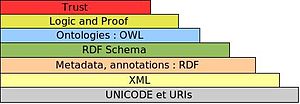
With the shift of the web towards the semantic web and the focus being on data connectivity and its co relevant display. The web is giving priority to Rich Snippets, HTML 5, microformats and schemas.

Twitter last month announced Twitter cards that make it possible to attach media experiences to Tweets that link to your content. Simply add a few lines of HTML to your webpages, and users who Tweet links to your content will have a "card" added to the Tweet that’s visible to all of their followers.

There are 3 card types that can be attached to Tweets, each of which has a beautiful consumption experience built for Twitter's web and mobile clients:

· summary: The default card, which includes a title, description, thumbnail image, and Twitter account attribution.

· photo: A Tweet sized photo card.

· player: A Tweet sized video/audio/media player card.

The summary card can be used for many kinds of web content, from blog posts and news articles, to products and restaurants.

The card is designed to give the reader a preview of the content before clicking through to your website just like a snippet.

You’ll notice that this card makes use of all of the properties described in the previous section: URL, title, description, and image.

Card Property
Description
Required
twitter:card
Should be set to a value of
"summary"
No. If no twitter:card value is
set, we will default to a summary card.
twitter:url
Canonical URL of the card content.
Yes
twitter:title
Title should be concise and will
be truncated at 70 characters.
Yes
twitter:description 
A description that concisely
summarizes the content of the page, as appropriate for presentation within a
Tweet. Do not re-use the title text as the description, or use this field to
describe the general services provided by the website. Description text will
be truncated at the word to 200 characters.
Yes
twitter:image
URL to a unique image representing
the content of the page. Do not use a generic image such as your website
logo, author photo, or other image that spans multiple pages. Images larger
than 120x120px will be resized and cropped square based on longest dimension.
Images smaller than 60x60px will not be shown.
No

If any required fields are omitted, the card may not be shown in the Tweet. Note that the card displays clear attribution for both the website and content creator. Here's the full HTML for the card above:

<meta name="twitter:card" content="summary">
<meta name="twitter:site" content="@nytimes">
<meta name="twitter:creator" content="@SarahMaslinNir">
<meta name="twitter:url" content="http://www.nytimes.com/2012/02/19/arts/music/amid-police-presence-fans-congregate-for-whitney-houstons-funeral-in-newark.html">
<meta name="twitter:title" content="Parade of Fans for Houston’s Funeral">
<meta name="twitter:description" content="NEWARK - The guest list and parade of limousines with celebrities emerging from them seemed more suited to a red carpet event in Hollywood or New York than than a gritty stretch of Sussex Avenue near the former site of the James M. Baxter Terrace public housing project here.">
<meta name="twitter:image" content="http://graphics8.nytimes.com/images/2012/02/19/us/19whitney-span/19whitney-span-articleLarge.jpg">
After this code is added the expanded tweet will appear as follows on Twitter when that particular link is shared:

This kind of  code can be easily added to WordPress for each blogpost .

In order to add this code for each blogpost in Blogger, follow the following instructions:

1. Login to Blogger account.

2. Navigate to Design > Edit HTML

3. Click on Download Full Template for your security purpose.

4. Check the Expand Widget Templates box then..

5. Add the relevant code in the <head> section of your Blogger template. Enter the following code in the head section i.e above</head>

6. Click on the Save Template button

7. To check your description you can use the view source in your browser once you have navigated to the post page

This is an example code for 2 blogposts on my blog:

1) http://blog.webpro.in/2012/03/how-semantic-web-html5-microformats-and.html

2) http://blog.webpro.in/2012/06/empower-your-website-to-claim-your.html

<b:if cond='data:blog.url == &quot;http://blog.webpro.in/2012/06/empower-your-website-to-claim-your.html&quot;'>

<meta name='twitter:card' value='summary'/>

<meta name='twitter:site' value='@webprotech'/>

<meta name='twitter:creator' value='@webprotech'/>

<meta name='twitter:url' value='http://blog.webpro.in/2012/06/empower-your-website-to-claim-your.html'/>

<meta name='twitter:title' value='Empower Your Website To Claim Your Search Engine Presence'/>

<meta name='twitter:description' value=' SEO though a branch of online marketing has its own purpose and identity which is beyond marketing – inbound or outbound. All about the SEO Cocktail '/>

<meta name='twitter:image' value='http://3.bp.blogspot.com/-POb-AA9g7VQ/T9nZS79Z96I/AAAAAAAABcE/2QYKTrePsvo/s1600/cocktail.gif'/>

</b:if>

<b:if cond='data:blog.url == &quot;http://blog.webpro.in/2012/03/how-semantic-web-html5-microformats-and.html&quot;'>

<meta name='twitter:card' value='summary'/>

<meta name='twitter:site' value='@webprotech'/>

<meta name='twitter:creator' value='@webprotech'/>

<meta name='twitter:url' value='http://blog.webpro.in/2012/03/how-semantic-web-html5-microformats-and.html'/>

<meta name='twitter:title' value='How The Semantic Web, HTML5, Microformats And SEO Are Inter-Linked'/>

<meta name='twitter:description' value=' HTML5 and microformats helping the representation of content as data for the semantic web '/>

<meta name='twitter:image' value='http://commons.wikimedia.org/wiki/File:W3c-semantic-web-layers.svg'/>

</b:if>

Twitter is in the process of bringing this new content preview experience to users on Twitter. To participate in the program, you should apply to participate. As Twitter rolls out this new feature to users and publishers, they are looking for sites with great content and those that drive active discussion and activity on Twitter.

Empower Your Website To Claim Your Search Engine Presence

SEO is usually correlated with various concepts like rankings, links, content, etc. The Google Analytics metrics report the success or the failure depending on what metrics you focus on as per your web presence, purpose and priority. But, is SEO only about rankings and thereby traffic and conversions? The answer is an emphatic NO. I think that this sudden wave of correlating SEO with marketing is diluting the whole meaning and existence of the SEO industry. SEO though a branch of online marketing has its own purpose and identity which is beyond marketing – inbound or outbound. Good SEO empowers the website from the first link of the internal navigation structure to the last image displayed on the website. Good SEO empowers the website in such a way that as an offshoot the following benefits are derived: · A brand is built · The site gets regularly crawled and indexed by the search engines · The Technical aspects like the 301s, XML sitemaps, robots.txt etc. are up to the mark · The social media signals are integrated · Makes it immune to the negative effects of the algo. Changes · The site gets targeted locally and globally · Links get built naturally In order to derive those benefits the SEO needs to follow the strategic steps over a period of time . 
The SEO Cocktail
The SEO Cocktail
· Optimum On-Page SEO (Neither more nor less) · Strengthen the internal architecture and navigation · Ensuring that the content falls under the category of quality content · Ensuring that content on the site is available in a balanced form of images, text, video, podcasts, news, etc. · Set canonical and duplicate content issues · Work on reducing page load time · Future proof the site with relevant microformats · Make sharing the content easy so that the site has the potential for getting natural links built gradually · Monitor the social media presence from the search engine perspective i.e share knowledge and information to add the value aspect to the social media account · Claim local presence via Google places and submission in important local directories. · Regularly suggesting and ensuring the execution of ideas for quality natural inbound links · Defend the site against negative SEO · Take corrective measures if the site gets affected adversely impacting the search engine presence negatively · Improve landing page design for better conversions · Improve upon the existing links and discard any if harmful · Customize 404 pages so that traffic from broken links is not lost · Monitor the analytics metrics to keep on improving continuously All these tasks involved in achieving SEO targets are a cocktail of logical, technical, management, design & development, promotion and psychological efforts which carve a special niche for SEO in the online world. SEO is a complete package due to which all roads from the web lead to your website or some online presence of the website reaping direct or indirect benefit. Measuring SEO success by the marketing perspective and the standard analytics metrics like visits, conversions, bounce rate, pages per visit etc. is a very narrow approach. All SEO benefit cannot be quantified as all the SEO efforts help build an online goodwill, reputation, persona, brand, reflect the company culture, add to the trust and authority factor and much more. The benefit accrued from all this cannot be quantified by any formula. You may get tired of spending on Ads. And paid campaigns, social media patterns may change affecting your social media marketing campaigns but genuine SEO efforts made for web presence keep adding on to the quality presence making it richer like old wine and empowering your overall web presence and website continously.

SEO Action Plan For The Knowledge Based Semantic Web

knowledge remix blog as a graph
knowledge remix blog as a graph (Photo credit: g.janssen)

The Wall Street Journal Post sometime back mentioned in the post that ….” Google is aiming to provide more relevant results by incorporating technology called "semantic search," which refers to the process of understanding the actual meaning of words.” Related to that we had posted our views on http://blog.webpro.in/2012/03/my-views-on-wsj-post-google-gives.html .

After the Panda and Penguin updates, Google on 16th May 2012 announced its Knowledge Graph on a blogpost titled , “Introducing the Knowledge Graph: things, not strings”.

In this article it is explained that :

The Knowledge Graph enables you to search for things, people or places that Google knows about—landmarks, celebrities, cities, sports teams, buildings, geographical features, movies, celestial objects, works of art and more—and instantly get information that’s relevant to your query. This is a critical first step towards building the next generation of search, which taps into the collective intelligence of the web and understands the world a bit more like people do.

Google’s Knowledge Graph isn’t just rooted in public sources such as Freebase, Wikipedia and the CIA World Factbook. It’s also augmented at a much larger scale—because we’re focused on comprehensive breadth and depth.

This is the first step to try to convert an information based engine to a knowledge based engine. This kind of engine is solely based on data and data relationships. Whatever useful information people are searching for offers valuable data for the knowledge graph which can be helpful to others searching on the same topic later.
The search queries help Google to add and correlate data thereby enriching the knowledge based search engine results. The information based search engine takes the string of words from the search query and maps it with the content indexed in the database and displays the sites responding strongly to the ranking factors in the algorithms in the SERPs.

In case of knowledge based search engine an additional dimension of the knowledge factor is added which is determined by the correlation, the relationship and how the content of the site is inter-linked with other entities on the web. This is one way the Knowledge Graph makes Google Search more intelligent. The results are more relevant because the search engine understands these entities, and the nuances in their meaning, the way you do. This makes the search engine think more like the user.

Google says…

“We’ve always believed that the perfect search engine should understand exactly what you mean and give you back exactly what you want. And we can now sometimes help answer your next question before you’ve asked it, because the facts we show are informed by what other people have searched for. “

How does one optimize a site for such a knowledge based search engine?

· Have loads of relevant knowledge rich content in all forms on your site.
· Share that content all over the web so that it gets correlated to the relevant topics and the relevant industry
· Every piece of content on the web is data . How well this data gets indexed and how well It get interlinked is important.
· Represent the following content on the site as microformats or as data :
Reviews
People
Products
Businesses and organizations
Recipes
Events
Video

To check your markup, use the rich snippets testing tool.

· Aim at establishing an authority and brand on social media
· Participate in discussions to put forward your opinion
· Have an active Google+ business page presence
· Use Google+ as a blogging platform
· Do not focus on Guest blogging and blog commenting for link building but post comments and guest blog for sharing your knowledge
· Forget about keywords and focus on the keyness
· Implement the hCard Code for the address on the contact page
· Do not neglect the On Page Optimization as the knowledge quotient will be applicable only if the relevant pages respond to the basic ranking factors.
· Keep improving the Technical aspect of SEO in response to the data received from Webmaster Tools


The Penguin Update And The SEO Ideology And Process

We all know that Google is all out to fight spam and is aggressively working for improving the quality of search results like never before. Since, Feb. 2011 we have had a series of Panda updates and now the Penguin Update is the latest antidote added to the search algorithm for devaluing the sites which adopt manipulative methods and spam inbound links to deceive Google to get high rankings.In simple words I can say that Google is penalizing sites which have broken their rules and guidelines. Google has always considered SEO as a positive and constructive action for achieving good search visibility. According to Google SEO IS NOT SPAM . But, there is a very thin line between SEO which is positive and constructive and SEO which uses manipulative methods to achieve the desired result. It is usually referred to as the white hat v/s black hat SEO strategies.

White Hat Methods for SEO are very simple and straight forward, Black Hat techniques on the other hand are, the ones which are complicated and understood only by people who adopt these techniques as they are not the standard norm.

Post Penguin update the SEO blogosphere is filled with posts on Over Optimization, Link Pruning, Natural way of acquiring links, etc.

But, first of all ,'To Optimize' means to achieve a perfect balance – nothing more and nothing less. According to the Merriam-Webster dictionary, to optimize is to make as perfect, effective, or functional as possible. In engineering, optimization is a collection of methods and techniques to design and make use of engineering systems as perfectly as possible with respect to specific parameters. So, if you have been optimizing sites as per the Google guidelines and have been adopting the right white hat off page and on page techniques then I don’t think this kind of an update should worry you as an SEO and let all the pandas and the penguins play to the glory of Google.

The Google Peng
Antarctic: Signy Island - Adelie penguins (Photo credit: ¡WOUW!)

Google is becoming more and more efficient in detecting low quality content , duplicate content , innumerable low quality inbound links acquired with unfair means, doorway pages, keyword stuffing and non-reasonable use of footer links with anchor text stuffed with keywords to manipulate and misguide Googlebot. But, again if you have not been doing this in the name of SEO then there is no need to worry.

The Penguin Update if there is any (or just a false alarm by Google to instill fear and initiate self correction) then it is basically making the SEOs who have been following the above methods go crazy as it is affecting their guilt conscience and making them go for a rectification spree else I think the others do not have to bother at all. We have not made any changes on the sites managed by us and practically 90% of our sites have shown an increase in targeted traffic and improved rankings from 29th April 2012.

I believe these series of the Panda and Penguin updates will still take atleast another 6 more months to effectively churn out stable quality results and penalize sites using manipulative methods to deceive the Googlebot.

Many people have been writing about how SEO should be an invisible layer which should enhance the search visibility of the site but should not show on the site. I think SEO is that technical layer which is applied on the site to make the search engine bots read and index what your visitors are reading. Your site communicates with the search engine bots not only via the HTML tags in the <Head> and <Body> section but via other files too like the robots.txt, sitemap.xml, .htaccess, HTTP headers, etc. and the medium of instruction used is the search engine web master tools available for that. Hence, the off page optimization also includes how well you communicate with the search engine via these tools. Even the analytics used by the search engine to give you reports of the progress of your site gives a lot of information to the search engine regarding some quality metrics. As in the long run once the on page optimization is set up and if you focus on the natural way of building off-page SEO, you will see that the better your site performs and the online sales, likes, +1s and links from your site get shared on social media the site gets an automatic momentum as all these metrics and signals boost the potential energy of the site which in a way gets reflected in the kinetic energy flow in SERPs.

The initial on page and other SEO techniques give the initial push to the site but for the site to go on doing well, the users have to show that they like to be on the site and complete the call to action of the pages on the site. For instance if it is an ecommerce site then the online sales show and increase and there are more and more repeat visitors buying online along with the new visitors then for sure your site is going to get a boost from the search engines as this proves that if the visitors can trust you with their credit cards then the trust factor of the site is high.

I think if we optimize the site and update the site with great content continuously and share it on the web and make it capable of being shared further by others then the SEO is like the initial push that a body in the state of rest gets and keeps on going ahead unless it is faced by the unbalanced force. The Panda and the Penguin updates are that unbalanced force which are applied by Google to stop the momentum and motion of the sites using unfair means and not to the sites which are optimized according to their guidelines.

You have to learn the rules of the game. And then you have to play better than anyone else. - Albert Einstein 

editorial-policy-WebPro-Technologies-LLP-Ahmedabad

Editorial Policy: Human Expertise, Enhanced by AI

At WebPro Technologies, our content reflects over two decades of experience in SEO and digital strategy. We believe that valuable content is built on accuracy, clarity, and insight—and that requires human judgment at every step.

From 2024 onwards, we have been using AI tools selectively to brainstorm ideas, explore perspectives, and refine language, but AI is never the final author. Every article is researched, fact-checked, and edited by our team, ensuring relevance, accuracy, and originality. AI supports our workflow, but the responsibility for quality and credibility remains entirely human.

This hybrid approach allows us to combine the efficiency of technology with the depth of human expertise, so our readers get content that is both informative and trustworthy.

At WebPro, we see AI not as a replacement for human creativity, but as a tool that helps us raise the standard of excellence in the content we share.

SEO Ahmedabad

Contact Info

802, Astron Tech Park, Satellite Road, Opp. Gulmohar Park Mall, Ahmedabad 380015, India

+91 9825025904
info@webpro.in

Daily: 9:00 am - 6:00 pm
Sunday: Closed

Copyright 2025 WebPro Technologies LLP ©  All Rights Reserved