Integrating The Print Media, Mobile And The Online Media With QR Codes

The user is always at the nucleus of any online marketing campaign. The user wants the most relevant information at the most easily accessible option which involves the least navigation and search activity in the whole process of finding the relevant information.

The challenge today is to reach out to more and more people via all the available options possible. We talk about integrated marketing and also integrating search and social but integrating print and online media via mobiles is something which has an easy accessibility and one can reach out to the targeted segment more effectively.

QR (Quick Response) as the name goes it can generate a quick response and is very cost effective. The use of the QR code can enhance the print media by empowering it with the digital dimension. QR Codes can be added to the newspaper Advertisements, coupons, visiting cards, leaflets which one distributes, etc. so that people can add the contact info or view your site readily from their smart phones without any delay and at their convenience.

For example below is the newspaper advertisement of a garment store and under the QR Code they make it very clear by mentioning how to use it and the reader can directly go to the latest collection on their website.

Key Points To Keep In Mind While Using The QR Codes:

· See that the reader reaches the most relevant landing page as per the content on the print media

· The landing page should have the call to action like a form, a buy button, contact details, subscribe button or whatever is the purpose of the page

· One can easily track the ROI from such a campaign as the page can be easily tracked and monitored via analytics and one can even create a special landing page for such a campaign to calculate the ROI and study the response to the Ad.

This is gaining popularity and soon becoming the norm for integrating the print media with the digital media for easy accessibility and a wider outreach.

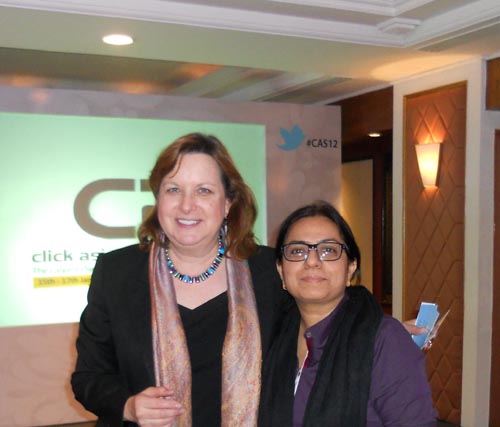
Click Asia Summit 2012 ( Day 3 #CAS12 ) Master Classes By Mahesh Murthy And Gillian Muessig

Day 3 of the Click Asia Summit was all about the master classes on social and search.One could attend 2 workshops that day . One was before lunch and the other one was after lunch. My work essentially revolves around SEO campaigns and I usually opt for SEO focused sessions but this time I decided to attend Mr. Mahesh Murthy’s workshop on “Creating great multi-media campaigns in an integrated world” just to acquaint myself about how other marketing companies approach a given multi media campaign.

Participants were broken up into teams, and a digital marketing project was given to each team, at the end of the session each team had to present the digital marketing campaign worked out by each . These were graded and analyzed at the end.

Before the teams started working on the project, Mr. Murthy gave an overview and an idea about what an ideal digital marketing campaign should be approached.

He pointed out that for every digital marketing campaign one should list out the following:

· Priorities to achieve via the campaign

· Process to achieve the same

· Template to judge the campaign

He also pointed out with an example of 4 videos the importance of having a strategy and making it go viral and also highlighted the reason for a video or any content to get shared.

· The first and foremost the audience has a lot of choice today so content should be remark worthy

· People share content because they want to be popular among their friends

· If the info comes via a friend it has a high trust factor

Hence,

Strategy + Virality = Success

What media you choose depends on what message you want to convey. People are not averse to marketing but they are averse to marketing that bores them.

"Digital is not niche anymore. It is mainstream" - Mahesh Murthy

The four videos taken as case study were as follows:

http://www.youtube.com/watch?v=bUD3E5-rfrc&feature=related > All strategy but no virality

http://www.youtube.com/watch?v=8jgGK4NJ8Hk&feature=related > No strategy but all virality

http://www.youtube.com/watch?v=YR12Z8f1Dh8&feature=fvsr > bad strategy but all virality

http://www.youtube.com/watch?v=owGykVbfgUE&feature=relmfu > all stategy and all virality

Mr. Murthy gave the project of designing a digital campaign for a water purifier . All the teams came up with different ideas and I am sure everyone left the place with their dimag ki batti being jaloed (minds Ignited) and I am sure Mr. Murthy too got some ideas for the next water purifier digital campaign his team may have to work on.

After this we dispersed for lunch and I got back to a session on Analytics, Glorious Analytics! By Gillian Muessig from SEOmoz

The session was divided into the following 4 categories :

Session I - Follow the Money... Backwards!
Choosing KPIs for your business

Session II - Tracking Social Media Metrics
Tracking things that matter in social media campaigns and understanding ROI

Session III - Tracking Conversion Rate Optimization Metrics
Layout, A/B and multivariate testing, and measuring results

Session IV - A Few Reliable Tools
An overview of: Google Analytics, Facebook Analytics and SEOmoz/OpenSiteExplorer.org

After the first 2 sessions , it became more of an open Q & A session where people started asking questions and Gillian answered patiently .

The questions were so varied and were SEO specific hence everyone got to learn something from what problems and issues they were facing on their sites.

The day ended with Gillian (or SEOmom as she is known as ) giving vouchers for a Spa to participants who had asked good questions and I personally got an SEOmoz souvenir which was a token of appreciation for all the help that I had offered. I am still wondering in what way I had helped out?? Infact it was the other way round for me and the pleasure was all mine.

Google+ As A Complete Blogging Platform Diverges To Converge And Converges TO Diverge

Google+ is a platform with some great features for sharing content. Moreover, it does not have the limitation of characters like Twitter which is truly a micro blogging platform. With the trend moving towards content excellence and content marketing and Google+ profile becoming the most integrated identity for an online presence. As the circles concept of Google+ makes it very easy to reach out to different groups of people and share what you want to share to the selected circle. Google+ has the potential of becoming an excellent blogging platform for all purposes personal and professional.

We have been till now blogging on our blogs and then sharing the link on the social media platform but with Google+ the blog post content , comments and the link to be shared on other social media sites can be available on the same platform.

With social media signals being incorporated in search the need to have a quality social media presence which reflects the trust and authority factor of the brand is highly imperative. Hence we can see the SEO blogosphere filled with posts of how blogging and social media presence can help the SEO and online presence of any site.

I think all the clients who cannot maintain a separate blog for various reasons can start off their blogging journey via their Google+ business page which will not only associate and correlate valuable content to their social profiles but also pass of the necessary content correlation to the social signals for getting integrated to search. The content shared and the UGC content generated can be in the form of images, videos, text, links, etc. a whole plethora of content options available to correlate to the social profile.

I think from the users perspective also when you share your comment or views on the Google+ profile where the blogpost link has been shared you have a better chance of correlating that content to your social profile rather than commenting on the blog where the blog post is published.

Eventually all the Google+ data being accessible by Google is an overall added advantage . So, atleast from the search perspective currently Google+ has a win-win potential to become a complete blogging platform converging your overall web identity on a single platform .

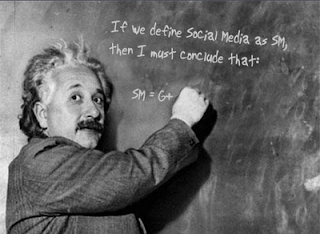
(Google+) = Blogging (Personal + Professional) + Social Media + UGC + Location + (+1 Counts) + Image Albums + Videos + Recommended Links to integrate your overall web presence = Search Plus
Image As Shared on  http://goo.gl/bTA5d

Search Queries , Google's Encrypted (Not Provided) Keyword Data And SEO

In mid October 2011 Google had announced that “As search becomes an increasingly customized experience, we recognize the growing importance of protecting the personalized search results we deliver. As a result, we’re enhancing our default search experience for signed-in users. “

This meant that , when you search from https://www.google.com, websites you visit from our organic search listings will still know that you came from Google, but won't receive information about each individual query. They can also receive an aggregated list of the top 1,000 search queries that drove traffic to their site for each of the past 30 days through Google Webmaster Tools. This information helps webmasters keep more accurate statistics about their user traffic.

When the user’s search gets redirected to https://www.google.com , the user can have an end-to-end encrypted search solution between his computer and Google. This secured channel helps protect his search terms and his search results pages from being intercepted by a third party. This provides him with a more secure and private search experience.

This organic search query data gets displayed in the Google Analytics Report as “Not Provided” for the keyword metrics for such a search as follows:

Keyword
Visits
Pages/Visit
Avg. Time on Site
% New Visits
Bounce Rate
1.
(not provided)
60
3.20
00:01:12
100.00%
25.00%

From the SEO perspective that means that the website owner will not get such keyword data as a result of which the visits were recorded. Google recommends the user to receive an aggregated list of the top 1,000 search queries that drove traffic to their site for each of the past 30 days through Google Webmaster Tools. This information helps webmasters keep more accurate statistics about their user traffic.

The Webmaster tools Search traffic data includes the following:

Queries: The total number of search queries that returned pages from your site results over the given period. (These numbers can be rounded, and may not be exact.)

Query: A list of the top search queries that returned pages from your site.

Impressions: The number of times pages from your site were viewed in search results, and the percentage increase/decrease in the daily average impressions compared to the previous period. (The number of days per period defaults to 30, but you can change it at any time.)

Clicks: The number of times your site's listing was clicked in search results for a particular query, and the percentage increase/decrease in the average daily clicks compared to the previous period.

CTR (clickthrough rate): The percentage of impressions that resulted in a click to your site, and the number of percentage points increase or decrease in the daily average CTR compared to the previous period. For example, if your CTR went from 40% to 30%, this column would show a change of -10.

Average position: The average position of your site on the search results page for that query, and the change compared to the previous period. Green indicates that your site's average position is improving.

To calculate average position, Google takes into account the ranking of your site for a particular query (for example, if a query returns your site as the #1 and #2 result, then the average position would be 1.5).

Such a depiction of data in SEO reports regarding keywords surely makes the website owner think from a larger perspective and focus on the correlation of content and keywords rather than rankings. This will take SEO campaigns above the metrics of keywords and rankings and the focus will be on other quality metrics like CTR , conversions, bounce rate, etc. which will improve the quality of the web overall as the websites besides being rich in content will have to focus on good landing pages, a proper call to action, page load speed and good navigation which will ensure a better UX .

Search query data is now integrated within Google Analytics and the SEO Reports can have those metrics , data and details from analytics itself.

The metrics can be found under Traffic sources and is represented as follows:

When the businesses are at a loss for the complete keyword data the focus is shifted to the search queries in WMT which have a good CTR which is a true measure of quality over quantity.

The percentage of the “Not Provided” data may vary from industry to industry but on an average should be in the range of 10 – 15 % currently but this encryption is trying to safeguard the privacy of the user and this way the website owners are also getting the accurate organic search data which is not influenced by personalized search preferences.

From the SEO perspective the only thing affected is the reports which tell the website owner about how many people visited their site while they were logged in to their Google account in the form of the “not provided” keyword. This as mentioned earlier makes them shift their attention to the content and keyword correlation and CTR to the data available in the WMT for atleast the first 1000 queries. This widened focus will definitely ensure more quality content on the web and that is a good thing.

I fail to understand why this made the SEOs attack Google with accusations , because according to me all these changes are drawing a clear, distinct line between organic search campaigns and paid campaigns and carving a niche for the SEO industry where the focus is on the holistic and overall quality aspects of the website rather than the cost paid for every click received.

Related Posts:

http://blog.webpro.in/2011/10/is-googles-encrypted-search-bane-or.html

http://www.seocopywriting.com/content-marketing/why-googles-recent-changes-mean-good-news-for-the-seo-industry/

Enhanced by Zemanta

The Evolution Of Search In Six Minutes By Google

Google published a video on their official search blog essaying a short history of the evolution of search, highlighting some of the most important milestones from the past decade—and a taste of what’s coming next.

Amit Singhal at the discussion hosted by Church Hill Club had openly explained the testing procedure of every algorithmic update at Google. He says that the focus has always been “DO What Is Best For The User”

Search behavior is always evolving and Google keeps on trying to keep up with the pace of this evolution in search and hence the search algorithm get updated nearly on a daily basis.

As part of making the video Google has  also created a timeline of search features. The timeline categorizes the different kinds of Universal Results and Quick Answers Google has over the years:


With this kind of approach to search one can only say that search is ever evolving, dynamic and here to stay. Hence ignoring an overall search presence is the biggest mistake one can make.

Is The SEO Of Your Website On External Link Steroids – A Case Study

Sometime back we had conducted a SEO Training Programme at Ahmedabad Management Association which was attended by many professionals from the Internet Marketing Industry and also by Marketing Managers of some companies.

After all the SEO training sessions were over one of the marketing managers after a few days called up to discuss some points related to the SEO of their site.

The main points were as follows:

  • We are ranking for many keywords but only the home page of our site is ranking as they did not have any idea about Google Analytics and Landing pages. ( After the SEO training programme they did an SEO audit on their site and found this.)
  • The SEO has given us a list of some 1000+ links are these links valid and relevant.
  • The On-Page of our site is practically zero but yet we have the page 1 rankings for so many keywords so is it correct to let the site be as it is.
  • The most valid question and concern was , what should we do to future proof the SEO of our site though we have the rankings.

Firstly, I was very happy at the fact that the training programme conducted by us had made them think beyond rankings for an SEO campaign and they were open for an approach of an overall quality presence rather than just being satisfied with page 1 rankings.

After the initial analysis it was found that:

  • The on-page factors were not as per the norms
  • The inbound links were not from authority sites with anchor text which just mentioned the domain name and all the links were to the home page.
  • The client was totally unaware about Google Analytics metrics and was not sure if the site was added to any webmaster tools account.
  • The client only got the ranking report regularly without any further analysis of any other metrics.
  • The client was not aware of the search and social media integration and did not have a blog or social media accounts.
  • Other technical factors like canonicalization, customized 404 pages, XML Sitemaps, etc. were not in place either.

In short only submission to some directories and link building was done in the name of SEO but surprisingly the site was ranking well.

There have been many such cases in the past too when the rankings have been achieved only by link building and though the links were not quality links but due to the sheer high no. of links the site had got a temporary boost but the website owners have approached us when the site suddenly disappeared from the search engines.

Hence I thought of sharing this case study. It is very difficult to say how long the benefit of such rankings will accrue to the site but it is very important for every website owner to know that a complete SEO campaign caters to the following aspects of the site.

  • On Page Factors as per the norms of the search engines and W3C
  • Off Page Factors which help create an ambience of natural external links to the site
  • The site should also have the potential to rank for local intent keywords and have a local search presence
  • The technical factors also should have been attended to
  • The client should also be given an overview of the analytics and
  • Should be guided to start a blog and engage on social media to benefit from the integration of social media and search.

No doubt quality inbound links are important but just focusing on one aspect gives a lopsided growth which may be working like steroids and giving a temporary boost which is not the main goal of a genuine SEO campaign. Once these directories close down or if the external websites remove the links the rankings are bound to get affected and the site will be lost in the invisible web.

Enhanced by Zemanta

Real Time Reports In Google Analytics

Author : Bharati Ahuja

Google  has recently launched the Google Analytics Real-Time Reports : a set of new reports that show what’s happening on your site as it happens.

Real-Time reports are available in the new version of Google Analytics, and administrators with Analytics accounts will get Real-Time reports.

Google on its blog mentioned the following 3 ways one can use this data:

  • Measure Social Media Impact 
  • Campaign Measurement 
  • Accessing Real Time 

With Real Time data it is possible to measure, monitor and track the immediate impact of a certain blog post or announcements shared via social media. We can assess the site traffic as a result of a certain tweet. We could also see when the blog stopped receiving the visits from the tweet, which helps know when to re-engage.

Similar is the case when we launch a new campaign and want to know what is working and whether the launch made an impact. The immediate traffic to the site will give us the indication of how well the launch was accepted by the netizens.

This data is available to some selected accounts and will soon be available to all. We have been having access to this data since 1st Week Of October and it surely is a great indicator to how your posts on Twitter are performing.

There is one more way this data can be of great help. Though we have to yet test its usability and ROI but this kind of Real Time Monitoring can help in serving the online customer online at that very moment instead of waiting for him to contact us .

The Real Time Data metrics that you get are as follows:

  • Top Referrals 
  • Top Keywords 
  • Top Active Pages 
  • Top Locations 
 

Overview: 


Locations: 


Traffic Sources: 
 
 
Content: 
 

All this data tells you how many visitors are currently visiting your site as of now and they have reached your site via which source , which keyword , which country and are currently viewing which page. This data is very helpful for an ecommerce site and if a person is appointed for monitoring this data and then cater to such real time visitors by asking the right questions and offer the requisite answers to their questions immediately via a chat feature on the site just like a salesman at a mall attends to the customers atleast during those hours of the day when the site gets maximum traffic.One can sign up for this on sign up for early access https://services.google.com/fb/forms/realtimeanalytics/.

Points Highlighted By Matt Cutts And Amit Singhal at The Keynote Session At Pubcon Vegas 2011 Day 2

Author : Bharati Ahuja

Following are some of the points which Matt Cutts and Amit Singhal of Google made at the Keynote Session of  Pubcon Vegas 2011 on Day 2.

These points have been jotted down by following  #pubcon on Twitter.

@mattcutts 

  • The best SEOs  don't want to go where search engines are but rather where they will be
  • What is a cell phone? it's a computer you carry with you everywhere. this will change things enormously
  • Googlebot is getting smart including processing java script, better understanding of page & content (above the fold)
  • SEO is not going to die
  • The web is one of the only places where, if you're a small biz, you can move faster than the big guys
  • Good editorial links matter. Bad links do not. Quality beats quantity .A really good editorial link can go a long way.
  • Got a page topped with ads? google's evaluating algo changes to penalize these
  • SEO is like coaching" helps you put your best face forward.
  • A special webmaster video for #pubcon: How does Google determine page speed? http://goo.gl/Nvm9z
  • Google currently looking into figuring out what content is above the fold as part of algorithm
  • Search is personal and will continue to get more personal.
  • We can give more data or we can go further back in time
  • Only rolling out SSL to http://google.com not to Google.ca, Google.fr etc. Just too complicated for now.
  • Historically SSL is hard to do on different hostnames (i.e. FR, DE) if they decide to rollout international
  • Number of users with SSL is single-digit percentage in aggregate. Tech sites will be higher due to type of users
  • There are no plans to offer analytics SSL data in a paid version of analytics
  • Google looks at over 200 signals to determine link quality.
  • Some sites may have 10,000 backlinks, but Google may not be crediting any of them. People don't see what links we trust and what links we don't trust.
  • Depending on the size & content, Google will remove spammy party of site, entire or folder
  • It's a lot harder to "fake natural" than to "be natural" online in terms of SEO
  • On press releases: you're going up to someone & asking them to write about you... it's better when someone comes to you

@theamitsinghal

  • On Author Authority - Visitors want to know a high quality author wrote it and why the author is high quality.
  • "If your child can learn something from the site, that's how we know it is quality."
  • If you can tell your child to go to a specific site, consider that "high quality content
  • It is our desire that every signed in google user has protection & privacy – internationally
  • At the end of the day, high quality content will win
  • Google likes to make changes algorithmically because it scales across languages, etc.
  • Google always prefers algorithms to human intervention.
  • If the internet remains healthy, Google will remain healthy.
A very big thanks to all the people who shared the event with their live posts on Twitter. 

The Right Approach For The Keyword Research Phase Of The SEO Campaign

Author : Bharati Ahuja

We all know that the whole search process starts with a search query . All the SEO campaigns revolve around having a quality search presence and high rankings for relevant keywords.

There are many keyword Research tools available online but most of them focus on what the keyword search trend has been till date or what kind of search terms are breaking as new searches on the search scene.

No doubt these tools can give a good insight into the past and present search trend and also reflect search behavior to a certain extent. But, I think if one gets too obsessed with the terms and phrases suggested then we sort of limit the circumference of search within those few terms which we focus on.

I think if you focus on the niche head terms of the industry (for which we know the SEO Campaign will have a long gestation period to start giving results) and due importance is given to a larger set of long tail keywords then I think you try to target a larger set of permutations and combinations of the possible targeted searches made for which your site can be found for.

As in the long run the search behavior keeps on changing and also varies from country to country.
Keeping all options open for a global audience and targeting for the maximum possible keyword phrases should be the goal for the keyword research phase .

For example if it is an edible oil refinery manufacturers and exporters site based in India

Keywords like

  • Edible oil refinery manufacturer India
  • Edible oil refinery suppliers India
  • Edible oil refinery exporters India
  • cooking oil refinery manufacturers
  • cooking oil refinery suppliers
  • edible oil refining
  • refining of cooking oil
  • Edible oil refinery exporters
  • Vegetable oil refinery manufacturers
  • Vegetable oil refining
  • Vegetable oil refinery Exporters
  • Edible oil refining process
  • Vegetable oil refining process
  • Cooking oil refining process

If such a wide range of possibility is kept open for the site to rank then the potential of the site to cater to a wider audience is possible .

Hence instead on focusing on only the keywords suggested by keyword research tools and Adwords also focus on the possible psychologies of people from various geographic areas unless you are focusing only on a very specific region where only the lingo and jargon of that place matters for the search of that site.

People from different places , of different age groups and of different educational backgrounds think differently and use different terminology and jargon. Hence the content of the website should be written keeping this in mind. Instead of  focusing on only certain fixed key terms we should try to keep the possibilities of a wider set of permutations and combinations of keyphrases open for the site.

As the basic thing is that the user does not see your keyword tag and search for your site he keys in what comes to his mind and the search engine bot takes that string of query and tries to hunt for the relevant site from the search engine index. So, making your website being available for a wider combination of queries is more beneficial. Like in the above case we want the website to rank if the person writes cooking oil, edible oil or vegetable oil whatever is the lingo and jargon used by the user.

The analytics data in fact can give a good idea of what searches are actually taking place country wise. A detailed discussion with the website owner who has a vast experience regarding his industry also helps. Hence we usually ask for a list of possible terms he thinks his website should come forward when someone is searching on the web from the website owner, then we add our our research results and come up with the widest possible keyword list which can be targeted as per the content available on the site.

The Latest Agorithm Update By Google Focuses On Giving Fresher And More Recent Results

Author : Bharati Ahuja

Google recently announced that after having the Caffeine Web Indexing System in place which allows Google to crawl and index the web faster and on an enormous scale they have made a significant improvement in the ranking algorithm which has the possibility of affecting 35% of searches.

The search results for those queries which according to Google deserve to be served fresh content shall be impacted. This according to Google is roughly 35% of the queries overall. For example queries related to an event, contest, movie reviews, latest product launch info, current elections, etc.

Library search results do not do justice to these kind of queries but the latest buzz from various microblogging sites and latest blogposts may offer much more relevant search results. As Google aptly writes on its blog - Different searches have different freshness needs.

There are two aspects to this update, first depending on the query the Google algorithm has to decide if that query deserves to be served fresh and latest relevant results from all over the web and secondly the way these results will be presented by Google on the search results page.

Currently it is showing these results on top of the page as shown below:

This is another quality improvement in the search results which is being served by Google. This kind of an update is quite justified keeping in mind the number of people increasing on the social media platforms and an average searcher on search engines who is more search savvy that ever before. Google has always been the best when it comes to search and this improvement proves that they would like to be ahead in all aspects when it comes to search.

If one wants to have a presence on the search results for those queries which deserve fresh search results related to your industry then the only way is to be the first one to blog about the latest topics , tweet or post about it on various social media platforms.

This can be seen in the image below when we made a search for “google algorithm updates”

Google Caffeine infrastructure gave the relevant data to Google by helping it index the web faster and now Google is offering it to its users in a relevant format as search results. Great , search has not been so hot and happening ever before. Although, only time will tell its actual impact , Google is surely gone one step ahead to please its users as far as search is concerned.

editorial-policy-WebPro-Technologies-LLP-Ahmedabad

Editorial Policy: Human Expertise, Enhanced by AI

At WebPro Technologies, our content reflects over two decades of experience in SEO and digital strategy. We believe that valuable content is built on accuracy, clarity, and insight—and that requires human judgment at every step.

From 2024 onwards, we have been using AI tools selectively to brainstorm ideas, explore perspectives, and refine language, but AI is never the final author. Every article is researched, fact-checked, and edited by our team, ensuring relevance, accuracy, and originality. AI supports our workflow, but the responsibility for quality and credibility remains entirely human.

This hybrid approach allows us to combine the efficiency of technology with the depth of human expertise, so our readers get content that is both informative and trustworthy.

At WebPro, we see AI not as a replacement for human creativity, but as a tool that helps us raise the standard of excellence in the content we share.

SEO Ahmedabad

Contact Info

802, Astron Tech Park, Satellite Road, Opp. Gulmohar Park Mall, Ahmedabad 380015, India

+91 9825025904
info@webpro.in

Daily: 9:00 am - 6:00 pm
Sunday: Closed

Copyright 2025 WebPro Technologies LLP ©  All Rights Reserved