
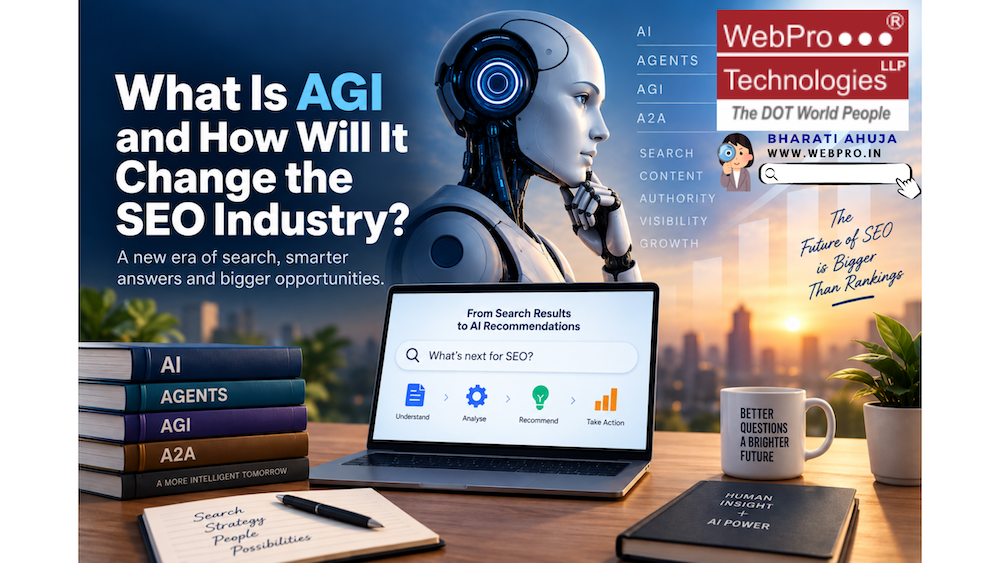
Artificial Intelligence has already changed the way we search, create content and market businesses. But the next major shift may be much bigger: Artificial General Intelligence (AGI).
The recent launch of GPT-6 Astra by OpenAI has brought the conversation about AGI much closer to reality. OpenAI describes Astra as its most intelligent and aligned model yet, with advanced capabilities in computer use, browsing, software engineering, science and complex professional work. It can carry out multi-step tasks, use software, conduct research and produce finished documents and analyses.
OpenAI President Greg Brockman has described Astra as potentially marking the beginning of the “AGI era.” However, AGI remains a debated concept, and there is no universally accepted test for when AI officially becomes AGI.
So, What Exactly Is AGI?
AGI stands for Artificial General Intelligence.
Unlike traditional AI, which is generally built to perform specific tasks, AGI refers to AI that can reason, learn, adapt and solve problems across a wide range of domains at a level comparable to—or potentially beyond—human intelligence.
Think of the difference this way:
Today’s AI:
“Analyse my SEO report and tell me what happened.”
AGI:
“Grow my company’s organic and AI-search leads by 30%.”
A highly capable AGI system could potentially analyse the market, study competitors, identify opportunities, develop a strategy, create content, make technical changes, monitor results and continuously improve the strategy.
That is where the real disruption begins.
How AGI Differs from Today’s AI
| Feature | Today’s AI (Narrow/Frontier) | Artificial General Intelligence (AGI) |
| Scope | Deep but narrow specialization (e.g., text, chess, coding). | Broad, universal capability across all intellectual disciplines. |
| Learning Style | Requires massive datasets or specific programming for new tasks. | Learns efficiently from few examples, mimicking human adaptability. |
| Problem Solving | Recognizes patterns from training data to predict answers. | Formulates original hypotheses, reasons causally, and innovates. |
| Context | Operates strictly within software boundaries or sandboxes. | Understands abstract concepts, intent, and real-world nuances. |
From AI to AGI: The Evolution of Intelligent Automation
The evolution of AI can be understood as a progression from assistance → autonomy → intelligence → collaboration:
| Technology | What it does | Example in SEO |
| AI | Performs specific tasks based on instructions | Generates content, analyses keywords or audits a webpage |
| AI Agents | Plans and executes multi-step tasks autonomously | Research competitors, identifies opportunities and creates an SEO action plan |
| AGI | Understands, reasons and learns across multiple domains | Develops an overall SEO and business-growth strategy and adapts it based on results |
| A2A – Agent-to-Agent | Enables different AI agents to communicate and collaborate | An SEO agent works with content, analytics, technical and outreach agents to execute a complete campaign |
In simple terms: AI helps us do tasks. AI Agents can perform workflows. AGI aims to think across domains and solve complex problems. A2A allows multiple intelligent agents to work together.
For the SEO industry, this could ultimately mean moving from human-led execution to AI-led collaboration, with humans providing strategy, judgement and oversight.
How Will AGI Change SEO?
The SEO industry has traditionally revolved around keywords, rankings, backlinks, content and traffic. AGI could change almost every one of these.
- SEO will move from keywords to intent
AI systems can understand complex questions and user intent far beyond individual keywords.
Instead of optimising for:
“best real estate agent Ahmedabad”
businesses will need to become the trusted answer to questions such as:
“Who are the most reliable real estate consultants in Ahmedabad for commercial property?”
SEO will increasingly be about understanding and satisfying the user’s underlying need.
- Content will become a commodity
AGI can potentially produce enormous volumes of high-quality content very quickly.
This means simply publishing more blogs will no longer create a meaningful competitive advantage.
The valuable content will be:
- Original research
- First-hand experience
- Proprietary data
- Expert opinions
- Case studies
- Real customer experiences
- Unique insights
In other words, authority will matter more than content volume.
- Rankings may become less important
The traditional search journey is:
Search → Google → Ranking → Click → Website
The emerging AI journey could be:
Question → AI research → Recommendation → Action
If an AI assistant can research several businesses and recommend the best three, the goal is no longer simply to rank #1.
The goal becomes:
“Will the AI recommend my business?”
- SEO will become Digital Authority
AI systems may increasingly evaluate information from across the internet—not just a company’s website.
That could include:
- Reviews
- News coverage
- Social media
- Industry publications
- Expert profiles
- YouTube
- Forums and discussions
- Business directories
- Structured data
- Third-party mentions
Therefore, SEO will increasingly overlap with branding, digital PR, reputation management and thought leadership.
- SEO execution will become increasingly automated
Technical audits, keyword research, competitor analysis, content creation, internal linking, reporting and even implementation can increasingly be handled by AI agents.
The SEO professional’s role will therefore shift from doing repetitive tasks to:
strategy + judgement + creativity + business understanding + AI orchestration.
The Future of SEO
AGI is unlikely to simply “kill SEO.”
It is more likely to transform what SEO means.
The old question was:
“How do I rank higher on Google?”
The new question will increasingly be:
“How do I become visible, credible and recommendable to both humans and AI?”
This represents a fundamental shift—from Search Engine Optimisation to AI Search Visibility and Digital Authority.
For businesses and SEO professionals, the message is simple:
Don’t prepare for the death of SEO. Prepare for the evolution of search.
The businesses that build genuine expertise, authority, reputation and unique value will be far better positioned for a world where both humans—and increasingly intelligent AI systems—decide what gets discovered, trusted and recommended.

Bharati Ahuja is the Founder of WebPro Technologies LLP, an SEO and digital strategy company she established in 2001. With over two decades of experience in search engine optimization, digital marketing, and ethical web strategies, she has been at the forefront of helping businesses build sustainable visibility online.