![]() |
| handshake isolated on business background (Photo credit: SalFalko) |
![]() |
| handshake isolated on business background (Photo credit: SalFalko) |
My first guest post for SEJ in September 2010 was about the shift from the traditional media of marketing to the internet media of marketing http://www.searchenginejournal.com/the-traditional-media-of-marketing-to-the-internet-media-of-marketing/23947/ at that time this question of who should manage the digital media which demands a multiple partner proliferation had just started brewing . In 2013 it has reached a turbulent stage as is described by the 2012 CMO Insights survey by Accenture.
The 2012 CMO Insights survey is the third in a series of studies sponsored by Accenture and aimed at understanding the opinions, challenges and points of view of senior marketing executives from around the world.
Results are based on online surveys across 10 countries with 405 senior executives who are key marketing decision makers in their companies.
According to this survey,
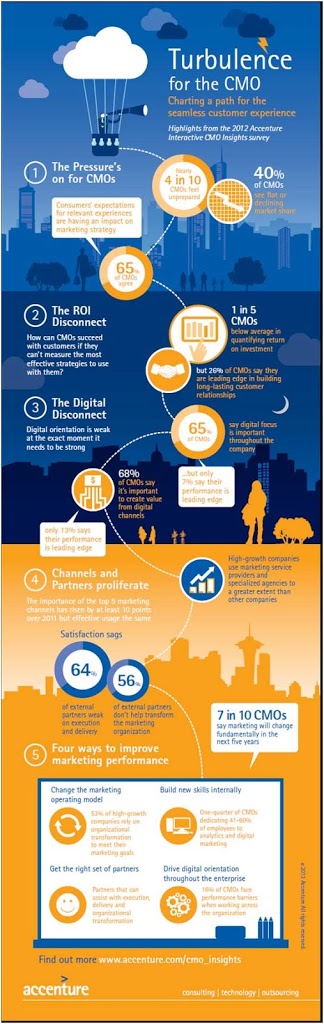
Turbulence is the new normal for chief marketing officers (CMOs). The main reason being competing business demands, proliferating channels and partners, and a disconnect between the talent they have and the capabilities they need.
Every digital marketing company I am sure will be able to relate directly to this as we face a real challenge when an overall ROI has to be calculated. It becomes more challenging when there are multiple marketing services providers but the tasks of each of these service providers are mutually inter-dependant for overall success.
For example if SEO , Social Media , Content Creation are handled by different agencies with no clear strategic leader coordinating all these activities then a lot of confusion, chaos and the blame game begins which is not less than a catch22 situation.
According to the survey for business survival CMOs need to:
• Fundamentally change the marketing operating model.
• Build new skills internally.
• Get the right set of partners.
• Drive digital orientation throughout the enterprise.
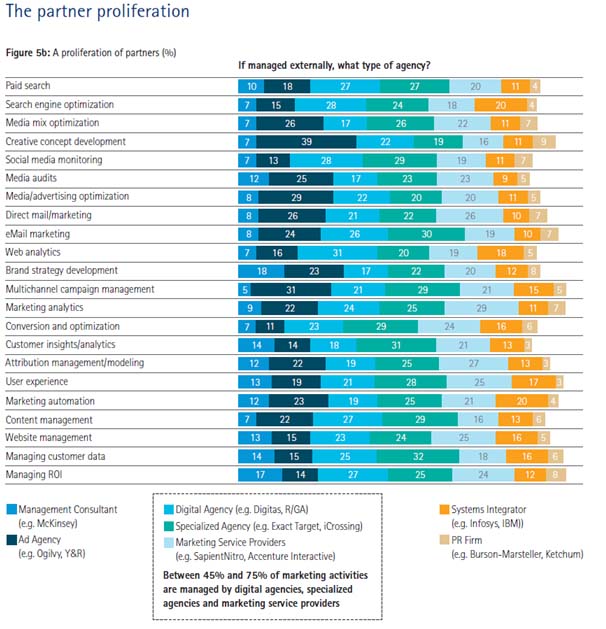
The Partner Proliferation list according to the survey is as follows:
When all these activities are to be managed in-house it requires a very big budget and specialized skill sets or if outsourced it needs precise coordination. The challenge that the online business owners small or big brands face today is how to the get the maximum ROI from the selected set of the above activities they decide to focus on for a wider and a qualitative digital presence.
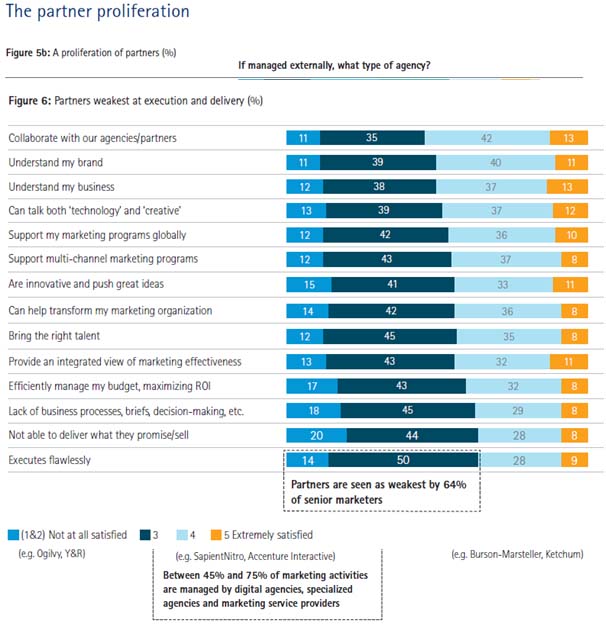
From the list above it is very clear that the digital orientation is the most important demand of the day but 19% of the CMOs say that digital orientation suffers from the lack of integration across the business and when it comes to other partners they are weak at execution and delivery.
Hence the need of the hour is to:
· Fundamentally change the marketing operating model
· Build new skills internally
· Get aligned with the right set of partners
· Drive digital orientation throughout the enterprise
The main focus being the digital orientation which is needed throughout the organization. The shift is not only on the media used for marketing but a shift is needed towards a whole new process of thinking from the digital perspective in order to gain a profitable overall ROI .
The whole survey is summarised as below and the full report can be downloaded on http://www.accenture.com/SiteCollectionDocuments/PDF/Accenture-CMO-Insights-Report-PDF.pdf
Today a quality web presence is the lifeline of every organization. In early 2000 anyone who had a website and had submitted them to search engines took pride on being visible in the search results and proudly printed the website URLs on the business cards and letter heads.
A decade down the line the world wide web is a more sophisticated place with the search engines and the search behaviour both having evolved qualitatively.
Today having a web presence does not mean only having a website. One needs to have a correlated quality web presence across the web. In order to achieve that objective a planned approach and a dedicated team is needed. SEOs and digital marketers have been filling the blogosphere with this message but yet when it comes to the website owners there is an aura of confusion and there is a need to understand the connectivity and correlation among all the online platforms – SEO, Social Media, and Regular Content Creation.
All these activities supplement each other and boost the quality search presence in the long run. One cannot focus only on one activity and then immediately jump to another just because it is being declared as the latest trend by some. This is very misleading for website owners.
Blog posts like SEO Is Dead, Content Marketing is the new SEO, Email is Dead, Social Media marketing is the latest online trend, etc. make the website owners especially the SMBs who have limited budgets skip from investing in one activity to another without actually benefitting from any.
Just the other day an SEO client wrote to us an email strictly mentioning that the coming months were the peak season for their business and we should have an aggressive SEO strategy to increase the traffic to the site.
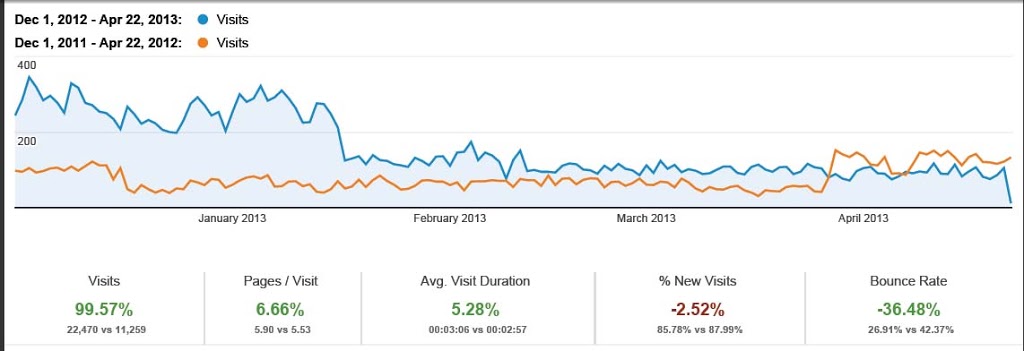
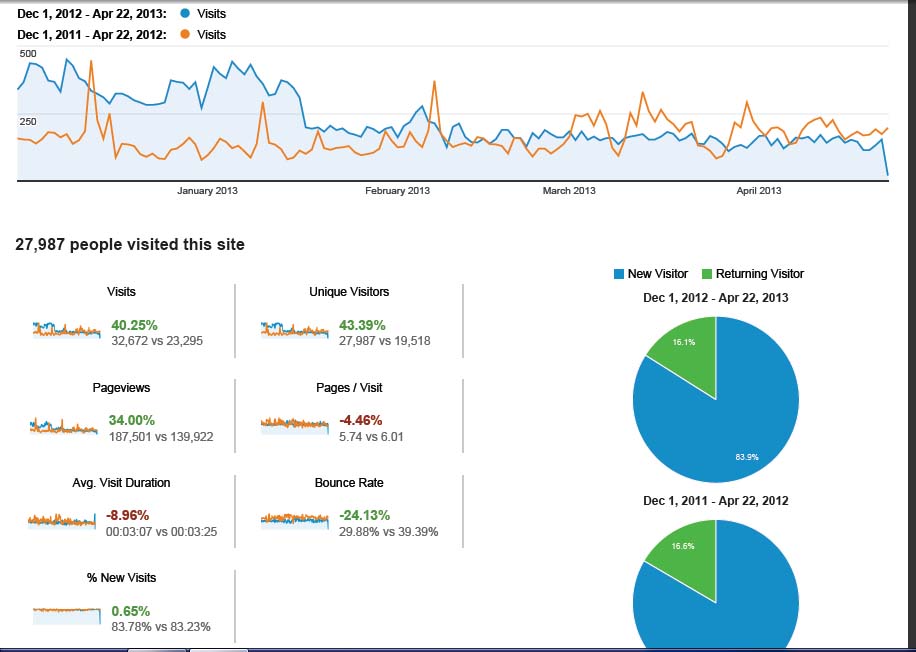
We started working on their site in Dec. 2012 and till date the increase in organic and overall traffic is as follows . As the site deals in seasonal products the period of comparison is very important.
Hence we took to compare the period of Dec. 2012 to April 2013 (After Our SEO Efforts) v/s Dec. 2011 to April 2012 (When the Site was Optimized by some other company)
As you can see that the SEO efforts have succeeded and the traffic has improved and yes the traffic is targeted and also the site is having a good search presence for most of the keywords. The SEO has done his bit. Now the client has to understand to enhance the quality of this search presence there needs to be an additional focus on content marketing, social media presence, take necessary steps as per the analytics reports, work on call to action, try out A/B testing to improve conversions, etc.
But just because you branch out to an additional activity you stop focusing on the previous one is not a viable solution. The saying, “The rolling stone gathers no moss “, proves to be very true here. Hence a coordinated effort to supplement the benefit from each activity is needed.
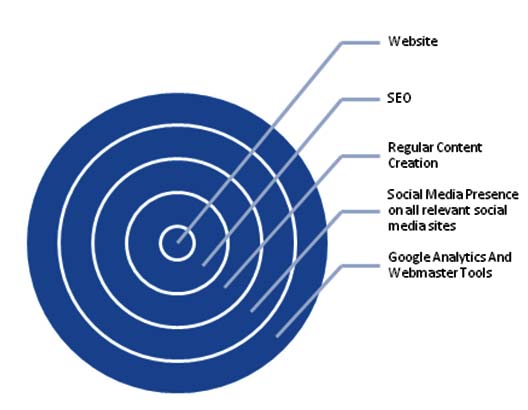
All these activities are like the concentric circles drawn around the same centre but with different radii.
Usually people start with developing a website and at the most sign up for an SEO contract and then expect for the overall results to accrue but that is like drawing a small circle or drawing just a part of the circle. The search presence or the SEO circle is one of the concentric circles.
The Concentric Circles Of Long Term Quality Web Presence:
A website owner can outsource each activity to different service providers or all these can be managed by one company but the correlation between all these activities will determine the actual success. As all these circles have the website as the centre as you draw each circle you go on increasing the circumference of the outreach.
This can be also co related to the structure of an atom where the website is the nucleus and each circle is an orbit which possesses the electrons of influence and outreach.
SEO is a necessity, content marketing is a strategy and social media is the channel.
If just one of the steps mentioned above are executed even with full sincerity, precision and dedication it will yield limited results only. In order to measure the overall ROI first one needs to measure the ROO (Return On Objective) of each outer circle . The objectives achieved with the activities of each circle will determine the total ROI (Return On Investment).
Today the challenge for the website owner is how to keep these activities coordinated and connected and make each task benefit from the other and get an overall boost to the online presence by capitalizing on the digital assets created thereby. It becomes more challenging if these tasks are performed by different services providers.
SEO in 2013 is about quality web presence, thought leadership, popularity, user generated content, company blogs , social media, guest blogging and every foot print on the web which helps you in implementing this online. SEO in 2013 has evolved to such a stage that it is a necessity and is finely woven into each and every online activity which helps you determine your search and web presence.
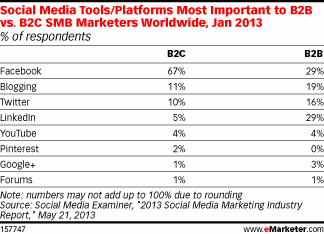
Social media has recently been the most rapidly growing channel which helps you get the much needed outreach whether it is B2C or B2B business.
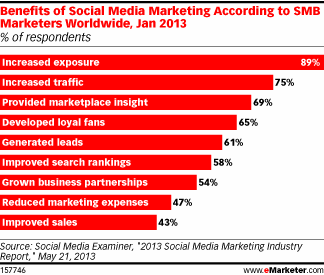
According to a recent eMarketer survey the statistics are as follows:
As we can see above, FaceBook and Blogging (Content Creation) are the 2 main social media platforms and the major benefits accruing from these platforms are increased exposure and increased traffic.
No brand can afford to neglect the social media presence as the benefits which can get accrued via social media are multifold and again are woven into each and every online marketing activity which any brand decides to opt for.
SEO is a necessity, social media is the channel and the content creation strategy determines your online brand identity.
As we can see above the benefits from social media mentioned above are interdependent and one benefit leads to another.
Social Media presence helps you to get increased exposure , this increased exposure increases the inbound traffic, the increased traffic and content on your site helps develop loyal fans which spreads a good WOM (Word Of Mouth) and generates leads, increase business partnerships and thereby increase sales. All the footprints and social signals created in the process give a boost to the SEO which in turn again generates all these benefits via search presence.
In theory this sounds very simple and logical but when put in practice a lot of effort, insight and an eye for defined goals is needed else all the time, money and effort can just go down the drain.
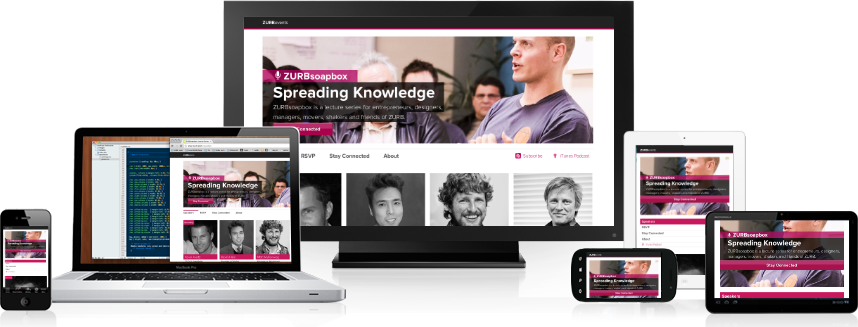
Responsive web design (RWD) is a web design approach aimed at crafting sites to provide an optimal viewing experience across a wide range of devices -from desktop computer monitors, tablets to mobile phones. Responsive web design is the latest web design trend of 2013 and becoming a standard practice for the web design industry .
A website developed using Responsive Web Design adapts the design of the page depending on the device it is going to be viewed. Hence, RWD uses fluid proportion based grids, flexible images and CSS3 media queries.
Why Is Responsive Web Design Becoming The Hottest Web Design Trend Of 2013 ?
The Forrester Research Mobile Advertising Forecast, 2013 To 2018 (US) predicts that mobile ad spend (smartphones plus tablets) will represent more than 29% of the total online ad spend in the US by 2018.
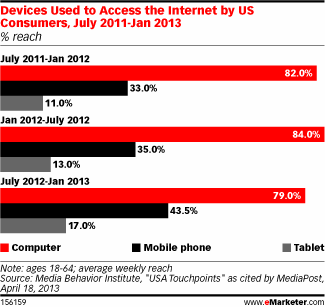
According to eMarketer the devices used to access the internet by US consumers from July 2011 to Jan 2013 were as follows:
As you can see the desktops use was reduced 3 %, the use of tablets increased by 6%, and the use of mobile phones increased by 10.5% which means an over all increase by 16.5% for hand held devices.
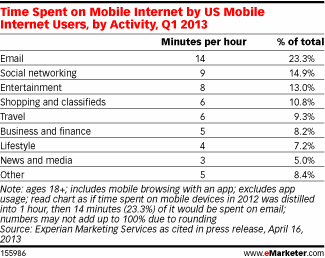
The time spent on Mobile Internet by US Mobile Users in the first quarter of 2013 by activity is as follows:
As we can see that email and social networking are at the top which directly is related to business hence as the smart phones become smarter and people become more dependent on them no company website can ignore responsive design in the coming future.
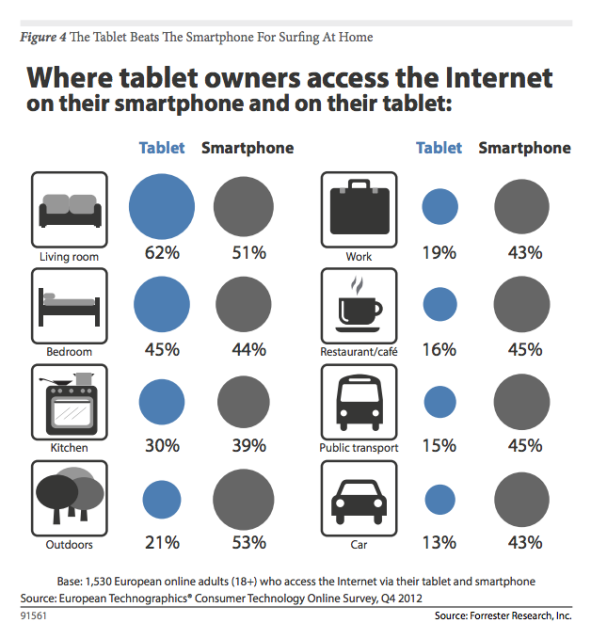
If the use of various devices by the user is increasing on a regular basis and the choice of the device depends on the place the user is surfing from, then surely the website has to get adapted to the device and display the right content according to the size of the display unit of the device.
According to Jeffrey Veen (The Vice President of products for Adobe):
According to - Jeremy Keith :
“Stop Thinking in Pages. Start Thinking in Systems”.
Jeremy Keith in the video on http://vimeo.com/50745034 explains some of the following points and much more:
Responsive Web Design And SEO: Does Google Support RWD?
Yes, Google supports Responsive Web Design
1. Google supports sites which use same URLs for different device specific layouts i.e the HTML is the same for every device but only the CSS changes as per the display required for the specific device.
2. Or, if the URLs remain the same but the HTML and the CSS change as per the user agent.
3. Or, have separate sites for mobile and web.
4. Be sure not to block the crawling of any Googlebot (i.e for the web or mobile) for the page assets (CSS, javascript, and images) using robots.txt or otherwise. Being able to access these external files fully will help Google algorithms detect your site's responsive web design configuration and treat it appropriately.
5. Googlebot and Googlebot-Mobile should should automatically be able to detect this setup while crawling the page assets like HTML, CSS, Javascript.
6. The Vary HTTP header helps Googlebot discover your mobile-optimized content faster, as a valid Vary HTTP header is one of the signals Google uses to crawl URLs that serve mobile-optimized content.
7. If the responsive design servers use different URLs for desktops and mobiles then on the desktop page, add a special link rel="alternate" tag pointing to the corresponding mobile URL. This helps Googlebot discover the location of your site's mobile pages.On the mobile page, add a link rel="canonical" tag pointing to the corresponding desktop URL.
8. This rel="canonical" tag on the mobile URL pointing to the desktop page is required to avoid duplicate content issues which have an adverse effect on the SEO.
9. Google supports the rel="alternate" annotation for the desktop pages in Sitemaps as follows but the required rel="canonical" tag on the mobile URL should still be added to the mobile page's HTML.
<?xml version="1.0" encoding="UTF-8"?>
<urlset xmlns="http://www.sitemaps.org/schemas/sitemap/0.9" xmlns:xhtml="http://www.w3.org/1999/xhtml">
<url>
<loc>http://www.example.com/page-1/</loc>
<xhtml:link rel="alternate" media="only screen and (max-width: 640px)" href="http://m.example.com/page-1" />
</url>
</urlset>
Is HTML5 The Right Choice For Responsive Web Design?
Matt Groener, Intel Developer Zone development team manager says:
Don’t you think it is high time to opt for Responsive Web Design and let your virtual presence flow to fit any device the user has?
What do you say?
Google launched the support for organization mark up as per schema.org . This mark up is for organization logos which is a way to connect a site with its iconic image.
For example, a business whose homepage is www.example.com can add the following markup using visible on-page elements on their homepage:
<div itemscope itemtype="http://schema.org/Organization">
<a itemprop="url" href="http://www.example.com/">Home</a>
<img itemprop="logo" src="http://www.example.com/logo.png" /> </div>
Markup like this is a strong signal to Google algorithms to show this image in preference over others, for example when we show Knowledge Graph on the right hand side based on users’ queries.
In fact lately I had observed many people adding the rel = “me” tag on static sites and by way of cross-linking their profile to their Google+ page the relevant image was getting displayed in SERPs.
This totally beats the purpose of the authorship mark up because in such cases I usually observed the site owner pics. which were getting displayed. As the publishership mark up did not get the green signal from Google this organization markup will surely help to keep a check on this and help the content to get correlated to the rightful authors which will in turn establish their thought leadership and of course the authority will also get passed on to the organization for which they write.
But the Rich Snippets Tool currently not displaying the logo in the preview although it detects the structured data on the URL tested.
Amit Singhal presented the future search experience which had a focus on the following 3 aspects of search:
He said, all this is possible due to the Knowledge graph which Google announced last year. Now Knowledge Graph is available in Polish, Turkish, Simplified Chinese and Traditional Chinese languages.
Google has updated its voice search feature with what it calls a "no-interface" approach for Chrome and Chrome OS.
Singhal revealed that there are now over five hundred and seventy million entities in the Knowledge Graph.
Singhal said, “Last year when we launched the Knowledge Graph, it was a huge advance in search technology. Knowledge graph enabled Google to move beyond keywords and understand real world entities.
The user can ask questions to Google like a friend and Google will answer back. This kind of verbal command is already being used by Google Glass and the command has to start with “OK Google....”
The conversational voice search and hot wording experience is soon coming on chrome and what is different is that Google says you’ll be able to continue the “conversation” to keep searching and it will understand where you are and when you ask how far is the airport from “here” then Google already knows without having you to say name of the place.
View the demo by Johanna Wright - VP Search And Assist Mobile at Google
Matt Cutts had been announcing on Twitter lately that there soon is going to be a major algorithmic update and yesterday the WebMaster video by him gave an idea about what to expect out of it in the near future.
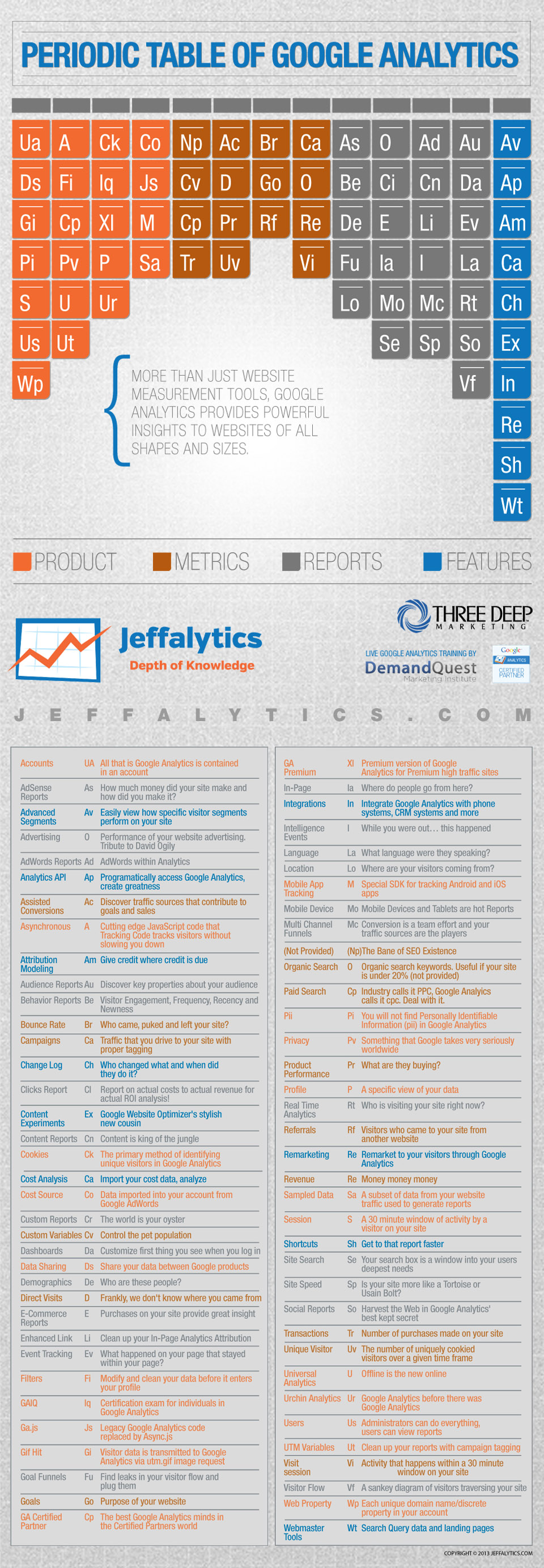
If you want a more scientific look at the Google Analytics , take a look at the Google Analytics Periodic Table created by Jeffalytics.
Courtesy of: Depth of Knowledge by Jeffalytics
The B2B Content Conversions Conference was held recently on 22nd and 23rd April 2013 - Times Center NYC. This conference presented key insights on how to manage the content lifecycle. The reputed speakers http://content2conversion.com/speakers/ shared their thoughts which were shared on Twitter - #B2BContentEvent .
![]() |
@jasonthibeault Jason Thibeault, Limelight Networks
Editorial Policy: Human Expertise, Enhanced by AIAt WebPro Technologies, our content reflects over two decades of experience in SEO and digital strategy. We believe that valuable content is built on accuracy, clarity, and insight—and that requires human judgment at every step.
From 2024 onwards, we have been using AI tools selectively to brainstorm ideas, explore perspectives, and refine language, but AI is never the final author. Every article is researched, fact-checked, and edited by our team, ensuring relevance, accuracy, and originality. AI supports our workflow, but the responsibility for quality and credibility remains entirely human.
This hybrid approach allows us to combine the efficiency of technology with the depth of human expertise, so our readers get content that is both informative and trustworthy.
At WebPro, we see AI not as a replacement for human creativity, but as a tool that helps us raise the standard of excellence in the content we share.

912, Anam 2, Ambli T Junction, BRTS Road, opp. McDonald’s, Ambli, Ahmedabad, Gujarat 380058 India
+91 9825025904
info@webpro.in
Daily: 9:00 am - 6:00 pm
Sunday: Closed
Copyright 2025 WebPro Technologies LLP © All Rights Reserved