SEO Audit Checklist 2017

SEO Audit Checklist 2017

Download PDF or Jpg

Embed the above image, using the following code:

amp-project

Understanding The Google AMP Cache

AMP is a way to build web pages for static content that render fast. Accelerated Mobile Pages (AMP) is an open content ecosystem which aims at giving the user a great reading and surfing experience.

Speed has always been the main quality criteria for Google as page load speed is the first impression that the user gets about the website.
The AMP ecosystem works entirely on the concept of caching. Hence, understanding the importance of the AMP cache is imperative for every SEO and online marketer who, advocate the implementation of AMP to their clients.

amp-project

AMP in action consists of three different parts:
• AMP HTML
• AMP JS
• Google AMP cache

AMP HTML

AMP HTML is a subset of HTML for authoring content pages such as news articles which helps improve UX by reducing the page load time.

AMP JS

To avoid the delay in page rendering AMP manages resource handling and asynchronous loading but third-party JavaScript is kept out of the critical path.

Google AMP Cache

The Google AMP Cache is a proxy-based content delivery network for delivering all valid AMP documents. It fetches AMP HTML pages, caches them, and improves page performance automatically.

What is a Cache server?

A cache server is a dedicated network server or service acting as a server that saves Web pages or other Internet content locally. By placing previously requested information in temporary storage, or cache, a cache server both speeds up access to data and reduces demand on an enterprise's bandwidth.

What is Google AMP Cache?

The Google AMP Cache is a cache of validated AMP documents published to the web. It is available for anyone to use. Google products, including Google Search, serve valid AMP documents and their resources from the cache to provide a fast user experience across the mobile web.

The concerns regarding AMP Cache are:

• The major concern for many is that their pages are served from a cached server which is out of their control.
• Many are also worried about the fact that the cached version served to the user may vary from the original version.
• Analytics attribution is another concern regarding AMP.

But, in fact there is no reason to worry about the AMP Cache delivery network.

• Every time the AMP content is served from the AMP Cache, the content is auto updated, and the updated version is served to the next user.
• The AMP cache uses the "stale-while-revalidate" model. It uses the original server caching headers, such as Max-Age, to judge the freshness of the content.
• The AMP cache model attributes the traffic to the publisher through the <amp-analytics> tag. The AMP supports a large number of analytics providers.
• When the AMP page is requested from the AMP cache, it is validated first. The page will not be served to the user if any problems are detected. Hence, it ensures quality pages are displayed on the user’s device.
• The main reason for a fast and user friendly experience is the pre-rendering feature. Due to pre-rendering the pages are served instantly.
• This is pre-rendering undoubtedly can be done from origin servers instead of the AMP cache but that uses up the bandwidth, CPU resources and battery of that server. This may affect the speed and contradict the main purpose of hosting AMP pages.
• The AMP cache also ensures security against XSS as in does not allow Cross-site scripting in the main document.
• Moreover, AMP is a win-win for users, publishers and advertisers. When you search on a search platform, the AMP pages as they come from the cache they do not associate the search term to it.
Optimizations, Modifications And HTML sanitization

The Google AMP Cache performs optimizations and modifications, such as the following:
• Validates if the content meets all the AMP norms.
• The AMP Cache along with the document caches images and fonts too.
• Optimizes image dimensions to prevent memory issues and poor responsiveness.
• The  amp-img tag removes the EXIF data and some metadata which can create issues or may be invisible.
• Converts GIF, PNG, and JPEG format images to WebP in browsers that support WebP.
• Serves over a secure channel (HTTPS) and uses the latest web protocols (SPDY, HTTP/2).
• In making the above transformations, the Google AMP Cache disregards the “Cache-Control: no-transform” header.
• All HTML comments are removed.
• Tag and attribute names are rewritten in lowercase.
• Attribute values are consistently quoted and escaped.
• All tags are closed, except for HTML5 void elements.
• Whitespace inside tags is removed.
• Text is escaped.
• Encoded text characters are simplified, using UTF-8 equivalent characters.
• Elements that can only be in the body get moved into the body.
• Outbound links are made absolute so that they continue to work when the document is served from the Google AMP Cache origin instead of the publisher origin.

The Google AMP cache not only ensures optimization of web pages but also validates them. Regarding Ads. Last year the Google AMP team laid out four core principles i.e speed, beauty, security and how to use all these 3 together.

If the AMP pages are being served from the cache then how will the ads be displayed?

The AMP Project announced the open source AMP for Ads initiative in July to work on the UX regarding ads on AMP pages. The initiative’s goal is to fix the foundation of digital advertising on the web, applying the principles of AMP to advertising and making ads faster, more beautiful and secure.

Since the announcement, AMP Ads have come a long way. Publishers across the world like The Washington Post, The Guardian, and USAToday have been testing AMP Ads experience for Publishers and users.

If the AMP pages are being served from the cache, then, what about the ads on the AMP pages?

There is still a long way to go and Google is yet exploring the use of AMP for ads.
According to Google, In the future:
• ads will be statically analyzable to be safe and behave well,
• they will be able to use a common set of functionality to significantly reduce bandwidth consumption,
• CPU usage will be limited to on-screen ads, maximizing battery life,
• and ads will be coordinated with the page making sure that primary content and functionality can always be buttery smooth at 60 frames per second.

Google says, we are trying to build a user-experience-first ecosystem for advertising on the web and, looking at the success of AMP in publishing, it might just work.

MobileApps

The Benefits of Combining Accelerated Mobile Pages (AMP) & Progressive Web Apps (PWA)

Google's core principle is: "Focus on the user and all else will follow." Page load time is a website's first impression for the user. That impression is directly correlated to the bounce rate of traffic to that website. User experience starts when the page loads and continues to be enriched with every tap or click. When each subsequent page loads like you are flipping a magazine, the user forms a positive impression of the whole experience of browsing that website. Undoubtedly, a seamless browsing experience leads to engaged users and results in more clicks, repeat visits, and more sales.

As traffic increasingly comes from mobile devices now, site speed is a crucial aspect of any website.

Google has been working on speeding up Google websites and has also been encouraging website owners to improve site speed with their latest developments: AMP and PWA. Both are different but can deliver amazing user experience when implemented together.

Accelerated Mobile Pages (AMP) are lightweight pages designed to load quickly on mobile devices. AMPs are served from the Google AMP Cache, which is a proxy-based content delivery network for delivering all valid AMP documents. It fetches AMP HTML pages, caches them, and improves page performance automatically.

AMP can ensure instant page load but cannot retain the same performance in case of complex functions like online payments and other dynamic functionality. That is where Progressive Web Apps (PWA) come to the rescue.

PWA adds the advantages of a native app to the website. PWA uses features like Service Workers, Push Notifications, and Web App Manifests.

What Is a Service Worker?

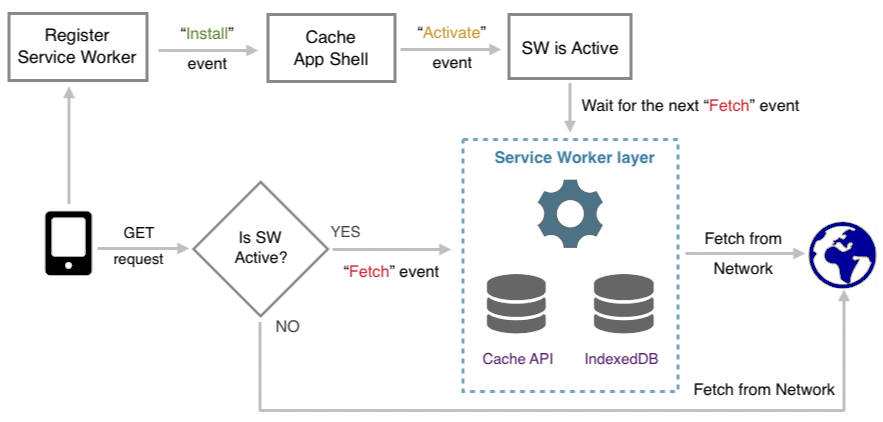
A Service Worker is a scriptable intermediate layer between the web page and the network. It is a script that the browser runs in the background, separate from a web page. It includes features like push notifications and background sync.

A Service Worker gives access to an API that provides a programmable network proxy within the client-side context. It makes it easier to create web applications that can handle network requests offline while browsing in varying network speeds. At times, an HTTP request is made but a response is not received on the mobile devices, which can happen when the user goes through a tunnel, or the network varies from 2G to 3G, or the user automatically joins a saturated WiFi network. The Service Worker allows developers to cache assets when connected and offers a seamless experience when offline so user experience is maintained.
Things to Note About a Service Worker

  •  A Service Worker is not HTML or XML. It is a JavaScript Worker.  Hence, the Service Worker does not access the DOM directly. The script communicates with the relevant pages by responding to messages sent by using the postMessage interface, and those pages can then access the DOM if required.
  • Service Worker is basically a proxy server which serves between apps, browsers, and the network when available. It allows you to control and handle network requests from the pages.
  • The Service Worker script does not run when not in use, and restarts when it’s next needed. Hence, you cannot rely on global state handlers. If there is information that you need to reuse on restart, service workers do have access to the IndexedDB API, which stores data inside the user’s browser.
  • Service Workers use Javascript Promises on a large scale. Technically, a Promise is a proxy for a value not necessarily known when the promise is created.
  • The browser needs to support Service Workers. Service Workers are supported by Firefox and Opera. Microsoft Edge is now showing public support.

Web App Manifests

The web app manifest is a JSON file. It is a simple text file which has the metadata for the app. This JSON allows you:

  • to control the look and feel of the app
  • to control how the app is launched
  • to display icons for the user home screen and splash screen which is displayed while the app is loading

When the app is launched, you can specify which page gets loaded as well as the screen orientation (portrait/landscape view).

Why Do We Need to Take PWA Seriously?

MobileAppsios-android

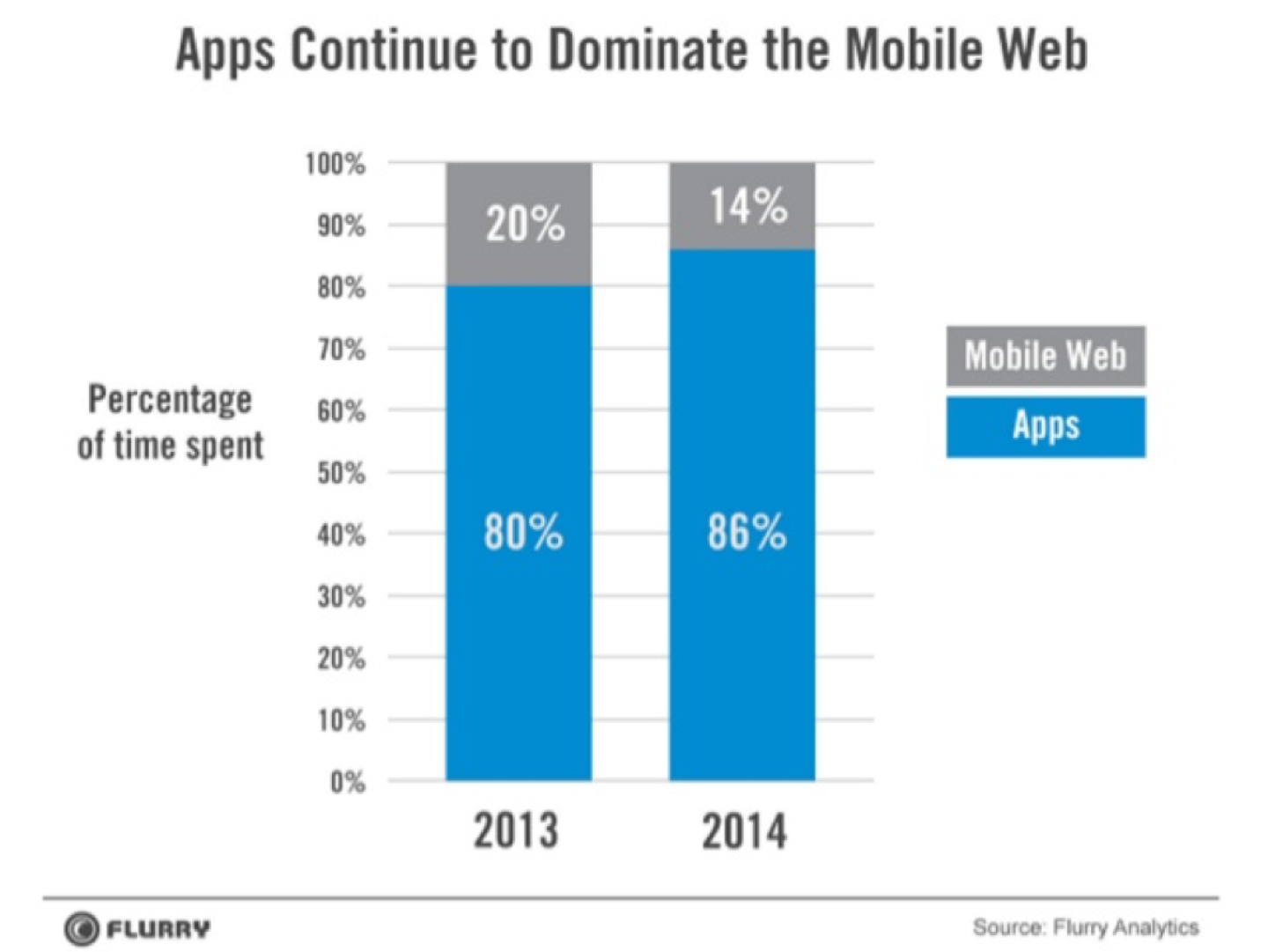
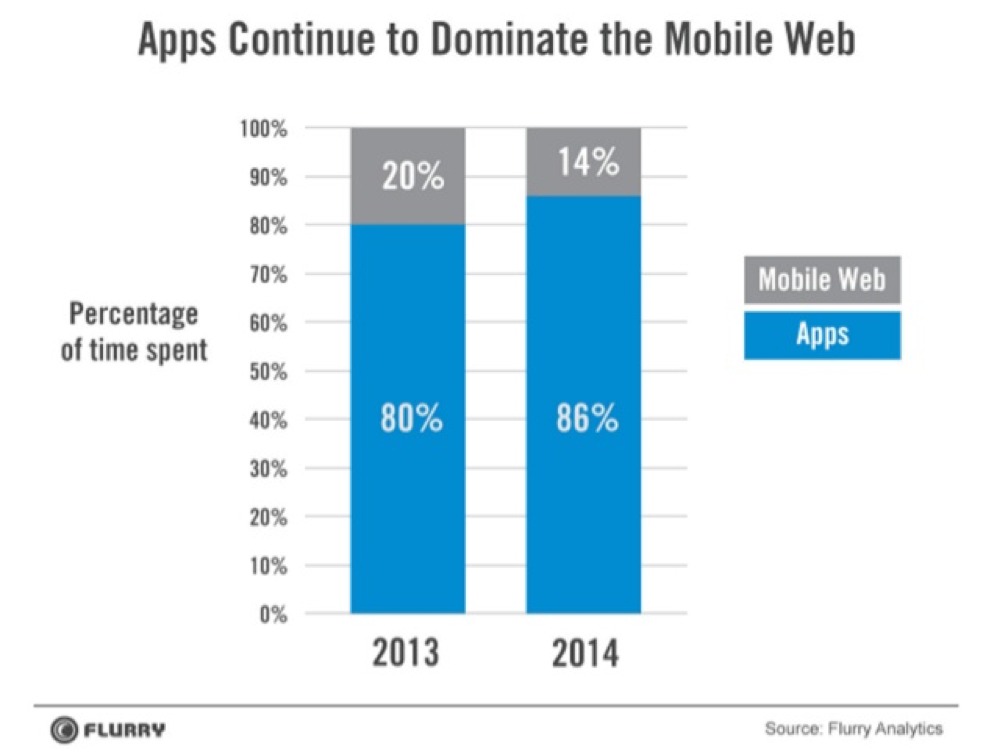
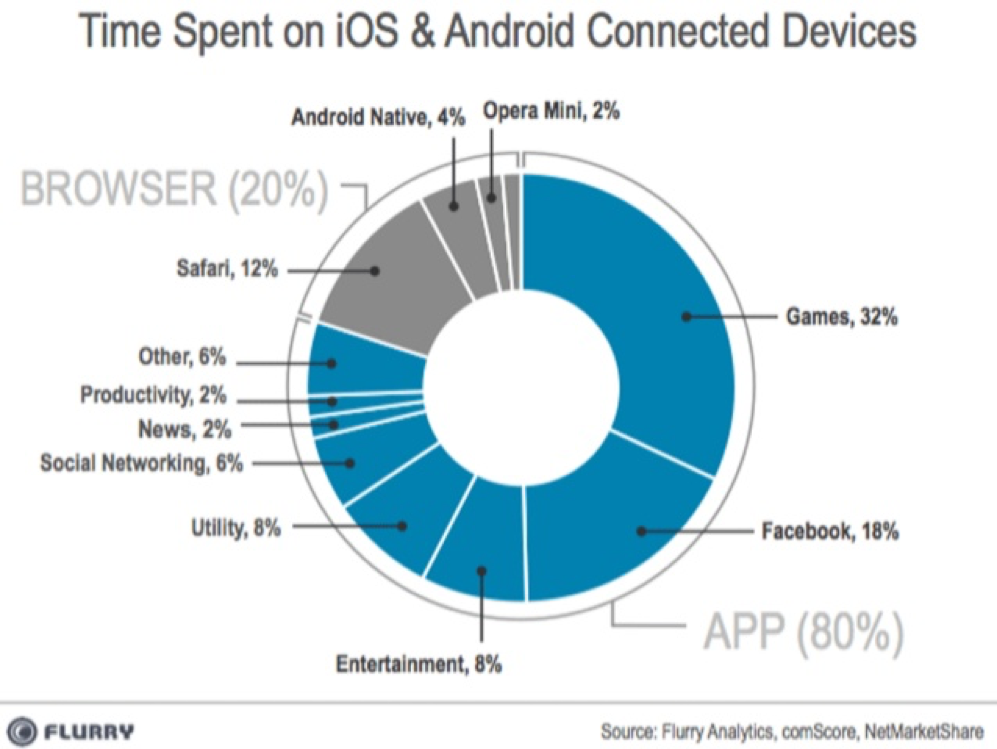
In 2013, according to Flurry Analytics, 80% of the mobile user’s time was spent inside apps and 20% on the mobile web.

  • With mobile devices becoming smarter, the time inside apps is surely going to increase.
  • The app needs to be installed on the mobile device which takes up a lot of storage space. PWA runs from the server leaving a lot of free space for the user on the mobile device.
  • According to a test, some native apps took up 460 MB of space whereas the PWA just needed 1 MB.
  • In the case of an app, the user needs to be notified to update it. The PWA lives on the server so there is no update distribution lag.
  • PWA can work offline.
  • PWA, being a website fortified with the benefits of an app, is linkable, searchable, and indexable.
  • flipkart.com had decided to discontinue their website and go app only, but that did not go well with the users. After their PWA named FlipKart Lite the statistics showed 40% returning visitors, +63 conversions from home screen visits, more time spent on FlipKart Lite. https://developers.google.com/web/showcase/2016/flipkart

The Mobile User Experience Journey From AMP to PWA

  • The Mobile user taps on the AMP search results and lands on the AMP page of your website.
  • The page loads instantly and the user starts reading the content.
  • The user taps on one the links on the AMP. This user gets navigated away from the AMP cache and is now served a page from the server.
  • The Service Worker script starts getting executed and an app-like experience is delivered to the user.
  • The user keeps reading the content as the script runs in the background and does not interfere with the user experience.
  • In fact, it enhances it by ensuring that the user is served the pages despite the network speed fluctuating. The user experience does not get affected in case the device switches to WiFi from Mobile Network or loses the internet connectivity for any reason. The PWA will further offer the option to the user to add the icon to the home screen just like a native app.
  • If the user adds the icon to the home screen, the user has access to app-like features and the website without installing the App.

Publications like the Washington Post have reported great success with  PWA and AMP. The two technologies complement each other: “AMP is a way to start fast, and PWA is a way to stay fast and stay engaged."

AMP helps in getting content to users faster by improving page load performance. PWA uses modern web capabilities to deliver an app-like user experience. AMP is like putting the website on a diet to give a lean display, whereas PWA is the necessary protein given to the website for a continuous robust performance. AMP helps in creating the first positive impression but PWA helps in retaining it.

Image Credits

Featured Image: https://events.google.com

In post Images: http://flurrymobile.tumblr.com/

SEO-2017

Seven Priorities For SEO 2017

SEO in 2017 is more technical than ever before. The SEO industry has reached an era where, the true identity and importance of SEO services has started being spelt out.

Search engine algorithms now are more sophisticated and can see thru spam more efficiently. So, if you are trying to manipulate the search results using old black hat techniques then you should quit the SEO industry immediately.

seo-2017

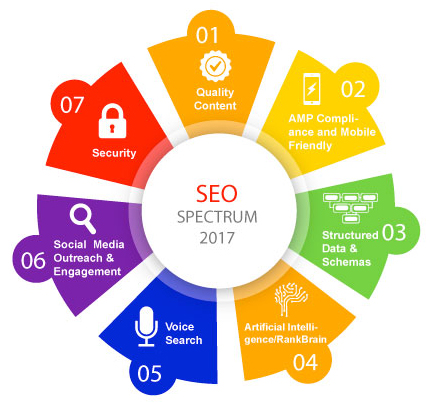
The array of seven entities which will create the SEO spectrum for 2017 are:

1. Quality Content:

We all have heard since long that, Content is “King”. Content will continue to reign supreme. As, without quality content, no web presence can serve any purpose. Only when the content is original, informative, compelling, it answers the user queries and also is in the right format, the users will be interested in reading or viewing it. SEO efforts can only help in improving the search presence of the content. But if the bounce rates are high and the content does not serve the purpose of the user then the bots are also going to push the content back in the search results.

2. AMP Compliance and Mobile Friendly:

AMP is an open source initiative by Google launched in October 2015. After working on the AMP Project and indexing AMP, Google has started showing AMP in search results since September 2016.

Accelerated Mobile Pages (AMP) are lightweight pages designed to load quickly on mobile devices. AMP-compliant pages use a subset of HTML with a few extensions. AMP improves the user experience by reducing the page load time by displaying the lighter version of the web page. If in case the website is not AMP compliant then having a responsive website is a must because mobile-friendliness is a ranking factor.

There are more number of mobile devices than the number of people in the world. Google soon is going to have a separate index for mobile which will be a primary one. If your website is not mobile-friendly or responsive and is neither AMP compliant then having a good mobile search presence is just not possible.

3. Structured Data And Schemas:

Structured data refers to kinds of data with a high level of organization, such as information in a relational database. When information is highly structured and predictable, search engines can more easily organize and display it in creative ways.

Structured data markup is a text-based organization of data that is included in a file and served from the web. It typically uses the schema.org vocabulary—an open community effort to promote standard structured data in a variety of online applications.

Structured Data on a web page can be provided by using:

JSON-LD is the recommended format. Google is in the process of adding JSON-LD support for all markup-powered features. By adding structured data you are adding meaning and relevance to it for the search engines to correlate better.

Google also encourages the use of structured data by giving information regarding it in Search Console and by offering a structured data testing tool.

The Semantic Web isn’t just about putting data on the web. It is about making links, so that a person or machine can explore the web of data. With linked data, when you have some of it, you can find other, related, data. Semantics or Structured Data add extra information to help you with the meaning of the information. Web sites using Schemas will be able to get more correlated to the contextual content.

seo-spectrum-2017


4. Artificial Intelligence/RankBrain:

RankBrain by Google, the machine-learning artificial intelligence system is a software which is integrated into the algorithm to mathematically connect words and phrases. RankBrain uses artificial intelligence to embed vast amounts of written language into mathematical entities — called vectors — that the computer can understand.

When a search takes place on Google, the search query now gets accessed by the RankBrain program/software to deliver more relevant search results. Especially if the query is a rare one.

By making the query accessible to software (RankBrain), the software will essentially become able to understand knowledge, think about knowledge via mathematical computations using word and phrase vectors, and create new knowledge. In other words, the software will be able to be more intelligent – not as intelligent as humans perhaps, but more intelligent than say, the word to word mapping is today. Especially for rare queries which need to be understood to deliver results.

For quality search results, Google wants to move away from word to word mapping and reach a level of, understanding the meaning behind the search query. Algorithms today are getting tuned to understand the intent of the user and display results which will be more useful for the user to take decisions or will give him more detailed information about the topic he is searching.

5. Voice Search:

Voice search is the next big frontier which needs to be given importance. The Mobile Voice Study by the Mountain View, CA, a provider of search, online advertising technologies and other Internet products and services found that 55 percent of teens aged 13-18 use voice search every day, while 56 percent of adults said using voice search makes them feel tech-savvy. Voice search is not about rankings or listings but being a part of the conversation.

As we can see that people prefer the video content more than text content when browsing from smartphones and mobile devices. The trend is moving to viewing content and to other formats which save time. Voice search avoids the hassle of keying in the query which is going to be a next big search revolution.

Google Webmaster Trends Analyst John Mueller said in a Google hangout, at the 23-minute mark, that Google is looking for ways to show webmasters in the Google Search Console how people are finding their pages through voice search. 2017 is the time to prepare for the voice search scenario.

6. Social  Media Outreach & Engagement.

Social Media is a platform which is here to stay. The social media sites may gain or lose preference but people surely check the social media accounts to get an idea about the company approach towards its customers.

Search and Social integration will only become stronger by the day and search algorithms will also be smart to filter social spam. Social Media platforms also are working on making their search functionality stronger. Hence, if the user goes to search and then reaches the social media accounts for further information or the user goes to social media accounts and the uses its search/search engines for more details is not imperative. But, having a social media presence is a must for putting your best foot forward and your voice heard.

7. Security

It's been two years since Google started its active campaign for Web security and announced HTTP to be a ranking factor.

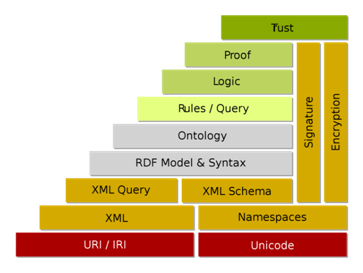
‘Trust’ is the icing of the multi layer semantic cake and signature and encryption as the two main structures.  Ensuring security for the user  can make the website trust worthy for the user.

semantic-layer

Secure sites generate a better CTR and users feel more confident in sharing personal data. eCommerce sites with payment gateways cannot underestimate the importance of having a secure site.

Security is a top priority for Google. Google also gives a ranking boost to HTTPS/SSL sites, provided the site has quality content. Security of a site influences the trust factor. But, moving from HTTP to HTTPS has a series of SEO repercussions which need to be kept in mind.

Just as white light consists of a collection of colors, white hat SEO in 2017 will be the  result of the correct implementation of the above mentioned points.

SEO services are becoming niche and are getting a definite meaning and form eventually. Finally, the much-awaited era for genuine SEO is in the offing.

SEL_Logo

A Humble Request to Search Engine Land Editors

If you are passionate about SEO then www.searchengineland.com  has to be on your priority list for latest search updates. Hence, being passionate about SEO and the search industry, I have been an avid reader of the searchenginland.com content. After the official  Google Webmaster’s blog https://webmasters.googleblog.com/  the SEL blog is one of the most trusted and reliable sources for any SEO updates.

After my humble experience in this field, I have been a contributor to some reputed blogs like SEJ, SEW, MOZ, Level343 and of course my company blog. The Author profile links are as follows:

https://www.searchenginejournal.com/author/bharati-ahuja/

https://searchenginewatch.com/author/bharati-ahuja/

https://moz.com/community/users/170771?170771

http://level343.com/?s=bharati+ahuja&lang=en

https://www.webpro.in/blog/

I thank all the editors of these blogs for accepting my articles and publishing them. As 'guest posting' is a matter of great importance to every SEO, I would like to bring this to your notice. I do understand and respect the fact that, to accept or reject a post is entirely the prerogative of the editor and I surely respect that. I think all authors must have at times faced the dejection of their article being rejected. It is all part of the game.

But, the most frustrating point is when you send a post as per the procedure mentioned on the site you want to contribute to, and:

  • You do not get any reply for more than 3 weeks
  • You don’t know if the post has been received or not
  • You do not have any idea if the post is under review or has been rejected

yesno

I have experienced this with SEL. I would like to bring to your notice that a lot of effort, time and resources are spent on writing a post. Especially for a reputed blog like yours, as every contributor would like to put their best foot forward. Hence if we get a timely reply for acceptance/rejection of the post, it would be very helpful. We can at least publish it on some other platform. I say timely response because as you know that due to the ever evolving nature of the SEO industry the post can be of less or no relevance if the publishing is delayed. This results in a sheer waste of valuable time and effort spent on writing that post.

I have also been communicating on Twitter and thanks for the replies but it does not lead to any definite answers.

https://twitter.com/sengineland/status/803287201681436672

As you mentioned in the Twitter conversation, you surely must be receiving many posts and it must be a challenging task to reply to all but I suggest that you at least mention the status (under review/rejected)  of the post in some way. Or, mention that if the contributor does not receive a reply in a specific time he/she should assume that the post is rejected and will not be published.

I am sure every well written, in-depth post, when published, is a mutually beneficial proposition for the writer as well as the blog on which it gets published.

Last but not the least, "Wishing A Merry Christmas & Happy Holidays" to everyone at Search Engine Land.

card1

Rich Cards Enriched with Local Restaurants and Online Courses Verticals

In May 2016 Google announced a new search result format “Rich Cards”  for 2 categories,  i.e  Recipes and Movies. The Rich Cards used schema.org structured mark up, just like the Rich Snippets format. Yesterday, Google announced  that they are expanding it to two new verticals for US-based sites: Local restaurants and Online courses.

card2card1

  Google has added: By building Rich Cards, you have a new opportunity to attract more engaged users to your page. Users can swipe through restaurant recommendations from sites like TripAdvisor, Thrillist, Time Out, Eater, and 10Best. In addition to food, users can browse through courses from sites like Coursera, LinkedIn Learning, EdX, Harvard, Udacity, FutureLearn, Edureka, Open University, Udemy, Canvas Network, and NPTEL. AMP HTML is not required for Local restaurant pages and Online Courses rich cards. But, Google recommends that you create AMP pages to further engage users. Users consuming AMP’d content will be able to swipe near instantly from restaurant to restaurant or from recipe to recipe within your site. Users who tap on your Rich Card will be taken near instantly to your AMP page, and be able to swipe between pages within your site. Google is soon moving to add Rich Cards to other  verticals too .
AMP-Preview-Results

How To Add Google Analytics To AMP Pages

AMP Pages are the future for mobile search results. Google has announced recently that they will be removing “mobile-friendly” labels from search results and they also announced that they are testing to show AMP pages with a AMP icon  in the search results.

AMP-Preview-Results

Hence, soon the AMP pages will move out from the Top Stories section and will be a part of the SERPs. Considering how the mobile usage is exponentially increasing ,  making your site AMP compliant and tracking its performance is a necessity.

In order to add Google analytics to the AMP Pages,  include the following script in the <head>, before the AMP JS library:

<script async custom-element="amp-analytics"
    src="//cdn.ampproject.org/v0/amp-analytics-0.1.js"></script>

Add the amp-analytics element to the body of your page. Then to enable the built-in support for Google Analytics, set the type attribute of the amp-analytics element to 'googleanalytics'. It is recommended to include an id attribute so that you can easily identify each amp-analytics element (e.g. debugging).

<amp-analytics type="googleanalytics" id="analytics1">
  ...
</amp-analytics>
Note: It is recommended that you set up and use a separate property for AMP measurement.

Some other vendors offering Analytics For AMP Pages are:

  1. Adobe Analytics - marketing.adobe.com
  2. AFS Analytics  - afsanalytics.com
  3. AT Internet  - developers.atinternet-solutions.com
  4. Chartbeat - support.chartbeat.com
  5. Clicky Web Analytics - clicky.com
  6. Cxense -  wiki.cxense.com
  7. Google Analytics -  developers.google.com
  8. INFOnline / IVW -  www.infonline.de
  9. Krux -  help.krux.com
  10. Linkpulse -  docs.linkpulse.com
  11. Lotame -  mylotame.force.com
  12. mParticle - docs.mparticle.com
  13. Parsely -  parsely.com/docs
  14. Piano -  vx.piano.io
  15. Quantcast Measurement -  quantcast.com

Validation

To check if the analytics code is correctly added one can validate the AMP pages  on https://validator.ampproject.org/


Related Posts On AMP:

What Is AMP? All About Accelerated Mobile Pages By Google

intusive-content

Google To Remove Mobile-Friendly Labels and Keep Check On Interstitials For A Better Mobile Search Experience

Google recently announced on their blog that they will soon remove the “Mobile-Friendly” labels from search results.

Google said that they have found that 85% of all pages in the mobile search results now meet this criteria and show the mobile-friendly label.

This does not mean that mobile-friendly criteria is not a ranking signal. It will continue to be a ranking signal but the label will be removed from search results to keep the search results uncluttered. Google will continue providing the mobile usability report in Search Console and the mobile-friendly test to help webmasters evaluate the effect of the mobile-friendly signal on their pages.

Google also added:

“To improve the mobile search experience, after January 10, 2017, pages where content is not easily accessible to a user on the transition from the mobile search results may not rank as highly.”

Pages that show intrusive interstitials provide a poorer experience to users than other pages where content is immediately accessible. This can be problematic on mobile devices where screens are often smaller.

Here are some examples of techniques that make content less accessible to a user:

  • Showing a popup that covers the main content, either immediately after the user navigates to a page from the search results, or while they are looking through the page.
  • Displaying a standalone interstitial that the user has to dismiss before accessing the main content.
  • Using a layout where the above-the-fold portion of the page appears similar to a standalone interstitial, but the original content has been inlined underneath the fold.

Examples of interstitials that make content less accessible

Examples of interstitials that make content less accessible

By contrast, here are some examples of techniques that, used responsibly, would not be affected by the new signal:

  • Interstitials that appear to be in response to a legal obligation, such as for cookie usage or for age verification.
  • Login dialogs on sites where content is not publicly indexable. For example, this would include private content such as email or unindexable content that is behind a paywall.
  • Banners that use a reasonable amount of screen space and are easily dismissible. For example, the app install banners provided by Safari and Chrome are examples of banners that use a reasonable amount of screen space.

Examples of interstitials that would not be affected by the new signal, if used responsibly

Examples of interstitials that would not be affected

ad-blocking-and-SEO

With Ad Blocking On The Rise and The Mobile Web Expanding, SEO Becomes More Important Than Ever Before

Marketing Land published an article recently stating, “33 percent of internet users will be ad blocking by next year”. They also shared the following details :
  • Forecaster eMarketer estimates that this year, 70 million people in the US will use ad blockers, representing growth of nearly 35 percent year over year.  Next year, the company estimates that nearly 87 million internet users in the US will be blocking ads.
  • PageFair released a mobile ad-blocking report indicating that 419 million people around the globe were blocking ads on mobile devices. The majority were located in Asia, fewer in North America and Europe.
  • According to online polling firm CivicScience, 55 percent of survey respondents had ad blockers on their PCs, and 25 percent had them on their smartphones.  
The ads are being blocked but the use of search engines is no way on the decline. ad blocking and SEO   As the no. of online users go on increasing multi fold every minute the need for every business to have a quality web presence across all types of devices being used becomes all the  more a priority and a necessity and not an option. According to additional statistics:
  • Around 40% of the world population has an internet connection today.
  • In 1995, it was less than 1%.
  • The number of internet users has increased tenfold from 1999 to 2013.
  • Today there are more than 3 billion people online.
  • Mobile access to the Internet will be instrumental in bringing the next billion people online.
In today's digital world, we are all living our lives on multiple screens. With affordable devices and easy data plans mobile usage has grown exponentially, almost to the point where it is becoming increasingly clear that people are now using their mobile devices for doing everything they would previously do on a desktop. In fact, Internet searches on smart phone now exceed desktop searches. The mobile Internet does not just liberate us from the constraints of a wired connection, but it offers hundreds of millions around the world their only, or primary, means of accessing the Internet. Second, the mobile Internet does not just extend the reach of the Internet as used on fixed connections, but it offers new functionality in combination with new portable smart devices. The rapid increase in mobile usage has changed the way users look for information on the Internet — to buy or to interact with brands before making their purchase decisions. Here are some stats that show why businesses can no longer afford to treat mobile as an afterthought:
  •  80% of internet users today own a smart phone.(Global Web Index)
  • In the past two years, the number of consumers that consider mobile as their preferred device for researching products on the Internet has jumped from 25% to 53%. (Marketing Week)
  • 16 to 24 year olds spend an average of 3.25+ hours per day online on a mobile.(Global Web Index via Heidi Cohen)
For business owners and marketers in India, it’s time to pay more attention to mobile because:
  •  85% of India’s digital population access the Internet via mobile
  • Average mobile time doubled to 3 hours per day in 2015 from 1.5 hours per day in 2012.
  • In India, mobile contributes to 60% share of all shopping related queries and
    over 50% of all travel related queries.(Google India Report via Economic Times)
Marketers must identify these different patterns of user behavior to be able to boost their chances of attracting their target audience and converting a sale. From this standpoint, it’s critical for them to understand and stay current with ‘mobile search’ trends. Mobile using customers are typically more impatient, and even unforgiving, when it comes to website load times. According to some stats shared by Mobile Marketing Engine:
  • Over 70% of mobile consumers expect web pages to load almost as quickly or faster, as they do on their PC.
  • 74% of them will only wait for 5 seconds or less for a website to load on their device.
  • 46% of them will probably never return to a website if it didn’t load properly on their first try.
Without a fast-loading website, you’re at a greater risk of losing customers to your competitors. With the change in the user behavior, the search engines too are working on the search experience for the mobile web users . To improve the performance of the mobile web and to aid the creation of fast-loading mobile web pages, Google launched an open source initiative called Accelerated Mobile Pages (AMP) in October 2015. Search  at Google  I/O 2016  too was Dominated By Updates On Mobile Search, App Indexing  And Structured Data. Google-io-2016 Google I/O 2016 discussed:
  1. Introduction of  rich cards
  2. New Search Console reports
  3. Real-time indexing
  4. Getting up to speed with Accelerated Mobile Pages
  5. A new and improved Structured Data Testing Tool
  6. App Indexing got a new home (and new features)
  7. App streaming
At the Google AMA talk at SMX Advanced this year, Gary Illyes the  Standup Trends Analyst at Google (@methode)  gave the audience two things regarding the mobile web. danny-sullivan-gary-illyes-smx-advanced-1920-768x432
  • He said that AMP is going to be big, and SEOs and webmasters should think now about getting ready for AMP.
  • He also said, Currently, Google’s search results for desktop and mobile use the same index and almost all of the same ranking signals. Google is looking to separate some of them out. Google has told us in the past that they are experimenting with this, and Google is clearly still working on a mobile-only index.
All this proves that with the increase in the mobile traffic the focus needs to be on the mobile search presence. As the maximum ad blocking comes from mobile devices. As the paid media is facing a setback due to ad blocking, the focus needs to be on the earned presence and the owned presence. If the site is optimized well and the business has a good interactive social media presence it surely is not only going to help in reaching out to the targeted audience but also help in contributing to the trust factor. But, all this is easier said than done. One needs to have the right approach, patience and a long term strategy to achieve the goal of being found for the right searches. We need to keep in mind that the search engines started with a purpose of giving genuine organic results and not paid results. If any search engine focuses on paid search only it will be deemed as a paid directory and be abandoned. The web has witnessed the decline of many directories over the past decade. The psychological factor also hints that the users trust the organic search results more than the paid results. The future belongs to a platform where unbiased genuine results will be served to the user for whatever searches he makes. The Power Lies In The Hands  Of The People (The User) In Co Relation To Search And The WWW. The search engines too gear and navigate their development efforts according to the peoples demand, likes and dislikes and changing search behavior . Hence, as a business owner currently one needs to focus on:
  •  An extremely user friendly website
  • Optimize it for search engines
  • Upload regular, relevant and fresh content
  • Have an interactive, engaging social media presence
  • Focus on the mobile presence by having a responsive website or/and a Mobile App. Depending on the need, purpose and the target audience.
  • AMP is just at the initial stages but, now is the time to prepare for the future.
As Bill Gates has rightly said,:

 “WE ALWAYS OVERESTIMATE THE CHANGE THAT WILL OCCUR IN THE NEXT TWO YEARS AND UNDERESTIMATE THE CHANGE THAT WILL OCCUR IN THE NEXT TEN. DON’T LET YOURSELF BE LULLED INTO INACTION”

The importance of SEO can never be ignored. Whenever, someone on the web mentions ‘SEO IS DEAD’, it comes back to life with more vigor and vitality. In fact, with the expansion of the mobile web, SEO has got more extended and more technical. As the search algorithms get more sophisticated, the SEO deliverables too get more technical.  As  SEO now needs to focus more on speed, privacy, security, app challenges like giving the user a seamless experience from being navigated from the app to the website and back.
yoga-and-SEO

How SEO Is Like Yoga for Your Website. Happy International Yoga day !

The first International Day of Yoga was observed world over on June 21st 2015 by PM Narendra Modi. The United Nations has declared June 21st as the International Day Of Yoga. On this occasion I just thought of listing out the similarities between Yoga and SEO. 

Yoga is not about exercise but to find out the sense of individuality within one’s self, the world and the nature. Similarly, SEO is not about rankings but about establishing your brand online

In Vedic Sanskrit, yoga means "to add", "to join", "to unite", or "to attach" in its most common literal sense. Yoga can take on meanings such as "connection", "contact", "union", "method", "application", "addition" and "performance". In simpler words, Yoga also means "combined".

When we optimize a website we literally try to see that our website gets correlated to the targeted search queries and thereby the targeted audience. But, before this happens the site has to be as per the norms of the search engines and needs to be crawled and indexed regularly by the search engines. All this has to be achieved harmoniously via a step by step process .

yoga and SEO

Just as in Yoga the union of the body and soul is achieved gradually with regular practice and patience, the SEO results need patience and regular monitoring of the website.

According to David Gordon White, from the 5th century CE onward, the core principles of "yoga" were more or less in place, and variations of these principles developed in various forms over time:

  1. Yoga, as an analysis of perception and cognition
  2. Yoga, as the rising and expansion of consciousness
  3. Yoga, as a path to omniscience
  4. Yoga, as a technique for entering into other bodies, generating multiple bodies, and the attainment of other supernatural accomplishments

 SEO also can be compared to Yoga as per the above 4 points:

  1. SEO helps the search engines in the perception and cognition of the content of the website so that it can correlate it to the  relevant  search queries.
  2. As a result of genuine SEO the website gradually expands its search presence by adding various formats of content so that the brand can be found on various platforms of search, like image search, blog search, videos, etc.
  3. Hence, genuine SEO helps the website to be found on search engines via any devices and in various formats.
  4. Apart from the content format and the type of search results, SEO also makes the website capable of being found globally by gradually attaining search presence on increasing no. of country domains like, Google.com, Google.co.in, Google.co.uk, Google.com.au, etc. (In short international SEO helps you to achieve international search presence)

Apart from the spiritual goals, the physical postures of yoga are used to alleviate health problems, reduce stress and make the spine supple in contemporary times. Yoga is also used as a complete exercise program and physical therapy routine.

The three prominent types of yoga are:

  • Karma yoga: The yoga of action
  • Bhakti yoga: The yoga of devotion
  • Jnana yoga: The yoga of knowledge

Apart from attaining good search presence for targeted search queries, the main goal of SEO is to help build a brand for the business , win the trust of the users and help in retaining it for a long time.

All this can be possible by working on :

  • On-page factors
  • Technical factors and
  • Off-page factors

While the practice of yoga continues to rise in contemporary American culture, sufficient and adequate knowledge of the practice’s origins does not. According to Andrea R. Jain, Yoga is undoubtedly a movement for spiritual meditation, but  now is being marketed as a supplement to a cardio routine. This scope "dilutes its identity." Contemporaries of this faith argue that the more popular yoga gets, the less concerned people become about its origins in history.

While the SEO industry shows a promising growth quantitatively and qualitatively, the true meaning of SEO is tarnished by black hat SEOs and newbies who promise quick results and measure its success by rankings alone. This dilutes the true meaning of SEO and defeats the main purpose of optimizing a site.

Yoga  is both an Art and a Science... 

SEO too is considered as an Art and a Science...

editorial-policy-WebPro-Technologies-LLP-Ahmedabad

Editorial Policy: Human Expertise, Enhanced by AI

At WebPro Technologies, our content reflects over two decades of experience in SEO and digital strategy. We believe that valuable content is built on accuracy, clarity, and insight—and that requires human judgment at every step.

From 2024 onwards, we have been using AI tools selectively to brainstorm ideas, explore perspectives, and refine language, but AI is never the final author. Every article is researched, fact-checked, and edited by our team, ensuring relevance, accuracy, and originality. AI supports our workflow, but the responsibility for quality and credibility remains entirely human.

This hybrid approach allows us to combine the efficiency of technology with the depth of human expertise, so our readers get content that is both informative and trustworthy.

At WebPro, we see AI not as a replacement for human creativity, but as a tool that helps us raise the standard of excellence in the content we share.

SEO Ahmedabad

Contact Info

802, Astron Tech Park, Satellite Road, Opp. Gulmohar Park Mall, Ahmedabad 380015, India

+91 9825025904
info@webpro.in

Daily: 9:00 am - 6:00 pm
Sunday: Closed

Copyright 2025 WebPro Technologies LLP ©  All Rights Reserved