Questions Website Owners Should Ask Their SEO To Determine The Success Of The SEO Campaign

It is 2015 and SEO is very much alive and in fact according to my opinion is gaining its true existence and importance like never before.

But, even today when website owners want to evaluate the success of an SEO campaign, they first check the rankings and many times only the rankings.

This has always been a myopic view of the SEO results and now with the current scenario its all the more short sighted and does not give the true picture. Focusing on the larger picture especially in the first 2 years of the SEO campaign is more important.

When I say larger picture, I mean the other parameters which need to be monitored in the initial stages of the SEO campaign.

First let us list the stages in the SEO campaign.
• SEO Audit (on-page and off-page)
• Corrective actions taken on the audit results
• Working on the Local Search presence
• Monitoring the results of the actions taken via WMT and GA

Once the action has been taken on all the factors or while the SEO efforts are in progress the focus should be on how the content is getting correlated to the search queries targeted. Google has got certain parameters in GA and GWMT which give a correct idea.
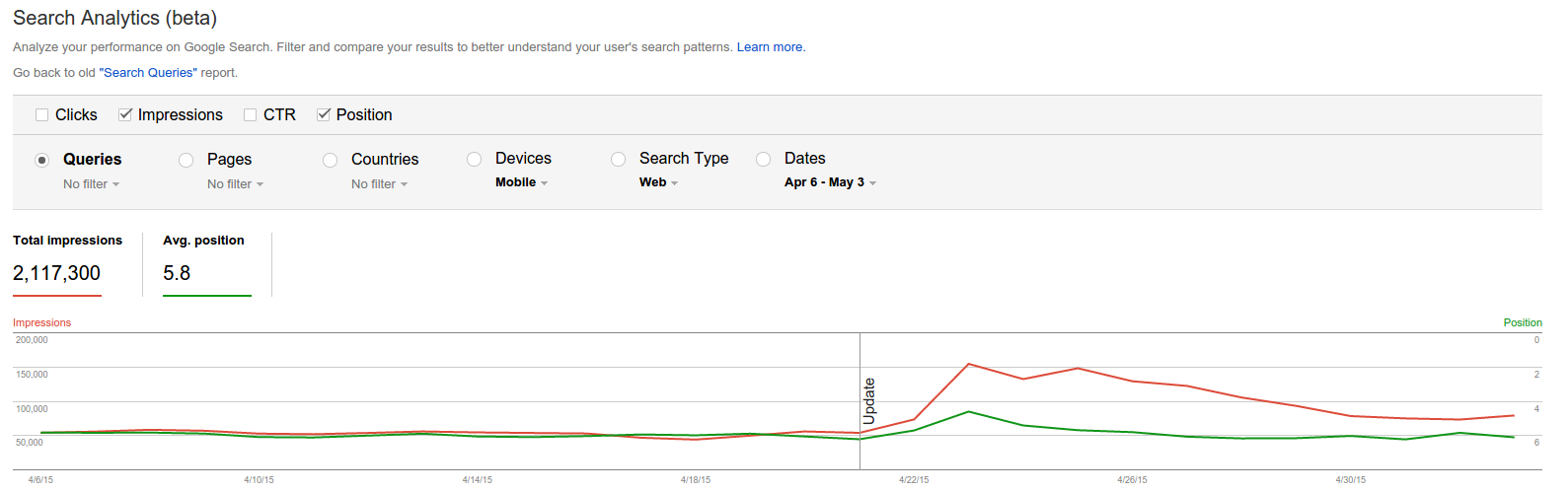
Recently Google has introduced a detailed Search Analytics Report in GWMT which gives an in-depth idea about these parameters.

Starting with a SEO campaign is like sowing a seed. One needs to nurture it with corrective on-page factors and enrich it with regular informative content to make the search presence grow.

When you sow a seed you do not expect it to be a full-fledged tree in a short duration but you nurture it till it is growing and also protect it once it is fully grown.

Data from Search Analytics OF GWMT and Search Engine Optimization metrics of GA should be tracked to get an idea about the success of the SEO effort put in.
Rankings and a good search presence with a good outreach is the long term goal for SEO. But during the initial stages of the SEO campaign one has to see how closer we are to the goal each day rather than checking if we have reached the goal.

Hence the Search Analytics data , other data from the WMTs and the Search Engine Optimization data helps us measure and monitor how efficiently we are marching ahead towards our goal.

There are some differences between Search Analytics and Search Queries. Data in the Search Analytics report is much more accurate than data in the older Search Queries report, and it is calculated differently.

Search Analytics In Google webmaster Tools

The Search Analytics Report shows :

• How often your site appears in Google search results.
• See how your search traffic changes over time, where it’s coming from, and what search queries are most likely to show your site.
• Learn which queries are made on smartphones, and use this to improve your mobile targeting.
• See which pages have the highest (and lowest) click-through rate from Google search results.

The following metrics are available in the Search Analytics Report :

• Clicks - Count of clicks from a Google search results page that landed the user on your property.
• Impressions - How many links to your site a user saw on Google search results, even if the link was not scrolled into view. However, if a user views only page 1 and the link is on page 2, the impression is not counted.
• CTR - Click-through rate: the click count divided by the impression count.
• Position - The average position of the topmost result from your site. So, for example, if your site has three results at positions 2, 4, and 6, the position is reported as 2. If a second query returned results at positions 3, 5, and 9, your average position would be (2 + 3)/2 = 2.5.

Grouping your data

This data are grouped in the table by selecting a grouping category at the top of the report; for example, choose "Queries" to group data by search query terms, or "Pages" to group by the canonical page returned by search results.

Group by query

Group results by query strings that users searched for on Google. Only searches that returned your site will be included. Very rare queries are not shown in these results to protect the privacy of the user making the query.
Common uses:
• Review the Query list for expected keywords. If keywords that you expect to see don't appear, your site might not have enough useful content relevant to those keywords. If unexpected words (like "Viagra" or "casino") appear, it's likely that your site has been hacked.
• Find queries with high impressions and low CTR. These queries can help identify where you can improve your content to satisfy your user’s interests.

Group by page

Group results by individual page on your property that were returned by search results. Grouping by page can change the metric calculation for CTR, impressions, and clicks.

Group by country

Group results by the country where the search came from; for example, Canada or Mexico.

Group by device

Group results by the device making the search; for example, desktop, tablet, or mobile. If you have separate mobile and desktop sites, for example m.example.com and www.example.com, the metrics for each site will be reported separately in Search Analytics. If you don't have a separate mobile version of your website—for example, you dynamically detect the user agent and adjust the site layout accordingly in a single site—you must group by device to compare the clicks and impressions you get from mobile devices compared to clicks and impressions from desktop users.

Group by date

Shows a graph of your selected metrics over the selected time span. Default time span is four weeks. The data table is not shown when grouping by date.

The Search Engine Optimization reports in Google Analytics use four metrics specific to Google Web Search data:

  • Impressions -the number of times any URL from your site appeared in search results viewed by a user, not including paid AdWords search impressions
  • Clicks—the number of clicks on your website URLs from a Google Search results page, not including clicks on paid AdWords search results
  • Average Position—the average ranking of your website URLs for the query or queries. For example, if your site's URL appeared at position 3 for one query and position 7 for another query, the average position would be 5 ((3+7)/2).
  • CTR—clickthrough rate, calculated as Clicks / Impressions * 100
    The SEO Geographical Summary Report
  • The Geographical Summary report provides a general view of Impressions, Clicks, and CTR by country.

At a glance, you can see which countries are generating the most search activity for your site on Google search. You can also selectGoogle Property as a primary dimension to see a breakdown of search activity on Google search by the following:
• Web search
• Mobile search
• Video search
• Image search

The SEO Queries Report

The Queries report shows the Google search queries that generated the most impressions for your website URLs. You can sort by other columns—such as clicks—to order queries in descending/ascending rank by those metrics.

By using this report, you can identify search queries for which your site has a good average position, but poor click through rates. These are queries for which your pages get attention, so improved content could lead to more traffic.

The SEO Landing Pages Report

The Landing Pages report shows the URLs to your website that have generated the most impressions in Google Web search results. With this report, you can identify landing pages on your site that have good click through rates (CTR), but have poor average positions in search results. These could be pages that people want to see, but have trouble finding.
In addition, a single URL is typically associated with many unique queries. For this reason, the average position ranking for a given page can be influenced by more generic queries, and if you are comparing the top landing pages to the top queries with respect to Average Position, you should keep this in mind.

For example, for a website dedicated to classic automobiles, a query such as classic automobiles might return the URL for the home page only, whereas a query such as classic automobiles Ford might return the URL for the home page as well as other pages in the site.In this case, the generic query improves the position ranking for the home page over the ranking of pages that are more specific in nature.

Before the website starts appearing on page 1 search results for targeted search queries, it has to get crawled, indexed, correlated to relevant content and win the trust factor of the search engine.

Hence, as a website owner instead of only checking rankings ask the following questions to the SEO :

• Are the no. of impressions for the site in the search results increasing?
• Are these impressions from relevant search queries?
• Is the geographic reach increasing?
• Are the landing pages increasing in no.?
• Are the impressions of these landing pages in the search results relevant to the search queries targeted for that page?
• The CTR (click thru rate) gives you an idea about the relevance of the title tag and the description tag. Can the CTR rate increase if the meta tags are rewritten with more compelling content ?
• If our site is responsive then are we getting clicks from mobile devices?
• Is the ‘Mobile Friendly’ label visible for the site for mobile search results?
• Also check the indexing, crawling rate and the crawl errors in the WMT.
• Check if there are any errors or warnings for the XML sitemaps submitted?

Once the answers to these queries are sort and corrective actions taken for improvement then check the rankings and the inquiries from the web via the contact age or the call to action on the various pages to determine the success of the SEO campaign and organic search presence.

Please Note: The Mobile-Friendly Update Launched By Google Is Called Mobilegeddon By Search Engine Land and Not By Google

Including mobile friendliness as one of the ranking factors has surely made the SEOs and website owners busy . They are all working on making their sites responsive and gain the Mobile-Friendly badge for search results.

All this is ok but is it justified that all the posts on this topic are referring this update as Mobilegeddon. This is so misleading Google has not called it ‘Mobilegeddon’ but every post you find on the web on this topic is referring this update by this name.

Clients call you up and ask questions about the Mobilegeddon Update.  By just reading a few posts some of them  exhibit an aura of  see I know it all.  Its all over the web .

But, has Google announced in any of their blog posts that they are calling this change as the Mobilegeddon Update, The way they announced the Panda and the Penguin algorithm? The answer is NO.

Search Engine Land has nicknamed it as Mobilegeddon . See the snapshot of the SEL Blog Post  below.

Mobilegeddon -SEL

You can see the no. of posts referring to this change as the 'Mobilegeddon' in the image below:

Mobilegeddon

Please note that this name is given to this change by Search Engine Land and not by Google. 

It reminds me of how the Local search Update got famous as the Pigeon Algorithm or Pigeon Update because Search Engine Land named it so.

What Google Has To Say About Mobile Rankings And Mobile Friendliness

Google published a blog post on  21st  April 2015 and confirmed that with mobile phones increasingly becoming the primary way for people to search the Internet, we want to ensure that when you search on Google you find content that is not just relevant and timely, but also easy to read and interact with on smaller mobile screens.

According to Google visitors abandon websites that aren’t mobile friendly at higher rates. And research shows 74% of users say they are more likely to return to a mobile-friendly site.

In February 2015, Google published a blog post mentioning that they want more mobile friendly websites in the search results.

Two important major announcements made by Google in February 2015 blog post were:

  • Starting April 21, we will be expanding our use of mobile-friendliness as a ranking signal, meaning more mobile-friendlysites in search results.
  • We will begin to use information from indexed apps as a factor in ranking for signed-in users who have the app installed.

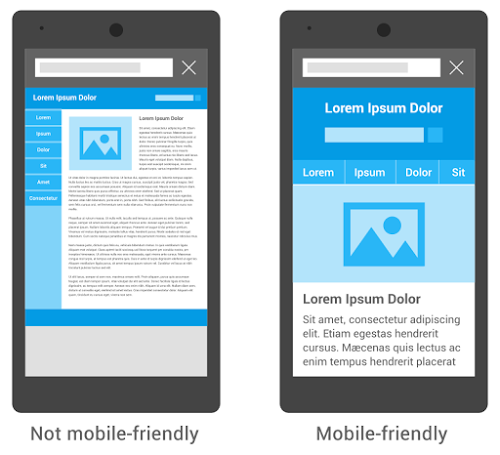
Google’s mobile ranking will now use mobile-friendliness as a signal that weighs in favor of pages that are formatted for mobile phones, like the image on the right.

 Google’s Mobilegeddon , Mobile Rankings And Mobile Friendliness

Points To Take A Note Of :

  • Back in November, Google introduced a “mobile-friendly badge” to notify users when a link in search results led to a mobile friendly-page, andprovided resources to help webmasters become mobile-friendly.
  • Google has started rolling out the change to take into account whether a site is mobile-friendly when Google ranks search results on mobile phones.
  • This change will be one of the 200 ranking factors and  non-mobile-friendly sites won’t disappear from mobile Search results—they may still rank high if they hold great content the user wants.
  • If you use Google search on your mobile phone, you can now more easily find high-quality and relevant results where text is readable without tapping or zooming, tap targets are spaced appropriately, and the page avoids unplayable content or horizontal scrolling.
  • In just the two months since Google announced this change, Google says they have seen a 4.7 percentage point uptick in the proportion of sites that are mobile friendly, and we hope to see even more in the coming months.
  • Webmasters can check if their site is mobile-friendly by examining individual pages with the Mobile-Friendly Test or check the status of the entire site through the Mobile Usability report in Webmaster Tools. Once a site becomes mobile-friendly, Google will automatically re-process those pages (and webmasters can expedite the process by using Fetch as Google with Submit to Index).

Google Algorithm Will Give Priority To Mobile-Friendly Sites Starting 21st April 2015

Google has always put the user at the helm when it comes to search. When it comes to search results Google focuses on the user and when it comes to updating the search algorithm it’s the user behaviour which becomes the focal point.

In February 2015, Google published a blog post mentioning that they want more mobile friendly websites in the search results.

Two important major announcements made by Google in the blog post were:

  1.  Starting April 21, we will be expanding our use of mobile-friendliness as a ranking signal, meaning more mobile-friendly sites in search results.
  2.  We will begin to use information from indexed apps as a factor in ranking for signed-in users who have the app installed.

Google Algorithm to find mobile friendly sites for search results

Google has clearly stated that starting  21st April 2015, they will be expanding the use of mobile-friendliness as a ranking signal. This change will affect mobile searches in all languages worldwide and will have a significant impact in search results. Consequently, users will find it easier to get relevant, high quality search results that are optimized for their devices.

Google resources available online to check and test the mobile-friendliness of a website are as follows:

Other Resources answering the following questions:

  1. Why make a website mobile-friendly?
  2. How do I start?
  3. What are the top three things I should know when building a site for mobile devices?
  4. How much does it cost to build a site for mobile devices?
  5. What should I think about when working with a developer?
  6. What are the top three mistakes beginners want to avoid?
  7. What are the next steps?

Related Posts:

SEO In 2015: There is no such thing as, NEW SEO or Old SEO. SEO is SEO.

It is time to wind up 2014 and welcome 2015 and march ahead with the lessons learnt in the past year. The Digital World is ever evolving and especially the arena of Search Engine Optimization is the most critically acclaimed and a service which gets predicted as dead at the end of every year, especially post Panda and Penguin algorithm updates at Google.But, as usual we at WebPro Technologies have always remained positive about its need for every website hosted on the WWW . Hence, at WebPro Technologies it is that time of the year when SEO business targets are set for the coming year. We again state that SEO is again going to be one of our major services for 2015 along with Social Media services, Content Writing and Email Info Campaigns for our current client base and the prospective future clients which we are very positive and hopeful about in the coming year.

Let us understand why SEO will always be needed as long as people use search engines.

Search engines know that if they do not give quality results to the users then the users will look for other options and stop using their search engine. We have seen in the past that search engines like Altavista, Hotbot, lycos , Yahoo, etc. (The search options available in early 2000) all got extinct as they did not succeed in upgrading their algorithms with the pace with which the spammers were misusing it. Google has been comparatively successful and has tried to combat the spam and is always trying to improve the search results with time.

There is no such thing as:
NEW SEO or Old SEO.
SEO is SEO.

As the old saying “people do not change, they reveal who they are” Similarly SEO is not changing but as the algorithms are getting more sophisticated and are able to see through the spam and gimmicks used by immature and black hat SEOs, its true meaning and purpose is getting highlighted with every update in the search algorithms.

SEO is changing for people who did not understand the true meaning of SEO and used tricks to gain search presence rather than having a correct approach towards reaching there.

SEO is changing for those website owners who wanted cheap options and hence put their trust in so called link builders instead of having an SEO culture in their organization.

SEO is changing for those website owners who have burnt their fingers in the past with the launch of the Panda and Penguin updates.

W3C is the main organization which establishes the World Wide Web Standards. Google and all the search engines follow the WWW standards but the Vice Versa is not true.

Hence as the law of Transitivity states if a=b and b=c then a=c.Similarly if we follow the W3C norms for web development and since Google algorithms are also becoming sophisticated in verifying these norms on websites then we in the long run we take care of on-page SEO automatically.

Ideal SEO campaigns have always focused on the following aspects:

On Page Factors:

· Title Tags

· Description Tags

· Suggestions for landing pages to make them more effective

· Work on the site architecture and navigation

· Image optimization

· Making the maximum benefit from videos on the site

· Header Tags

· Working on the content to ensure that it falls in the category of quality content

Off Page Factors and Quality Web Presence:

· Integrating Social Media

· Social Media sites focused are Twitter, Google+ profile and pages , Facebook Business Page and Linkedin Profile

· Guiding the in house staff on how to use social media effectively to establish trust and authority

· Guidance on how to develop a blog and maintain it

· Improve on the quality of existing inbound links to the site by working on the details about the domain authority, Anchor Text and the relevant linked page from the external site.

· Work on cleaning the link profile of non topical links.

· Help in creating and monitoring a social media and content development strategy.

Local Search:

· Adding the details to Google Places and Google Maps

· Integrate the Google Places account with the Google+ Business Page

· Suggesting methods by which you can encourage customers to write reviews

· Optimize for Local intent keywords for organic search

Other Technical Factors:

· Set the canonical issues

· Robots.txt

· XML Sitemaps

· Add Structured Data in the form of Microformats and Microdata wherever applicable on the site

· Customized 404 (Page Not Found) Page

· Work on Improving the Site Speed

· Add Authorship Markup to the blog

· Add Twitter Cards and FaceBook open Graph meta tags to the blog

· Guide the web developer to implement microformats or schemas for products and reviews.

All the factors mentioned above work together and in unison to influence the rankings. On-page optimization lays the foundation stone for the edifice , the off-page optimization influence the popularity and affect the stability and improvement of the rankings achieved and the technical factors influence the search engines to crawl and index the website efficiently.

All this cannot be achieved in a day. SEO is an ongoing process and the website needs to be tweaked and tuned as per the changing algorithms of the search engines in order to adapt the site to the changing scenarios so that it can withstand the algoquakes and maintain the visibility.

I think these aspects (especially the on-page ) have been applicable since the time the search engines have started. Hence, the SEO in 2015 is not new but the algorithms are more sophisticated to see thru the spam in the way these factors have been implemented to trick search engines by spammers. Hence in a way we can say that the algorithms are new.

Genuine SEOs are implementing these aspects as per W3C since early 2000. Yes the off page optimization does vary and widen as per the user behaviour . In 2000 social media was not a rage online hence it was not a part of the SEO campaigns. The off-page and Technical factors do get tweaked with time but the basic approach remains the same. The off-page factors get affected by major user behaviour changes and the technical factors get affected as per the sophistication in the algorithms and how this data will be fetched by search engine bots from the servers.

Keeping this the basic approach to SEO in 2015 still remains the same but the algorithms are more sophisticated and we need to be more systematic in the execution of the above mentioned factors. We also need to be more patient for the results to accrue as though the indexing is faster by the search engines , the competition is also increasing at an alarming rate with billions of websites being launched on a regular basis.

Hence in 2015 it is very necessary to have an integrated digital presence by focusing on :

· SEO

· Social Media

· Content

· Email Campaigns

Only when all the above mentioned media are implemented together a certain online reputation can be created.

When your potential customer sees your website ranking for the searches he made on the search engine and then also checks the social media for the buzz and finds the presence of your business and reads what his contacts had to say and also get an email from you in his inbox giving more information it is surely going to register in his mind and will surely consider when he takes a decision related to the products and services you have to offer.

The consistency in our thought process and our approach towards SEO is proved by the blog posts we have written in the past. These posts are testimony to the fact that we still believe in what we do. Our basic approach to SEO still remains the same but it has become more systematic and every passing year since 2000 has just made us more confident giving a new lease of life to our services, despite the xn posts on the blogosphere about SEO being dead.

Some of our past year end posts which prove the consistency in our approach towards SEO Services offered by us are as follows:

Dec. 2010 : SEO And Online Presence In 2011

Dec. 2011: Saying Bye to SEO 2011 and A Very Big Hi to SEO 2012

Dec. 2012: Points To Ponder On For SEO 2013

Nov. 2012:  The Evolving Face Of SEO - 14 SEO Facts For 2013

Dec. 2013: SEO 2014 The Year Of Positive SEO And The Survival Of The Fittest

Can You Imagine Life Without Google? LOL....

Can you imagine life without Google? The brand has become such an important part of our everyday internet use as the number one search engine. More recently, its increasing array of products have made themselves comfortable on our computers; GoogleDrive, GoogleMaps, etc. And like a true friend, it doesn’t mind if we fire the odd joke in its direction.

Google Jokes

Hope that gave you a few laughs. 
Which of these Google jokes tickled you the most?
Contributed By : 
 

James Reynolds James Reynolds is the founder of Veravo. which consists of two search engine marketing agencies; SEO Sherpa and Click Jam. He is also the host of the Traffic Jam Podcast. James is fanatical about all things search, social and content on the web. He is a contributor to several leading publications and mentors start up companies in his free time.

Google Launches ‘Mobile Friendly’ Labels For Mobile Search Results

Google has always been focusing on the fact that only the User is important to them . As the users are shifting to mobile devices in large numbers Google also has started giving highlighting in the search results if a website is mobile friendly.This currently is information for the user who is searching on mobile devices. But this mention is surely effect the click thru rate of websites listed in search results on mobile devices. It is simple logic that why would a user click on a site which is not mobile friendly when he is searching using a mobile device.

This change will be rolling out globally over the next few weeks. According to Google a site is mobile friendly when it :

  • Avoids software that is not common on mobile devices, like Flash
  • Uses text that is readable without zooming
  • Sizes content to the screen so users don't have to scroll horizontally or zoom
  • Places links far enough apart so that the correct one can be easily tapped

The search results on the mobile devices appear  as follows:

Google Search Results For Mobile Friendly

Google has also launched a mobile friendly tool to check the mobile friendliness of a website:

The new tool is at google.com/webmasters/tools/mobile-friendly and it basically gives you a pass or fail grade. Either it tells you that you are mobile friendly or you are not mobile friendly. For example as follows:

Google Mobile-Friendly Test Tool

In June 2013, Google introduced a penalty for sites providing a bad mobile search experience. Sites generating errors and other problems for mobile visitors received less visibility in Google’s smartphone results — the results Google shows to mobile searchers, as opposed to desktop searchers.Now with this display of the mobile friendly tab in search results it is crucial for every website to be responsive and follow the rules to be mobile friendly.

Related Posts:

http://googlewebmastercentral.blogspot.in/2014/11/helping-users-find-mobile-friendly-pages.html
http://searchengineland.com/google-officially-launches-mobile-friendly-labels-mobile-search-results-208949

Add Email Marketing To The Digital Marketing Mix To Reap Rich Returns From The Overall ROI

With the increase of eCommerce sites and a phenomenal increase in the usage of the hand held devices like smart phones and tablets the mindset of the people in accepting email updates is becoming more positive.

I think the curated content in the inbox regarding any topic, product or service is being welcomed by the users. Especially from companies who have a good overall web presence. When the user receives an email from a brand which he has come across on search engines and social media platforms , he is more likely to read the email content rather than mark it as spam.

email marketing - WebPro Technologies India

But there are some dos and donts when you start with the Email Campaigns. I would rather call it Email Info Campaigns rather that Email Marketing Campaigns. If you are continuously emailing sales messages then the chances of that email being marked as spam is very high. But, if you create the content of the email with a purpose of informing the reader and educating the reader regarding a topic then it more accepted.

Some Basic Dos and Donts.

1. Don’t buy email lists. Create them by adding genuine email ids collected by you over a period of time (Ids of customers, enquiries, etc)

2. Focus on informative content.

3. Recycle informative blog content as email content.

4. Make it easy to unsubscribe.

5. Ask for permission before adding the email id to the subscription list.

6. Don’t send only sales oriented emails.

7. Have a link to the web version of the newsletter in the email.

8. Add the company logo and the contact details in the newsletter.

9. Keep mobile devices in mind. one out of every three clicks occurs on a mobile device today.

10. The right colour combo and font size is very important.

Email is one-to-one communication and is more welcomed by people especially from brands they already familiar with. Hence it is an effective tool for retention marketing. However to keep the ROI high one needs to follow some dos and donts. The main misconception is that email marketing is very cheap and sending emails in bulk is the solution but that is incorrect. Having a well planned email campaign and measuring the ROI requires a well planned strategy with a focus on content and the outreach. This requires a sizable amount of investment.

When The CEO Wants To Know About Digital ROI Before Sanctioning The Digital Marketing Budget (With A Focus On SEO, Social Media, Email Marketing & Content)

Recently many companies though convinced about investing in the online presence are hesitant about sanctioning budgets for SEO, Social Media, Content Writing, Email Marketing and other online presence campaigns. The reason being, the top management need the facts, figures and futuristic growth assurances before sanctioning these budgets.

Digital ROI - SEO, Social Media, Content , Email Marketing

The earned and owned media help in establishing online reputation and also help in building a brand. Focusing on earned and owned media i.e SEO, Social Media, Content and Email Marketing a business can sow the seeds of web presence which in the long run can help in branching out to the world wide web and gain the targeted traffic to their website and increase the outreach on the social media platform.

In order to achieve this of course a well planned strategy and a holistic approach is needed. Every media has got a different purpose but eventually leads to a common goal i.e quality online presence.

Just as a balanced diet is needed to keep oneself healthy an integrated approach or a healthy marketing mix is essential for an overall web presence which leads to the online growth of the business.

We shall focus on :

· SEO

· Social Media

· Content

· Email Marketing

When The CEO Wants To Know About Digital ROI Before Sanctioning The Digital Marketing Budget (With A Focus On SEO, Social Media, Email Marketing & Content)

SEO

SEO is at the root of the earned and owned media campaigns. Only when the website will be indexed and crawled properly and will get correctly correlated to the relevant search queries the targeted traffic from the search engines will be accessed.

  • SEO Campaigns work on the On-Page factors, Off-Page Factors and the Technical factors of the website to see that all the pages of the website are getting crawled and indexed regularly.
  • SEO also monitors that the relevance of the search queries for which the website is getting correlated to.
  • Moreover, SEO also checks whether the traffic is coming from the targeted geo locations.
  • More pages becoming the landing pages for relevant and targeted search queries is also one of the goals of the SEO Campaigns.
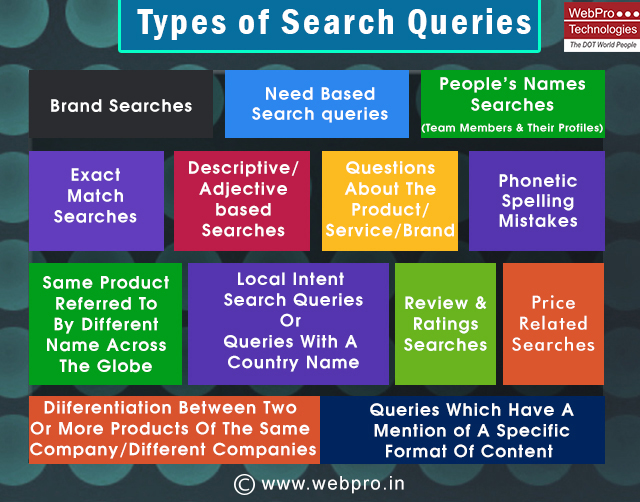
  • Increase in non-branded search queries over a period of time is also a positive offshoot of an SEO Campaigns.
SEO ROI can be easily calculated by the data available from Google analytics and from the in-house sales team.
A simplest SEO ROI calculation would be attained by answering these following questions:
How many visits received from search engines?
Let us denote this as – a
How many enquiries received via the website form or calls received from visitors after visiting the site which they found via search engines?
Let us denote this as - b
The no of enquiries thus received got converted to sales?
Let us denote this as – c
The amount of profit from these invoices drawn?
Let us denote this as – d
The cost of SEO monthly / annually depends on what basis you are calculating ?
Let us denote this as – e
I suggest the ROI to be calculated half yearly or annually as this gives a clear idea.
Hence , (assuming you keep the period of the calculation the same for all the metrics)
 
SEO ROI = (d – e) / e * 100

Basically,

ROI = ( Annual Profit from the sales which were achieved via the Enquires from search engines – The annual cost of SEO for the website) divide upon (The annual cost of SEO for the website) multiplied by 100

There can be many permutations and combinations that can be worked out in order to get various performance data as per your requirement. For example if you want to measure the conversion ratio of your sales department keeping in mind the online enquiries received then it can be done as follows:

Conversion Ratio = c/ b * 100

This can become as a KPP (Key Performance Parameter) for your sales team which can be monitored on a periodic basis to have a direction and guidance for chalking out the sales plans for the next period with a targeted approach and also the reasons for the low or high ratio can be discussed and therby helping to find the strengths and weaknesses in the system .

Social Media:

Measuring the ROI for social-media marketing can be a lot more challenging since its results involve such intangibles as engagement, audience reach, and “buzz.”

Social Media may or may not be an engine for direct sales but it surely helps in reaching out to the existing and potential online customers by creating a communication platform where both the parties have a equal chance to voice their say.

Usually people focus on the no. Of likes, followers, +1s and other such quantifiable metrics to calculate the ROI from social media but it does not limit to these metrics only. Social media ROI is much more it is the online reputation and brand awareness that gets generated as a result of the engagement on social media platforms which is the real ROI from social media presence.

Social Media is the platform where the word of mouth goes viral. Hence it reflects not only the plus points of the products and business but also the drawbacks get a chance to get highlighted. The challenge lies in how the criticism is faced and handled to turn the tables in your favour. The social media is a place where you interact with your existing customers and the potential customers in one place which can be tricky but can help sales too as your satisfied customer can be your best evangelist.

Content

Content is at the core of any online marketing activity. As a result the term “Content Marketing” has surfaced as a new wave online. But, we need to understand that “Content Marketing” does not mean marketing the content , but using content to market the product or service which your business offers. Just adding blog posts written by any third party regularly does not achieve the purpose of content marketing.

Regular fresh content can trigger the conversation and engagement on social media as managing social media for business is not like personal social media . Content Marketing adds more footprints on the web for web presence but also becomes the crux of connecting to people on the web which in the long run help share the word of mouth which is the basis on which decisions are taken by online buyers. As in real life we are what are thoughts are and we share our thoughts via discussions, seminars, exhibitions, road shows , etc. on the internet we need to share our thoughts via blogs, social media sites, videos, comments, reviews, etc. And establish the thought leadership.

Email Marketing

In 2011, the Direct Marketing Association estimated that email marketing typically returns £40 for every £1 invested. A number of sources have suggested that this is better than any other platform.

Email is an easy and inexpensive way of establishing early and long-lasting relationships by sending newsletters, promotions, new service announcements or event invitations we can remain connected .

Via email the receivers receive curated content about your company and industry and are kept informed. The recent trend is that people want to be informed about the latest without searching for it and email is the best platform that any business can use for this purpose.

With email, everything can be tracked and you can see who clicked on certain links and much more

Email marketing is 20 times more cost-effective than traditional media it's six to 12 times less expensive to sell to an existing customer than to a new one.

The fact is that just one platform in particular and singularly is not going to reap the desired benefit and the ROI needed. Only when all the above mentioned media are implemented together a certain online reputation can be created.

When your potential customer sees your website ranking for the searches he made on the search engine and then also checks the social media for the buzz and finds the presence of your business and reads what his contacts had to say and also get an email from you in his inbox giving more information it surely going to register in his mind and will surely consider when he takes a decision related to the products and services you have to offer.

An accurate ROI of any one media may not be possible but the real ROI is generated when each of these activities supplement each other and make the web presence of the business stronger and boost the online reputation so that the people can trust you online. Gaining trust online should be the long term goal for any web presence activity. (Read more about the Trust Factor on What Influences The Trust Factor Online ?)Eventually , If Content Is King Then Context Is Queen And The Trust Factor Is The Royal Crown.

The How, When, Where, Why Of Recycling Old Blog Content As Newsletters

If you have been blogging for a while then I am sure , there must be a long list of blog posts which must be informative and timeless. These blog posts can be of great use and can be recycled for email marketing as newsletters.

Recycling Old Blog Content As Newsletters

The How, When, Where, Why Of Recycling Old Blog Content As Newsletters:

1. By using it as content for newsletters which will be emailed you do not have worry about the Duplicate Content issue.

2. When you send the content as newsletter and link it to the the past post for the web version of the content , the reader gets an idea of how timeless your content is and how long you have been having a firm view about the topic which proves your experience in the field.

3. If you don’t wish to reveal the date of the blog post then one can easily remove the date stamp from the blog post and make it timeless.

4. One can even create a series of newsletters where you can divide a long blog post in parts and email it as Part 1 , Part 2, etc. to make the reader more curious so that every newsletter is welcomed by the receiver.

5. One can convert old content into a video, PPT, Infographic, Slideshow, PDF, Podcast, etc and share it via newsletter as per the relevant audience and requirement.

6. Make a round up post of all important posts topic wise and share the links via newsletter along with a snippet of the post. This shares various ideas you have regarding a topic in one single email. This can be done quarterly, monthly or yearly as the case maybe.

7. When you reread old content and try to organize it you get ideas for new content (The Eureka Moments) which can be used for blog content or newsletters.

8. You can make old content more purposeful and relevant by adding latest case studies, statistics, anecdotes, narratives, tutorials .

9. Old content is a digital asset which reaps dividend if used wisely.

10. Responses from readers can be shared on social media for further discussions.

11. If you want to focus on the writers and introduce them as your team then this can be an ideal platform to do so.

12. Such newsletters can become a communication platform with existing clients with whom you want to share ideas and communicate but due to lack of time such conversations always get postponed.

Whenever you have a 'Writer’s Block' and cannot think of topics and ideas this can be a boon and in this era of content marketing old informative posts can prove the statement “Old Is Gold” to be true. All the old content is a gold mine and can be helpful in enriching your online presence in various ways.

editorial-policy-WebPro-Technologies-LLP-Ahmedabad

Editorial Policy: Human Expertise, Enhanced by AI

At WebPro Technologies, our content reflects over two decades of experience in SEO and digital strategy. We believe that valuable content is built on accuracy, clarity, and insight—and that requires human judgment at every step.

From 2024 onwards, we have been using AI tools selectively to brainstorm ideas, explore perspectives, and refine language, but AI is never the final author. Every article is researched, fact-checked, and edited by our team, ensuring relevance, accuracy, and originality. AI supports our workflow, but the responsibility for quality and credibility remains entirely human.

This hybrid approach allows us to combine the efficiency of technology with the depth of human expertise, so our readers get content that is both informative and trustworthy.

At WebPro, we see AI not as a replacement for human creativity, but as a tool that helps us raise the standard of excellence in the content we share.

SEO Ahmedabad

Contact Info

802, Astron Tech Park, Satellite Road, Opp. Gulmohar Park Mall, Ahmedabad 380015, India

+91 9825025904
info@webpro.in

Daily: 9:00 am - 6:00 pm
Sunday: Closed

Copyright 2025 WebPro Technologies LLP ©  All Rights Reserved