Content-writing-chatgpt

AI Unleashed: Navigating the Future of SEO Content Creation with ChatGPT

Introduction

In the dynamic world of SEO, content creation stands as the cornerstone of any successful strategy. Crafting engaging, informative content, however, is no small feat. From selecting the right topic to refining language and adapting grammar for specific audiences, the content creation process involves numerous intricate steps.

This process is not only challenging but also time-consuming, requiring extensive research, statistics, and a deep understanding of the target audience.

The Challenge of Content Creation

Creating compelling content involves several key elements, including topic selection, drafting, organization under sub-headings, proofreading, and tailoring language to specific geographic locations.

Each of these steps demands careful attention and considerable time investment. Moreover, staying updated with research, statistics, and opinions from thought leaders in the industry adds an additional layer of complexity.

The Role of AI in Content Creation

Enter Artificial Intelligence (AI), a revolutionary force that has reshaped various industries, including content creation. One noteworthy AI tool in this domain is ChatGPT. Developed by OpenAI, ChatGPT is a Generative Pre-trained Transformer, specifically designed for generating human-like text with a focus on conversational applications.

Unveiling ChatGPT

Understanding the Model

The acronym GPT in "ChatGPT" stands for "Generative Pre-trained Transformer." Trained on a diverse dataset from the internet, this AI language model has the ability to generate responses based on patterns learned during training. The "Chat" in ChatGPT signifies its application in creating text for conversational purposes.

Capabilities of ChatGPT

ChatGPT serves as a versatile tool for content creators. It can quickly provide answers to queries that would typically require hours or even days of internet research.

Additionally, the tool can check grammar, adapt language to either UK or US English, translate content into various languages, and even suggest topics for future blog posts.

These capabilities make ChatGPT an invaluable assistant, enhancing productivity and efficiency in the content creation process.

The Impact on Productivity

Utilizing ChatGPT or other AI tools presents a significant opportunity for content writers to boost productivity.

By automating certain aspects of the content creation workflow, writers can allocate more time to creative thinking and refining the quality of their output. The efficiency gains provided by AI tools can lead to a more streamlined and effective content creation process.

Overcoming Writer's Block

One of the most substantial advantages of integrating ChatGPT into the content creation process is its ability to help writers overcome the dreaded writer's block.

When faced with creative stagnation, writers can engage in a conversation with ChatGPT, leveraging its capacity to offer prompts, suggestions, and a conducive conversational space to jumpstart creativity.

Responsible Use of ChatGPT

While ChatGPT offers remarkable assistance in content creation, it is imperative to use it responsibly and understand its limitations.

Rather than viewing it as a complete replacement for human creativity and expertise, it should be seen as a powerful complement.

Regular review, fact-checking, and human intervention remain essential to ensure the production of high-quality, accurate content.

The Limitations of ChatGPT

Inability to Generate Personal Experiences

One notable limitation of ChatGPT is its inability to generate personal experiences. Lacking firsthand knowledge, opinions, or unique insights, the model relies solely on patterns learned from data.

Content creators should be mindful of this constraint and not expect the model to provide insights based on lived experiences.

Behind the Scenes: How ChatGPT Generates Answers

ChatGPT derives its answers from the patterns ingrained during its training on a diverse internet dataset. The model, based on the Generative Pre-trained Transformer architecture, excels at predicting the next word in a sentence given the context. This training process enables the model to capture grammar, semantics, and some aspects of reasoning.

Contrary to real-time internet access, ChatGPT does not fetch answers on-demand. Instead, it relies on the knowledge embedded in its parameters from the training data. While it can provide information on a wide array of topics, users must be cautious, as the model may not always have the most up-to-date or accurate information. Independent verification of critical information remains a best practice.

Conclusion

In the realm of content creation, harnessing the brilliance of AI, particularly through tools like ChatGPT, is undeniably a smart move. The efficiency gains, creative assistance, and the ability to overcome writer's block make AI a valuable asset for content writers.

However, the responsible use of such tools is paramount, and content creators should continue to exercise human judgment, ensuring that the content generated aligns with their standards of accuracy, relevance, and quality.

As AI becomes more sophisticated, it will not only assist in mundane tasks but also act as a catalyst for creativity. Future content creation workflows will witness a quantum leap in creative expression, with AI serving as a source of inspiration, ideation, and even challenging creators to push the boundaries of conventional storytelling.

In essence, the future of content creation, shaped by the ongoing evolution of AI, promises a paradigm shift in how we conceive, produce, and consume information. Content creators embracing this wave of technological advancement will find themselves at the forefront of a new era in digital communication, where the collaboration between human ingenuity and artificial intelligence propels creativity to unprecedented heights.
Google-Structurd-Data-ProfilePage

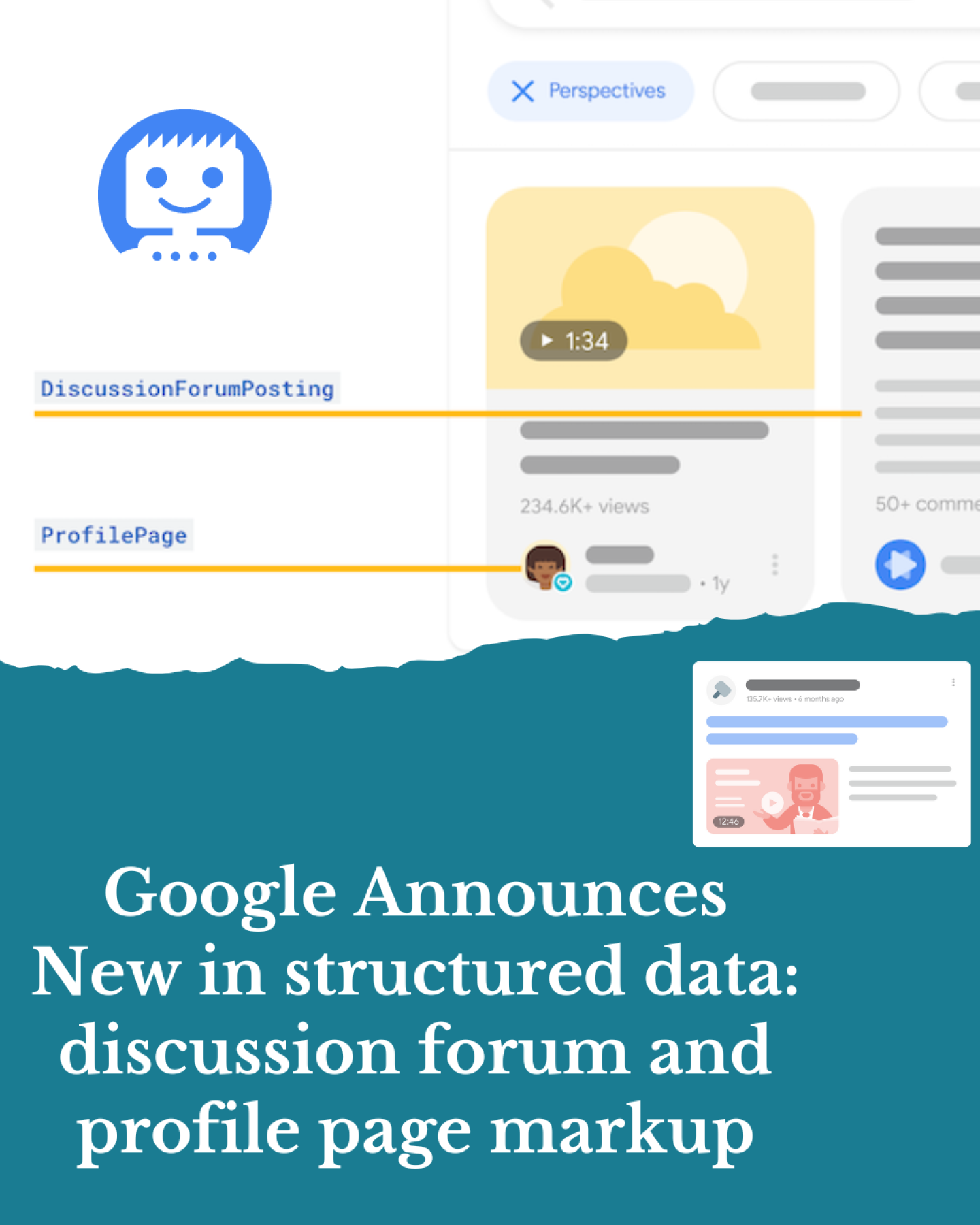
Google Announces New in structured data: discussion forum and profile page markup

In the dynamic landscape of the internet, content has undeniably been the driving force behind the inception and evolution of search engines. Over time, the sheer volume of content hosted on internet servers has experienced an exponential increase, shaping the digital realm we navigate daily. Traditionally, it was a safe assumption that content was predominantly created by human hands. However, the rapid expansion of artificial intelligence (AI) applications has blurred the lines between human-generated and AI-generated content, presenting a challenge for search engine algorithms.

The Crucial Role of Content in Search Engines:

As the backbone of search engines, content plays a pivotal role in determining the quality of search results. The ability to distinguish between human and AI-generated content has become important for ensuring the accuracy and relevance of search engine results. In light of this, the future holds the promise of search engines that can effectively make this crucial distinction, ultimately leading to higher-quality search results.

Google's Commitment to Diverse Perspectives:

In a significant development in May of this year, Google announced new features aimed at discovering and exploring diverse perspectives within search results. This initiative specifically targeted content from forums and social media sites, recognizing the importance of varied viewpoints in the digital space. Fast forward to November 27th, 2023, Google unveiled support for profile page and discussion forum structured data in Google Search, accompanied by new reports in Search Console.

ProfilePage Markup for First-Hand Perspectives:

The ProfilePage markup is designed for any site where creators, whether individuals or organizations, share their first-hand perspectives. This structured data enables Google Search to better identify information about the creator, including their name, social handle, profile photo, follower count, and the popularity of their content. This advancement aligns with Google's goal of providing accurate and complete information in search features showcasing first-person perspectives from social media platforms and forums.

DiscussionForumPosting Markup for Online Discussions:

Complementing the ProfilePage markup, the DiscussionForumPosting markup is tailored for forum-style sites where individuals collectively share their first-hand perspectives. This structured data empowers Google Search to identify forum sites and online discussions across the web. Forums employing this markup stand a chance to have their content featured in Google's Perspective and "Discussions and forums" features, although the use of the markup does not guarantee appearance.

Google's Historical Pursuit of Quality Content:

Google has a longstanding commitment to identifying and promoting quality content. The foundation stone for its Knowledge Graph was the Google Authorship Markup, which aimed to filter quality content and reveal the individuals behind the posts. However, the success of this endeavor was hindered by its integration with Google Plus, a platform that Google eventually shut down. The recent support for profile page and discussion forum structured data suggests a renewed focus on authorship and content quality.

The Implications for Search Engine Friendliness:

This recent development hints at a potential algorithm update where the proof and identity of the content's author or creator could become a crucial on-page factor for search engine friendliness. As search engines increasingly prioritize content that establishes the profile of the publisher or author, it is advisable not to hastily delete pages containing old content. These pages serve as a testament to the author's experience, with factors such as the date of publication, comments, likes, and replies validating the author's expertise.

The Value of Retaining Old Content:(Old is Gold)

Retaining pages containing old content becomes a strategic move, as they inherently demonstrate the author's journey and longevity in the industry. The date of publication, coupled with engagement metrics like comments, likes, and replies, becomes a powerful validation of the author's expertise. For instance, an author with content dating back to the early 2000s and recent publications establishes a timeline that inherently proves their experience and adaptability. The combination of quantity and quality, along with user-generated content, further solidifies the author's thought leadership in the industry.

In conclusion, the evolving landscape of content creation, coupled with Google's recent advancements in profile page and discussion forum structured data, signals a potential shift in the importance placed on content authorship. As search engines increasingly focus on showcasing diverse perspectives and prioritizing content from credible creators, the strategic retention of old content and the incorporation of structured data markup could become pivotal for individuals and organizations aiming to enhance their search presence and thought leadership in the digital landscape.

An In-Depth Exploration of Google Algorithm Updates Since 1998


Before we go down the memory lane, decode the Google Algorithm Odyssey and unravel their SEO impacts let us understand a few concepts.

  • What is an algorithm?
  • What does the Google Algorithm do?
  • Why is the Google algorithm important?
  • How often does Google update its algorithm?

What is an algorithm?

An algorithm is a step-by-step procedure or a set of rules designed to solve a specific problem or perform a particular task. In the realm of computing and mathematics, algorithms serve as a sequence of instructions, typically used by computers to process data, perform calculations, and automate various tasks.

Fundamentally, algorithms are the backbone of computer science, guiding the way in which data is processed, analyzed, and transformed. They can range from simple, well-defined sequences of operations to complex, multi-layered procedures that deal with vast amounts of information.

The primary goal of an algorithm is to provide an efficient and effective way to solve a problem or execute a task, often by breaking it down into smaller, more manageable steps.

What does the Google Algorithm do?

The Google Algorithm refers to a complex system used by Google's search engine to determine the relevance, quality, and ranking of web pages in response to user queries.

Why is the Google algorithm important?

Its primary function is to sort through the massive amount of web content available and provide users with the most relevant and high-quality results based on their search queries.

The overarching goal is to provide users with the best possible answers to their search queries while combating spam, low-quality content, and manipulation.

How often does Google update its algorithm?

 As the Google search results depend on the  Google algorithm the algorithm is of core importance for every SEO. The very fact that there are minor updates on a regular basis the SEO industry has to keep a track and also be aware of the major updates.

The main goal of every update is to combat spam in any form to make search results more relevant for the user.

The major updates are announced by Google on their search blog and also shared on social media by Google. Understanding the impact of every update on the search results is what keeps every SEO on their toes.

As a company policy, Google does not comment on what their new updates do. There are no new guidelines on their site for webmasters or SEO community other than the same old narration of how ‘very good content’ would be rewarded and ‘unethical techniques’ would be penalized.

Algorithms are always closely guarded secrets of search engines since any leak would mean an abuse of the system leading to contamination of their search results. Silence pays. Any comment, acceptance or a denial on the new algorithm behavior usually lets out parts of the algorithm secret.

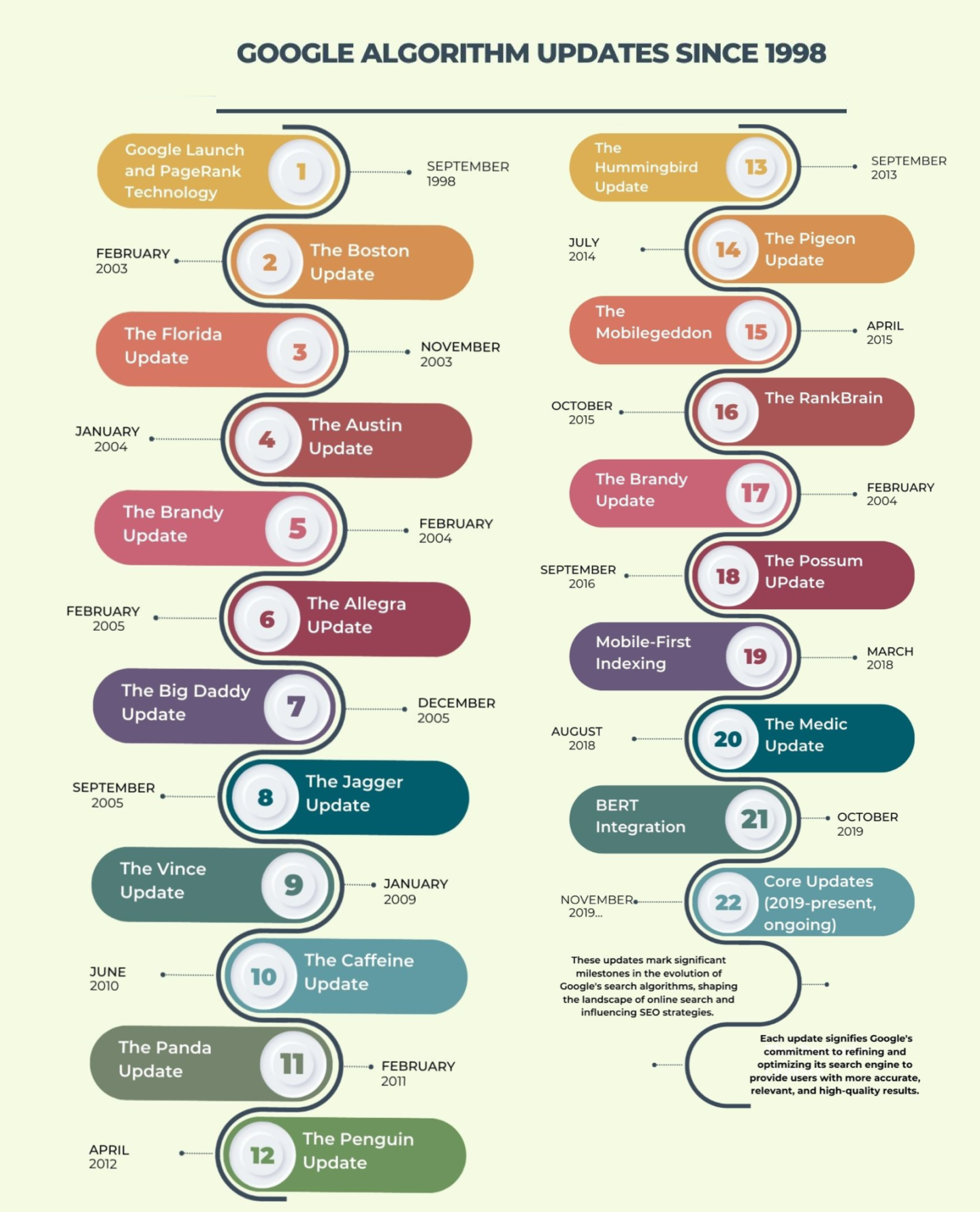
List of Major Google Algorithm Updates:

  1. Google Launch (1998): Birth of Google as a search engine with PageRank technology.
  2. Boston (2003): Focused on link quality and anchor text relevance.
  3. Florida (2003): Targeted keyword stuffing and manipulative SEO tactics.
  4. Austin (2004): Aimed to differentiate quality content from spam.
  5. Brandy (2004): Improved semantic search and relevance understanding.
  6. Allegra (2005): Emphasized trust factors, link quality, and duplicate content.
  7. Big Daddy (2005): Infrastructure update focusing on crawling and indexing.
  8. Jagger (2005): Addressed manipulative link building and low-quality backlinks.
  9. Vince (2009): Speculated to favor larger brands in search results.
  10. Caffeine (2010): Enhanced speed and indexation of websites.
  11. Panda (2011): Targeted thin, low-quality content and content farms.
  12. Penguin (2012): Focused on web spam, particularly manipulative link schemes.
  13. Hummingbird (2013): Emphasized understanding user intent and context in searches.
  14. Pigeon (2014): Focused on local search results and ties between local and core algorithms.
  15. Mobilegeddon (2015): Gave priority to mobile-friendly websites in mobile search results.
  16. RankBrain (2015): Introduced machine learning for understanding search queries better.
  17. Possum (2016): Enhanced the importance of the user's location in search results.
  18. Fred (2017): Targeted low-value content primarily existing for revenue generation.
  19. Mobile-First Indexing (2018): Google started using the mobile version of a site for ranking and indexing.
  20. Medic (2018): Primarily affected health and wellness sites, emphasizing expertise, authority, and trustworthiness (E-A-T).
  21. BERT (2019): Leveraged natural language processing for better understanding context in search queries.
  22. Core Updates (2019-present, ongoing): Regular broad updates focused on improving overall search quality.

Let us understand and delve deep into all the major Google Algorithm updates till date:

Google Launch (1998): The birth of Google as a search engine with the PageRank technology.

 The inception of the Google saga can be traced back to 1995 at Stanford University. Larry Page, contemplating graduate school at Stanford, was guided around the campus by Sergey Brin, a fellow student.

Collaboratively, they crafted a search engine utilizing links to gauge the significance of individual pages across the World Wide Web. Originally dubbed "Backrub," this search engine underwent a transformation and emerged as "Google."

The nomenclature "Google" was a clever play on the mathematical term denoting 1 followed by 100 zeros, vividly encapsulating Larry and Sergey's mission to "organize the world’s information and make it universally accessible and useful."

Distinguishing themselves from conventional search engines that relied on the frequency of search terms on a page, Larry and Sergey envisioned a more sophisticated system.

They conceptualized an algorithm called PageRank, which assessed a website's relevance based on the quantity of pages and the significance of those pages linked back to the original site.

This visionary approach marked a departure from the traditional methods of result ranking and laid the foundation for Google's transformative impact on information retrieval.

Boston (2003): Focused on link quality and anchor text relevance.

Following the integration of PageRank technology, Google underwent a pivotal algorithm update in February 2003. This update, complementing the significance of the number of links, introduced a crucial emphasis on the quality of links.

Distinguishing itself from previous iterations, this algorithm enhancement aimed at refining the relevance of search results. It achieved this by elevating the importance of various factors, including title tags and anchor text.

The Boston update played a pivotal role in not only improving the overall quality of search results but also setting the stage for subsequent updates that would further fine-tune and enhance Google's search algorithm.

Florida (2003): Targeted keyword stuffing and manipulative SEO tactics.

 On November 16, 2003, Google implemented the Florida update, strategically timed just before the Christmas shopping season and the Pubcon Florida event in Orlando.

This update holds historical significance in the realm of search engine optimization (SEO) as it signaled a paradigm shift towards a more content-centric approach. The Florida Update emerged at a crucial juncture, aiming to address the prevalence of "keyword stuffing," a tactic that had become commonplace among black hat SEO practitioners following the Boston 2003 Update.

Central to the Florida Update was the objective of diminishing the effectiveness of such manipulative techniques. It specifically targeted spam practices like "cloaking," wherein different content is presented to search engines compared to users, and "doorway pages," pages designed solely for search engines, devoid of any value for users.

Marking the inaugural major Google algorithm update, the Florida update had far-reaching consequences, significantly impacting a substantial number of websites in what can be described as a catastrophic outcome.

Austin (2004): Aimed to differentiate quality content from spam.

 Released in January 2004, the Austin update represented a significant overhaul of Google's search engine ranking algorithm. It directly followed the 2003 Florida update, which targeted spam sites relying on backlinks from link exchange farms. The Austin update aimed to further refine the search algorithm to combat manipulative tactics.

However, the update faced criticism from webmasters as unintended consequences ensued. Numerous websites not involved in the manipulative practices addressed by the update experienced substantial ranking losses. In response to feedback and identified issues, Google introduced the Brandy update, perceived as a corrective measure to rectify the shortcomings of its predecessor.

During this transition, noticeable shifts occurred in search results. E-commerce giants like Amazon and eBay frequently emerged as top hits, leveraging their extensive link networks. Another noteworthy change was the integration of dynamic web pages into the index, showcasing Google's commitment to adapting its algorithms to accommodate the ever-changing landscape of online content.

Brandy (2004): Improved semantic search and relevance understanding.

Released between late January and mid-February 2004, Google's Brandy update stands as the official successor to the Austin Update. Unlike altering the Google ranking algorithm, the Brandy Update focused on modifying the database or index, bringing about crucial improvements.

This update was particularly beneficial for numerous websites that had been unfairly penalized by deactivating certain evaluation criteria introduced by prior updates. The adjustments made during the Brandy update showcased Google's commitment to refining its processes and ensuring a fairer assessment of web content without fundamentally altering the underlying ranking algorithm.

 Allegra (2005): Emphasized trust factors, link quality, and duplicate content.

Between February 2nd and 8th  2005, Google implemented the “Allegra Update,” marking a pivotal shift in its search algorithm. This update followed Google's extensive efforts to cleanse the Search Engine Results Page (SERP) from spam sites through previous updates like Florida, Austin, and Brandy in 2003-2004, setting the stage for a transformative moment in the SEO landscape.

The Allegra update of February 2005 was primarily geared towards Google's ongoing battle against spam websites. This conclusion is drawn from the observable results of the update, as the implementation of the algorithm change led to the exclusion of numerous spam sites from the SERPs.

Despite its impactful nature, Google has not officially disclosed details about the rollout of the Allegra update. Within the SEO community, there is no consensus on the specific aspects affected by the update. However, it is generally assumed that the algorithm adaptation targeted areas such as duplicate content, suspicious links, and latent semantic indexing, reflecting Google's commitment to refining search results by combating spammy practices.

Big Daddy (2005): Infrastructure update focusing on crawling and indexing.

The Big Daddy Google Algorithm Update of 2005 stands as a pivotal milestone in the evolution of Google's search engine. Crafted to bolster the search engine's prowess in comprehending and ranking web pages based on relevance and quality, this update instigated transformative changes.

Big Daddy ushered in significant modifications to Google's infrastructure, crawling mechanisms, and indexation processes. Its primary focus was on tackling issues like canonicalization, duplicate content, and URL handling. By emphasizing the importance of accuracy and reliability in search results, the update urged webmasters to produce high-quality, original content. Big Daddy laid a solid foundation for subsequent algorithm updates, embodying Google's ongoing commitment to refining its search engine capabilities.

Dubbed "Big Daddy," the nomenclature was deliberately chosen to distinguish it from other updates, imparting a distinctive and memorable identity. While speculation surrounds the name, it is widely believed that "Big Daddy" was selected to convey the update's significant and authoritative nature.

Undeniably a major update, Big Daddy left an indelible mark on search results and the practices of webmasters, highlighting its substantial impact on the evolving landscape of Google's search engine infrastructure.

Jagger (2005): Addressed manipulative link building and low-quality backlinks.

 In September 2005, Google rolled out the Jagger update, the another significant algorithmic change in its history. Jagger marked a notable shift by placing a heightened emphasis on link quality, specifically penalizing websites associated with low-quality or spammy backlinks. Conversely, it rewarded sites boasting high-quality and authoritative backlinks, recognizing them as indicators of trustworthiness and credibility.

The crux of Jagger's impact lay in its targeting of low-quality links, encompassing paid links, link farms, and reciprocal links. By doing so, the update sought to refine the criteria for evaluating the quality of a website's link profile. This strategic move reflected Google's commitment to enhancing the overall quality of its search results by favoring websites with trustworthy and reputable link structures, thus promoting a more reliable and credible online environment.

Vince (2009): Speculated to have favored larger brands in search results.

 The codenamed "Vince" represents a substantial and enduring modification to Google's ranking algorithm. Announced in 2009 and swiftly implemented globally, this algorithmic shift began to exert its influence on the German search market by December of the same year.

The Vince Update made its debut on January 18, 2009, bearing the name of a Google engineer as a tribute to his contributions to this significant algorithmic alteration. Matt Cutts, who led Google’s web spam team at the time, characterized it as a "simple change."

In essence, the Vince update constituted a rapid and conspicuous adjustment, particularly in terms of broad-level, competitive keyword terms. Its primary aim was to favor first-page rankings for prominent brand domains over sites that had previously occupied higher positions. This strategic alteration signaled a shift in Google's approach, reflecting an inclination toward recognizing and elevating the visibility of well-established and authoritative brands in the search results landscape.

 Caffeine (2010): Enhanced the speed and indexation of websites.

 On August 10, 2009, Google unveiled Caffeine, a pivotal update that would go on to be one of the most significant milestones in the history of the search engine.

The scale of the Caffeine Update was so immense that Google initiated a "Developer Preview" phase, spanning several months. Recognizing the critical nature of this update, Google granted SEO professionals and developers early access to identify and report any potential issues. Finally, on June 8, 2010, Caffeine was officially rolled out.

The primary objective behind Google Caffeine was to revolutionize the indexing process, enabling the web to be cataloged at a faster pace. This transformation aimed to provide users with more up-to-date and fresh content in search results, underscoring the increasing importance of speed and currency in the evolving landscape of the web.

The  Google Caffeine infrastructure not only facilitated quicker indexing of the web but also ensured that the relevant data generated was presented to users in a format that aligned with their search queries.

This advancement marked a momentous shift in the dynamics of online search, ushering in an era where speed and the availability of fresh content became paramount considerations for an enhanced user experience.

 Panda (2011): Targeted thin, low-quality content and content farms.

 Google Panda made its debut in February 2011, as part of Google's concerted effort to eradicate black hat SEO tactics and web spam.

In the initial announcement on February 24, 2011, Google detailed the objectives of Panda Update 1.0 , emphasizing its intent to diminish rankings for low-quality sites.

These were defined as sites that added minimal value for users, copied content from other websites, or were deemed generally unhelpful. Simultaneously, the update aimed to elevate the rankings of high-quality sites, those featuring original content, research, in-depth reports, and thoughtful analysis.

Expressing enthusiasm for this ranking improvement, Google underscored its belief that Panda represented a substantial stride toward enhancing result quality. On April 11, 2011, Google transformed Panda into a global update, highlighting that adherence to Google's quality guidelines was crucial for site improvement.

In subsequent updates during May and June 2011, Google refined and optimized the algorithm for more efficient application. The focus was on rewarding sites that followed guidelines, enriched their content with quality, and served as valuable information sources for users.

Interestingly, when the Google Panda update initially launched, Google had not assigned an official name. Search Engine Land dubbed it the "Farmer" update, but Google later officially adopted the name "Panda" after a few days.

This update marked a significant milestone in Google's commitment to delivering higher-quality search results and combating content that failed to meet their quality standards.

For further details, you can visit: WebPro - Understanding and Adapting to the Google Panda Update

 Penguin (2012): Focused on web spam, particularly manipulative link schemes.

In 2012, Google introduced the "web spam algorithm update," a strategic move aimed at combatting link spam and manipulative link-building practices.

This web spam algorithm eventually became officially known as the Penguin algorithm update. The nomenclature was revealed in a tweet by Matt Cutts, who served as the head of the Google web spam team at that time.

The Penguin Update served as the latest countermeasure integrated into the search algorithm to devalue sites employing manipulative tactics and spammy inbound links in an attempt to deceive Google for higher rankings.

In simpler terms, Google took punitive measures against sites that violated their rules and guidelines. Google has consistently viewed Search Engine Optimization (SEO) as a positive and constructive strategy for achieving favorable search visibility.

Google explicitly asserted that SEO is not synonymous with spam. However, the crucial distinction lies in the methodology employed—there exists a fine line between positive, constructive SEO and tactics that manipulate the system to achieve desired results. The implementation of the Penguin Update reinforced Google's commitment to maintaining the integrity of search results and penalizing practices that deviate from ethical SEO standards.

Hummingbird (2013): Emphasized understanding user intent and context in searches.

 The Hummingbird update, announced on September 26, 2013, and already in operation for a month, signified a significant shift in Google's search algorithm. Named "Hummingbird" due to the speed and precision associated with hummingbirds, this update placed a heightened emphasis on natural language queries, prioritizing context and meaning over individual keywords.

TechCrunch characterized the advent of Hummingbird 1.0 as "the biggest overhaul to Google since the 2009 'Caffeine' overhaul," which had focused on speed and integrating social network results into search. Notably, Hummingbird impacted "around 90% of searches."

The crucial change introduced by Hummingbird was its ability to recognize complete-question searches, going beyond the traditional parsing of specific keywords.

This innovation empowered Google to accurately rank responses to long-tail question searches, marking a significant enhancement in its capacity to understand and cater to user queries in a more nuanced and context-aware manner.

 Pigeon (2014): Focused on local search results and the ties between local and core algorithms.

 On July 24th, 2014, Google introduced a new algorithm aimed at enhancing the relevance, accuracy, and usefulness of local search results, aligning them more closely with traditional web search ranking signals. The impact of these changes was evident in both Google Maps search results and general Google Web search results.

Dubbed the Pigeon update by the search community (coined by Search Engine Land following discussions with Danny Sullivan about an impending algorithm for local search), this update signaled a significant shift for businesses targeting local traffic.

In addition to prioritizing local search, businesses needed to consider search queries with a local intent.

This was particularly crucial in regions where local search results weren't explicitly displayed on Google's search results page. In such cases, maintaining a presence in organic search results became a valuable strategy for businesses seeking to maximize their visibility and reach.

Mobilegeddon (2015): Gave priority to mobile-friendly websites in mobile search results.

 The mobile-friendly update, rolled out on April 21st, 2015, potentially provided a ranking boost to pages that were optimized for mobile devices in Google's mobile search results. Often referred to as Mobilegeddon by Search Engine Land, this update marked a pivotal moment in Google's algorithm.

In a clear announcement, Google specified that, commencing April 21st, 2015, they would be expanding the use of mobile-friendliness as a ranking signal.

This change was not confined to specific languages or regions; it had a global impact on mobile searches, promising a substantial influence on search results. As a result, users were expected to experience enhanced ease in obtaining relevant, high-quality search results that were specifically optimized for their mobile devices.

RankBrain (2015): Introduced machine learning for understanding search queries better.

RankBrain, introduced in the spring of 2015 and officially disclosed on October 26 of the same year, represents a system through which Google can enhance its understanding of the probable user intent behind a search query.

Google dubbed RankBrain as its machine-learning artificial intelligence system, a revelation made by Bloomberg and later confirmed to Search Engine Land by Google.

Although operational for several months before its announcement, RankBrain had remained under wraps.

RankBrain constitutes one of the myriad signals—numbering in the hundreds—that collectively shape the algorithm determining the appearance and ranking of results on a Google search page

Impressively, within a short span since its deployment, RankBrain had ascended to become the third-most significant signal influencing the outcome of a search query.

Possum (2016): Enhanced the importance of the user's location in search results.

 Possum, a term coined by the local search community, refers to a substantial Local algorithm update that took place on September 1, 2016.

This moniker, proposed by Phil Rozek, carries a metaphorical significance as it aligns with the perception that numerous business owners believe their Google My Business listings have vanished, whereas, in reality, they have merely been filtered—they are essentially playing possum.

The primary objective behind the update was twofold: to broaden the diversity of local search results and to deter spam from achieving prominence in the rankings.

Fred (2017): Targeted low-value content that primarily existed for revenue generation.

Google's Fred algorithm update was implemented with the aim of eliminating what Google identified as low-quality results—specifically, websites that heavily depended on thin content and employed aggressive ad placement strategies.

Gary Illyes, a representative from Google, emphasized the continuous nature of algorithm updates and revealed that ongoing updates were playfully designated as Fred, unless specified otherwise.

The focal point of the Google Fred algorithm was to address black-hat SEO tactics geared towards aggressive monetization. The primary corrective action involved reducing the prominence of ads and enhancing the overall quality of the content.

 Mobile-First Indexing (2018): Google started using the mobile version of a site for ranking and indexing.

On March 26th, 2018, Google announced that, following a year and a half of meticulous experimentation and testing, they had commenced the process of migrating websites adhering to the best practices for mobile-first indexing.

Traditionally, the Google index predominantly relied on the desktop version of a page’s content to assess its relevance to a user’s query. Given that a majority of users accessed Google through mobile devices, the index pivoted toward prioritizing the mobile version of a page’s content.

Google communicated the migration of websites to the mobile-first indexing process to webmasters and site owners through notifications in the Google Search Console. This shift aimed to align search results with the prevalent trend of mobile device usage.

Medic (2018): Primarily affected health and wellness sites, emphasizing expertise, authority, and trustworthiness (E-A-T).

The Google Medic update, also referred to as the August 1, 2018 Core Algorithm Update, marked a significant overhaul of the Google search algorithm on August 1, 2018.

A primary objective of the Google Medic update was to tackle the issue of "Your Money or Your Life" (YMYL) pages. YMYL pages encompass web pages with the potential to impact an individual's health, financial stability, or overall well-being. Examples of YMYL pages include those focused on financial products and services, medical and health information, and legal advice. The Google Medic update sought to enhance the quality and accuracy of YMYL pages, aiming to shield users from misinformation or potentially harmful content.

Renowned SEO influencer Barry Schwartz  coined the term "Google Medic" for this algorithm update, noting that over 42 percent of the affected sites belonged to the medical, health, fitness, or healthy lifestyle categories.

The Medic update aimed to underscore and enhance the expertise, authority, and trustworthiness (E-A-T) of pages capable of influencing a person’s well-being. Google penalized pages with perceived low or no E-A-T while rewarding websites that demonstrated a high level of E-A-T. This shift aimed to uphold user safety and promote reliable content in critical areas impacting users’ lives.

BERT (2019): Leveraged natural language processing for better understanding context in search queries.

In 2018, Google introduced an open-source natural language processing (NLP) pre-training technique called Bidirectional Encoder Representations from Transformers, commonly known as BERT. This release empowered individuals worldwide to train their own cutting-edge question answering systems and various other models.

In October 2019, Google announced the integration of BERT into its production search algorithms in the United States.

It's important to note that BERT is not a direct algorithmic update impacting on-page, off-page, or technical factors. Instead, BERT is focused on enhancing the understanding and correlation of search queries for more accurate results.

Through the implementation of BERT, Google aims to enhance its understanding of one in ten searches in the United States in English, with plans to expand to more languages in the future.

The primary objective is to grasp the correlation of prepositions, such as 'to' and similar words in search queries, establishing a more accurate context to deliver relevant search results.

Core Updates (2019-present, on going): Regular broad updates focused on improving overall search quality.

These updates mark significant milestones in the evolution of Google's search algorithms, shaping the landscape of online search and influencing SEO strategies. Each update signifies Google's commitment to refining and optimizing its search engine to provide users with more accurate, relevant, and high-quality results.

gmb-826x350

What Is Google My Business? A to Z of Google My Business (GMB)

What Is Google My Business?

Google My Business is a free tool that allows you to promote your Business Profile and business website on Google Search and Maps. With your Google My Business account, you can see and connect with your customers, post updates to your Business Profile and see how customers are interacting with your business on Google.

The following A to Z list gives you an idea about the Google My Business (GMB) aspects.

  • Address
You need a business address. This needs to be added and Google may send you a verification code by post on this address.
  • Business
You need to specify the type of  business you engage in.
  • Customers
All the details on the My Business Page are basically to offer details to your customers. The customers can use this same platform to interact with you.
  • Description
You need to give a detailed description of your business.
  • Events
In the posts section you can create an event and post it.
  • Full Access via Google My Business Apps
You can access your GMB account via mobile apps too.
  • Google Account
You need to have a Google Account in order to create this page.
  • Highlights
You can add the highlights or the USPs of your business on GMB.
  • Insights
Insights give you detailed analytics about the GMB presence of your business.
  • Join ‘My Business’ Support Page
The GMB support is very active and you can get answers to your queries easily.
  • Keep your customers updated by sharing what’s new via Photos & Posts
  • Locations
You can add as many locations you want. You can add different businesses and you can also add multiple addresses for branch offices for one business.
  • Messages
Customers viewing your listing can message you directly.  You can respond to them and connect with them. All this is free.
  • New Locations can be added easily
  • Ownership
You own the listing and can make changes as per your preferences.
  • Products & Photos & Posts
You can post product details, photos and also textual posts.
  • Queries to know the audience profile
You can ask queries to Google on the support forum or also to customer via posts directly to customers.
  • Reviews & Ratings
Customers can post reviews about your business by logging in to their Google account. These reviews are considered reliable and genuine by Google which can boost your search presence further. Your customers now get notified when you reply to their review.
  • Services
You can add the services from the list which Google has already created or you can also add services which are not mentioned in the list.
  • Try to connect with people posting reviews
You can try to engage and interact with the people posting reviews, ratings or comments.
  • Users
You can add other users to manage the GMB account. You can give them ownership rights or make them a manager.
  • Verify
The GMB listing has to be verified via email or by postal card. This depends on which geographic location you are and what Google has specified for that location.
  • Website
You can specify the URL of your website or Google also gives you an option of creating one on this platform.
  • Customer eXperience
A GMB listing enhances the customer experience. This has the Google maps integrated in the listing which is of great help to the customer. Y & Z Actually could not think of anything starting with Y or Z but to sum it up the above reasons are enough to understand why (Y) a business needs a GMB page and presence. The overall return will surely give a Zen like peace for the business owner if the page has all the correct details and shows in the search results for the targeted search queries.
mobile-first-indexing

Google Announces Mobile First Indexing For The Whole Web

Gary Illyes, Google webmaster trends analyst, during a SMX Advanced conference in Seattle in June 2017 had mentioned that the Mobile-First index is going to be huge.

Illyes had said:

“We don’t have a timeline for the launch yet but, we have some ideas for when this will launch, but it’s probably many quarters away. Our engineers’ timeline was initially end of 2017. Right now, we think more 2018.

Our blog Post: https://www.webpro.in/google-rolls-out-mobile-first-indexing-some-important-faqs-answered/  published in April 2018 , answers the following FAQs about Mobile First Indexing.

  1. What Does Mobile First Indexing Mean?
  2. How does Google evaluate sites for Mobile First Indexing?
  3. What are the best practices for Mobile First Indexing?
  4. Does Mobile First Indexing affect rankings?
  5. How does the page load time affect mobile-first indexing?
  6. How does Google notify webmasters/site owners that their websites have been migrated to mobile-first index?

Yesterday, Google has announced Mobile First Indexing for the whole web. Google published on their webmaster’s blog:

From our analysis, most sites shown in search results are good to go for mobile-first indexing. 70% of those shown in our search results have already shifted over. To simplify, we'll be switching to mobile-first indexing for all websites starting September 2020. In the meantime, we'll continue moving sites to mobile-first indexing when our systems recognize that they're ready.

Google points the following regarding Mobile First Indexing:

  1. When Google switches a domain to mobile-first indexing, it will see an increase in Googlebot's crawling, while Google updates its index to the site's mobile version.
  2. In Search Console, there are multiple ways to check for mobile-first indexing. The status is shown on the settings page, as well as in the URL Inspection Tool, when checking a specific URL with regards to its most recent crawling.
  3. Google recommends making sure that the content shown for the mobile version and the desktop version is the same (including text, imagesvideos, links). The  meta data (titles and descriptions, robots meta tags) and all structured data too should be the same.
  4. In the URL Testing Tools you can easily check both desktop and mobile versions directly.
  5. While Google continues to support various ways of making mobile websites, Google recommends responsive web design for new websites.
  6. Google suggests not using separate mobile URLs (often called "m-dot") because of issues and confusion Google has seen over the years, both from search engines and users.
SEO-Training-Ahmedabad-Management-Association

Understanding Structured Data (SD) and John Mueller’s View About SD Usage And Ranking Boost

What is structured data?

Structured data is highly-organized and formatted in a way so it's easily searchable in relational databases. We have to remember that  not all data is created equal hence not all data is organized equally. This means the data generated from social media apps are completely different from the data generated by point-of-sales or supply chain systems.

Examples of structured data include names, dates, addresses, credit card numbers, stock information, geolocation, and more.

The most attractive feature of structured data is that one can easily input, search and update data and also correlate it more efficiently.

Google works  hard to understand the content of a page. Clues on the page surely help Google in correlating content better. Since, structured data is a standardized and organized format for providing information about a page and understanding the page content; for example, on a product page, what is the name of the product, the price, availability, color, the image, description and so on.

Structured data schemas such as schema.org and data-vocabulary.org are used to define shared meaningful structures for markup-based applications on the Web. But, Google announced recently as schema.org is more popular and is widely being used so they will focus only on one SD scheme that is schema.org. From April 6, 2020 onwards, data-vocabulary.org markup will no longer be eligible for Google rich result features.

Is structured data a direct ranking factor?

Google Structured Data Guidelines clearly mentions the following:

Important:

Google does not guarantee that your structured data will show up in search results, even if your page is marked up correctly according to the Structured Data Testing Tool.

More so,

John Mueller of Google said on Twitter recently that although structured data, by itself, does not give you a ranking boost, it can help Google understand your content and thus help you rank in Google.

He added, in 2015 Google did say they may use structured data for ranking purposes. But just last year, Google said they don't want to depend on structured data for understanding the web, although they also said structured data is super important and here to stay.


understanding-BERT

Understanding BERT and What We Need To Do To Optimize For BERT

What Is BERT?

Since the inception of Google, Google has been always trying to make search better for the user in terms of the quality of search results and the display of the search results on the search results Page (The SERPS).

The quality of search results can only be better if the search query is understood correctly by the search engine. Many times the user also finds it difficult to formulate a search query to exactly meet his requirement. The user might spell it differently or may not know the right words to use for search. This makes it more difficult for the search engine to display relevant results.

Google Says,

“At its core, Search is about understanding language. It’s our job to figure out what you’re searching for and surface helpful information from the web, no matter how you spell or combine the words in your query. While we’ve continued to improve our language understanding capabilities over the years, we sometimes still don’t quite get it right, particularly with complex or conversational queries. In fact, that’s one of the reasons why people often use “keyword-ese,” typing strings of words that they think we’ll understand, but aren’t actually how they’d naturally ask a question.”

In 2018, Google  opensourced a new technique for natural language processing (NLP)  pre-training called Bidirectional Encoder Representations from Transformers, or BERT. With this release, anyone in the world can train their own state-of-the-art question answering system (or a variety of other models).

This enables the understanding of the relation and context of the words i.e tries to understand the meaning of the words in the search query rather than do word to word mapping before displaying the search results.

This not only requires the advancement in the software but also the hardware used has to be much advanced. So, for the first time Google is  using the latest Cloud TPUs to serve search results and get you more relevant information quickly.

By implementing BERT Google will be able to understand better 1 in 10 searches in US in English. Google intends to bring this to more languages in future. The main goal behind this is to understand the correlation of the prepositions like ‘to’ and other such words in the search query and establish a correct context to display relevant search results.

Before launching and implementing BERT for search on a wide scale and for many languages Google is testing and trying to understand the intent behind the search query fired by the user.

Google has shared some examples as below:

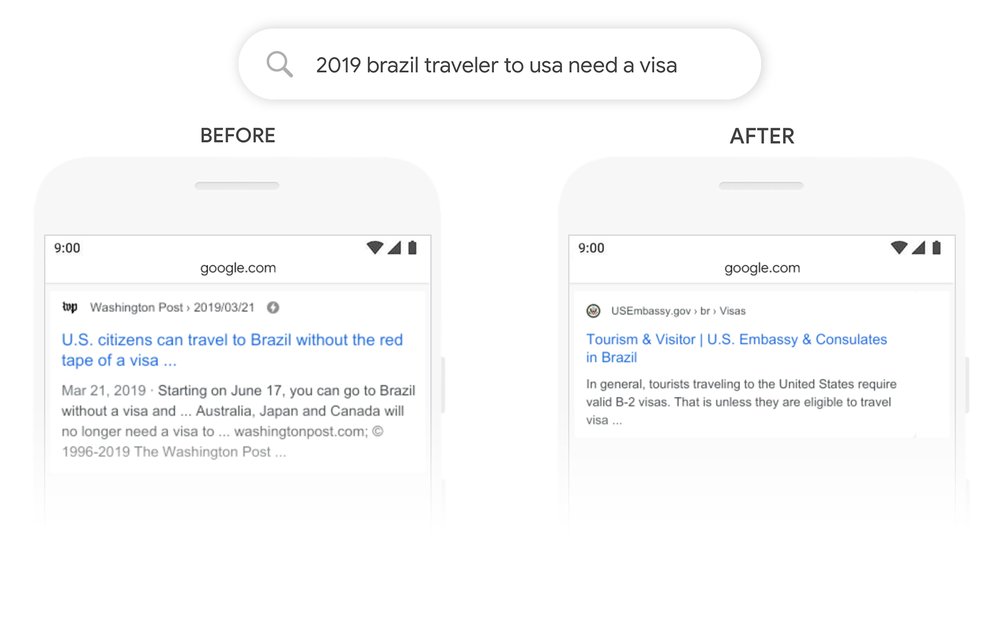
Here’s a search for “2019 brazil traveler to usa need a visa.” The word “to” and its relationship to the other words in the query are particularly important to understanding the meaning. It’s about a Brazilian traveling to the U.S., and not the other way around. Previously, our algorithms wouldn't understand the importance of this connection, and we returned results about U.S. citizens traveling to Brazil. With BERT, Search is able to grasp this nuance and know that the very common word “to” actually matters a lot here, and we can provide a much more relevant result for this query.

BERT Results Example

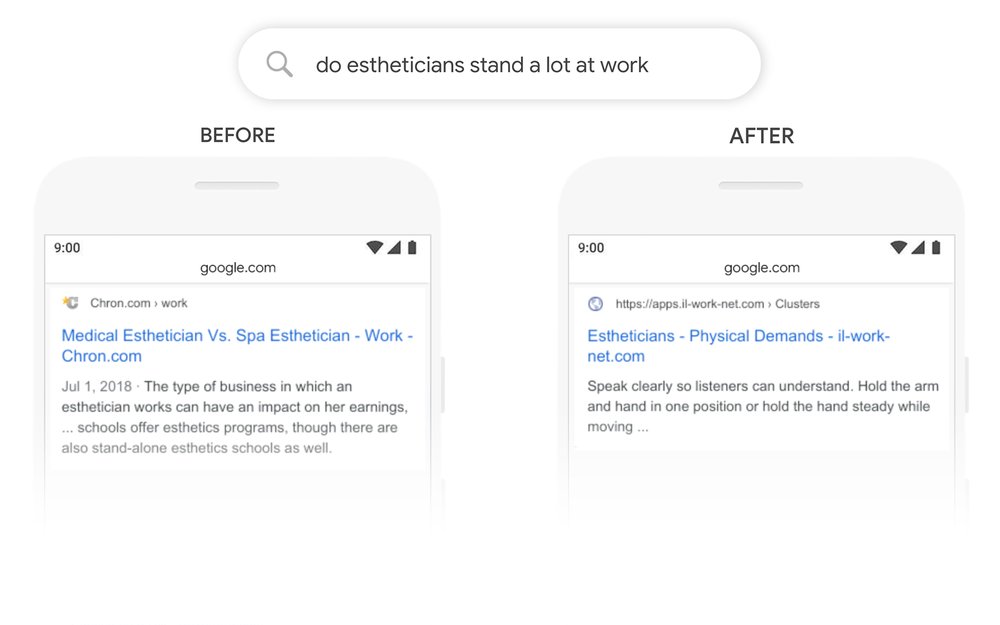
Let’s look at another query: “do estheticians stand a lot at work.” Previously, our systems were taking an approach of matching keywords, matching the term “stand-alone” in the result with the word “stand” in the query. But that isn’t the right use of the word “stand” in context. Our BERT models, on the other hand, understand that “stand” is related to the concept of the physical demands of a job, and displays a more useful response.

BERT Google Testing Query Example

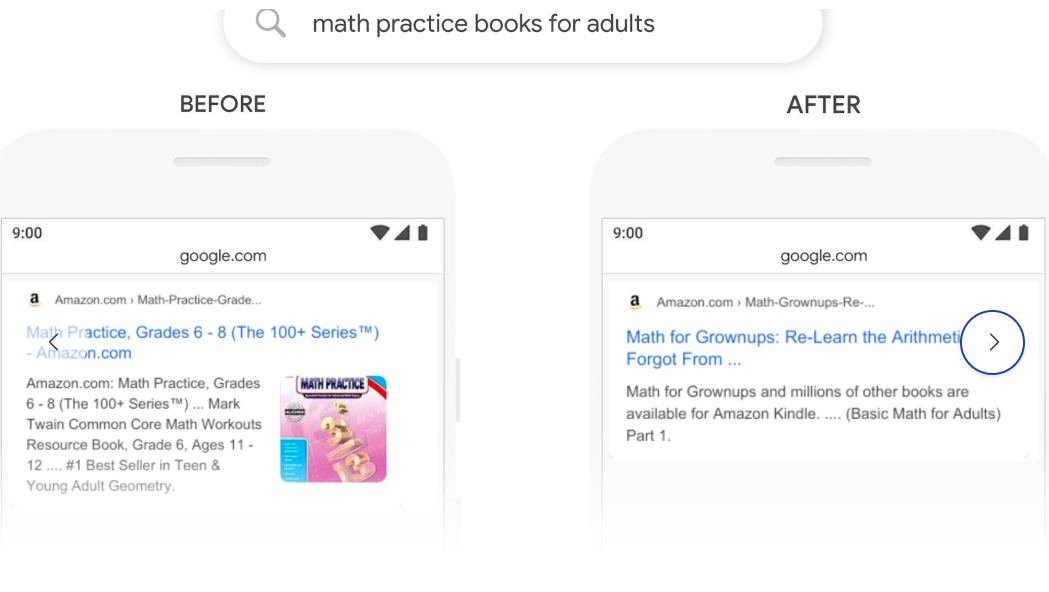
Some more examples about the nuances of the language which usually are not correlated correctly by the search engines for relevant search results.


BERT And SEO

BERT and Search Results in Google

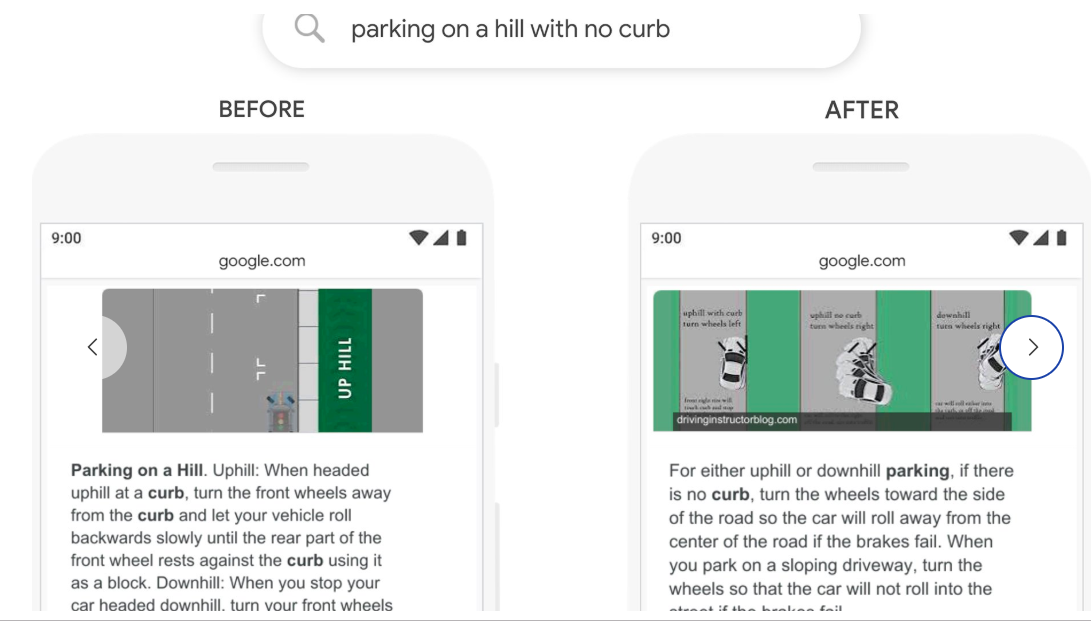
The above examples of before and after the implementation of BERT clearly show the improvement in the search results. This is also being applied to featured snippets.

BERT and SEO - Do we need to optimize for BERT?

After reading this, I am sure the SEOs have the most logical question – How Do We Optimize for BERT ?

The plain and simple answer is – We do not have to optimize differently for BERT. We just need to add more informative relevant content to get a more targeted and extensive search presence.

Look what the SEO experts have to say:


In a recent hangout John Mueller added to what Danny had tweeted regarding BERT. (Read Tweet embedded above)

Here was the question posed to John Mueller:

Will you tell me about the Google BERT Update? Which types of work can I do on SEO according to the BERT algorithms?

John Muller’s explanation on the purpose of the BERT algorithm:

I would primarily recommend taking a look at the blog post that we did around this particular change. In particular, what we’re trying to do with these changes is to better understand text. Which on the one hand means better understanding the questions or the queries that people send us. And on the other hand better understanding the text on a page. The queries are not really something that you can influence that much as an SEO.

The text on the page is something that you can influence. Our recommendation there is essentially to write naturally. So it seems kind of obvious but a lot of these algorithms try to understand natural text and they try to better understand like what topics is this page about. What special attributes do we need to watch out for and that would allow use to better match the query that someone is asking us with your specific page. So, if anything, there’s anything that you can do to kind of optimize for BERT, it’s essentially to make sure that your pages have natural text on them…

“..and that they’re not written in a way that…”

“Kind of like a normal human would be able to understand.  So instead of stuffing keywords as much as possible, kind of write naturally.”

We as website owners and SEOs have to understand that Google constantly keeps on working to make search and the search experience better for its users. BERT is one such exercise in that direction.

It is not an algorithmic update directly affecting any of the on-page , off-page or technical factors. BERT is simply aiming to understand and corelate the search query more accurately.

According to Google : Language understanding remains an ongoing challenge and no matter how hard they work in understanding the search queries better, they are always bombarded with surprises with time to time and this makes them go out of their comfort zone again.

As BERT tries to understand search queries better and thereby tries to give more relevant results, the SEO factors do not get directly influenced by its implementation. The only thing that has to be considered is the quality content which has to be regularly added to the site to keep it relevant and corelate to more and more search queries.

January202-core-update

Google Confirms - The January 2020 Core Update Is Live

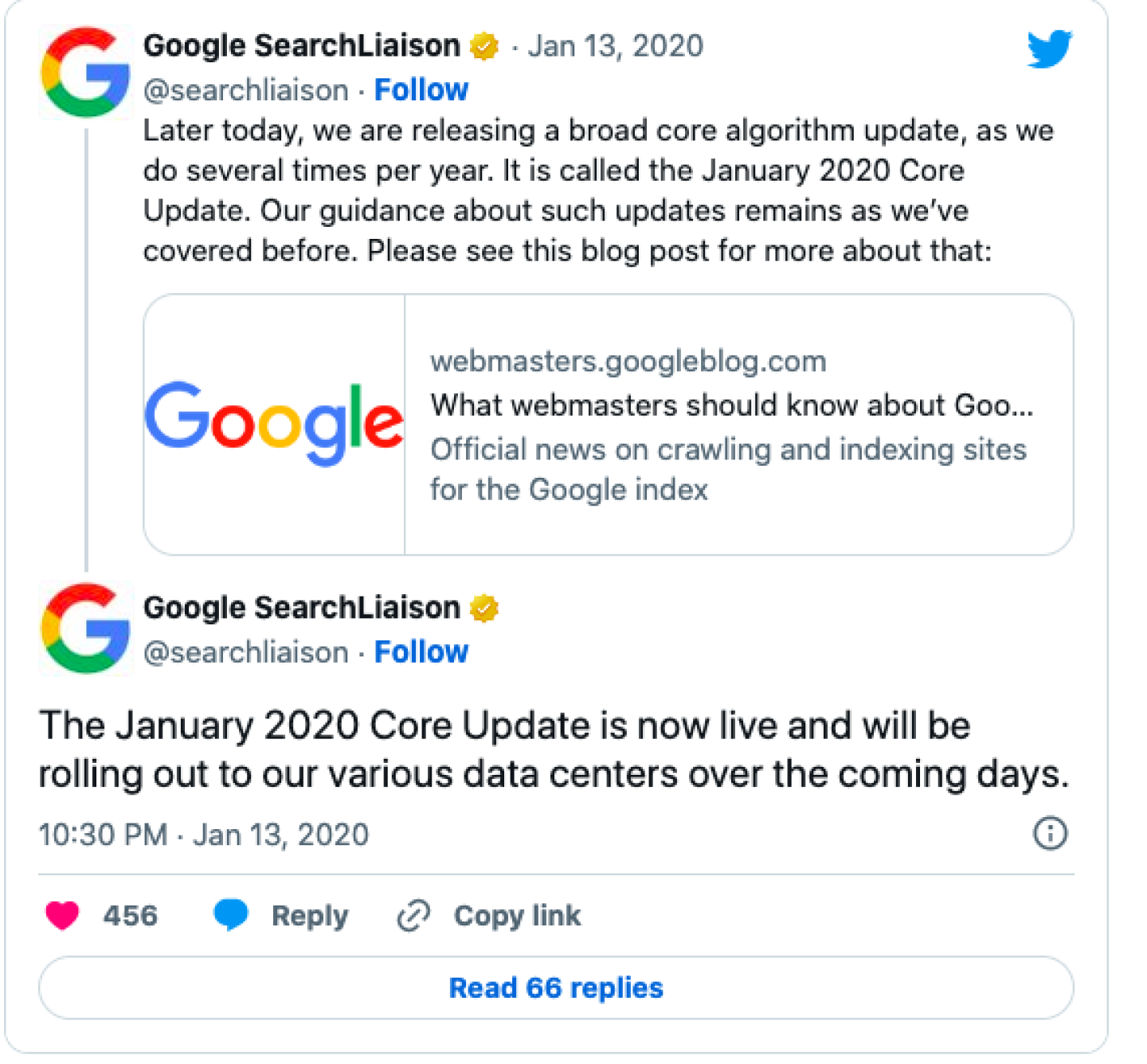
Yesterday, Google confirmed that there was a core update which had gone live. They called it the January 2020 core update.

@searchliaison is a Twitter handle of Official tweets from Google's public liaison of search.

@dannysullivan currently shares insights on how Google search works on this Twitter account.


Barry Shwartz also posted that the core update is live but its big. He also added on the SEO Round Table post that: “Again, it is less than 24-hours, so it is early and things need to settle down over the next few days with this update”

Google also shared a link to one of its previous posts which explains the nitty gritty of core updates.


18-09-2019

Google Updates its Rules for Review Rich Search Results

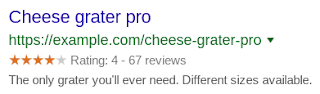
18-09-2019 Google posted on the webmaster blog today that  they have updated the review rich  rules for how and when it shows the reviews rich results. Search results that are enhanced by review rich results can be extremely helpful when searching for products or services (the scores and/or “stars” you sometimes see alongside search results). Google said that to make the review rich results more helpful and meaningful, they are now introducing algorithmic updates to reviews in rich results. review rich search results The main takeaway from this is that if the functionality of posting the reviews on the site is such that they can be moderated or updated then they will not be shown. This applies to even the reviews posted via the third party widgets.

With this change, Google has also  limited the pool of schema types that can potentially trigger review rich results in search. Specifically, they will only display reviews with those types (and their respective subtypes):

According to Google:

Reviews that can be perceived as “self-serving” aren't in the best interest of users. We call reviews “self-serving” when a review about entity A is placed on the website of entity A - either directly in their markup or via an embedded 3rd party widget. That’s why, with this change, we’re not going to display review rich results anymore for the schema types LocalBusiness and Organization (and their subtypes) in cases when the entity being reviewed controls the reviews themselves.

18-09-20019-2

The Nofollow, UGC and Sponsored Link Attributes - 20 Points To Ponder On


  1. Nearly 15 years ago, the nofollow attribute was introduced as a means to help fight comment spam. It also quickly became one of Google’s recommended methods for flagging advertising-related or sponsored links.
  2. From 10th September 2019 onwards, three new link attributes, 'sponsored', 'ugc' and 'nofollow', are applicable as hints for Google to incorporate for ranking purposes.
  3. For crawling and indexing purposes, nofollow will become a hint as of March 1, 2020.
  4. No Follow meta tag applies to all the links on the page.
  5. Rel-nofollow is applicable only to the link mentioned in the tag.
  6. No follow meta tag was a directive till Google announced the ‘rel’ link for 'nofollow'.
  7. From now on, the 'no follow' meta tag ceases to be a directive but is considered a hint just like the rel attribute .
  8. All the link attributes -- sponsored, ugc and nofollow -- are treated as hints rather than directives. A directive is a direct specification on which the mentioned action has to be taken by the bots. Hence, earlier when the page had a nofollow meta tag in the header the bot completely ignored the links on that page. A hint means that Google may or may not obey the Meta Robots Nofollow when it encounters it.
  9. There’s absolutely no need to change any nofollow links that you already have.
  10. The nofollow tag is still valid.
  11. But,there is no meta tag for rel-ugc and rel-sponsored.
  12. It is valid to use more than one rel value for a link. For example, rel="ugc sponsored" is a perfectly valid attribute which hints that the link came from user-generated content and is sponsored.
  13. You need not worry if you have used the attributes incorrectly.
  14. Google says, “There’s no wrong attribute except in the case of sponsored links.
  15. If you flag a UGC link or a non-ad link as “sponsored,” we’ll see that hint but the impact -- if any at all -- would be at most that we might not count the link as a credit for another page.”
  16. For WordPress, Joost de Valk (creator of Yoast SEO Plugin) has said that it’s one line of code (for blog comments) and will be added to the next release.If any SEO informs you that Google has announced something new and there will
  17. be many changes required site wide, then he/she is lying. Do not pay heed to it. They are just trying to cheat you.
  18. There is a new New Chrome extension that highlights links using rel=”nofollow”, rel="sponsored" and rel="ugc". The extension is called “Strike Out Nofollow Links”. The extension strikes out links containing relations rel="nofollow", rel="ugc" and/or rel="sponsored". No JavaScript is used, only CSS3 selectors.
  19. Using the new attributes allows Google to better process links for analysis of the web.
  20. As SEOs/developers this can be a small contribution to make things more organized for search engines.

editorial-policy-WebPro-Technologies-LLP-Ahmedabad

Editorial Policy: Human Expertise, Enhanced by AI

At WebPro Technologies, our content reflects over two decades of experience in SEO and digital strategy. We believe that valuable content is built on accuracy, clarity, and insight—and that requires human judgment at every step.

From 2024 onwards, we have been using AI tools selectively to brainstorm ideas, explore perspectives, and refine language, but AI is never the final author. Every article is researched, fact-checked, and edited by our team, ensuring relevance, accuracy, and originality. AI supports our workflow, but the responsibility for quality and credibility remains entirely human.

This hybrid approach allows us to combine the efficiency of technology with the depth of human expertise, so our readers get content that is both informative and trustworthy.

At WebPro, we see AI not as a replacement for human creativity, but as a tool that helps us raise the standard of excellence in the content we share.

SEO Ahmedabad

Contact Info

802, Astron Tech Park, Satellite Road, Opp. Gulmohar Park Mall, Ahmedabad 380015, India

+91 9825025904
info@webpro.in

Daily: 9:00 am - 6:00 pm
Sunday: Closed

Copyright 2025 WebPro Technologies LLP ©  All Rights Reserved